
Immersive XR Technologies and Digital Storytelling in Cultural Heritage Preservation Dissertation Topics I phdassistance.com
Info: Immersive XR Technologies and Digital Storytelling in Cultural Heritage Preservation Dissertation Topics I phdassistance.com
Published: 27th june in Immersive XR Technologies and Digital Storytelling in Cultural Heritage Preservation Dissertation Topics I phdassistance.com
Share this:
Related Services
Our academic writing and marking services can help you
Introduction
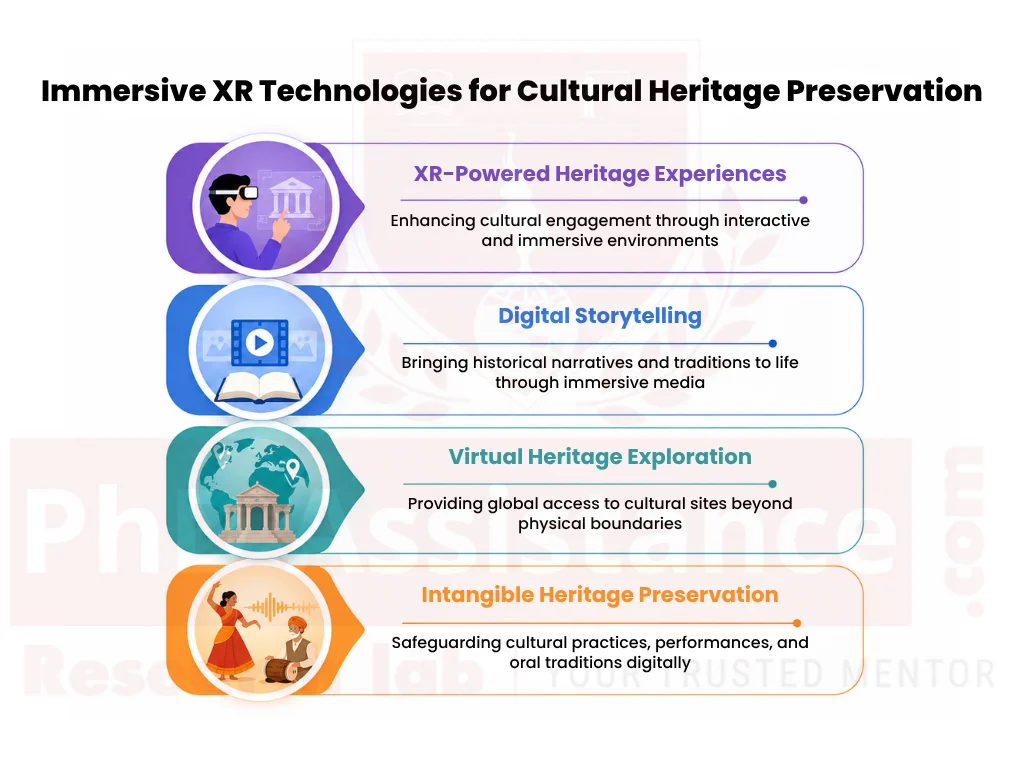
As immersive digital technologies are rapidly evolving in pace, they are changing the ways cultural heritage assets are being recorded, interpreted, managed, and conserved. Through the use of innovative technologies like VR/AR, XR, digital twins, and immersive storytelling, heritage can be experienced by the public in new ways not inhibited by physical place. Research at this time shows that the effects of immersive technologies on the transfer of knowledge, emotional impact, participation and engagement from the public is substantial and innovative new ways to conserve, preserve, digitise, Restore and teach people about heritage are appearing. There are still issues to address in Cultural Heritage Preservation, including assessing emotional impacts, management strategies, and scaling applications in a sustainable way. This ongoing digital evolution in the cultural heritage field necessitates innovative frameworks utilising these new technologies to build upon and enrich cultural heritage.
Proposed PhD Topic 1: Immersive XR-Based Emotional Engagement Frameworks for Enhancing Intangible Cultural Heritage Preservation
Background Context:
Growing popularity in XR technologies has been gradually reforming cultural heritage perception, interpretation, and retention. Lin et al. (2025) suggest that cultural XR applications may deepen audience involvement in storytelling, emotional interaction, and the multisensory dimension of cultural sites. Nevertheless, the use of such applications has often concentrated on tangible heritage such as monuments, historical sites, and museums. It, in addition, points out insufficient research towards preservation of ICH. The existing studies further mentioned a shortage in research dealing with prolonged emotional involvement in preserving cultural transmission. Cultural heritage and intangible forms such as performances and storytelling are now facing extinction from social transition, and thus it appears to require a study examining whether an emotionally triggered immersive XR approach might preserve and disseminate more Cultural Heritage.
PhD-Level Verification:
Studies currently explore XR experiences and emotional interaction individually, but few have addressed the incorporation of emotional design, user engagement and intangible heritage preservation into one combined context. Insufficient research is found about empirical investigations of immersion of emotional experience for sustained heritage preservation and engagement of intangible heritage.
Research Questions:
PhD-Level Contributions:
Suggested Readings:
Lin, C., Xia, G., Nickpour, F., & Chen, Y. (2025). A Review of Emotional Design in Extended Reality for the Preservation of Cultural Heritage..
Proposed PhD Topic 2: Virtual Reality Guided Learning Frameworks for Cultural Heritage Education and Knowledge Retentio
Background Context:
The use of VR technology in heritage conservation is evolving from purely documentary to more participatory educational ones. Caponi et al. (2026) support the concept that immersive and interactive experiences in the field of VR enable people to evolve from casual observer to active learner, because through guided exploration and storytelling in a virtual world, deeper experiential learning can occur. As many VR applications have been developed for depicting existing monuments and places of cultural interest, most of them focused on realism and exploration, while, surprisingly, few VR immersive tools provide a structured framework to support guided learning and to promote the acquisition of cultural knowledge, including the opportunity for personal reflection and in-depth analysis. Given the general trend towards digitalisation within educational environments, this article explores new and enhanced means for applying the VR technology towards more engaged and long-term cultural learning experiences.
PhD-Level Verification:
Existing researches evaluate the existing VR education and cultural heritage visualisation separately, while there is a shortage of research investigating immersive guided learning combined with pedagogy design and effectiveness assessment under a unified evaluation system.
Research Questions:
PhD-Level Contributions:
Suggested Readings:
Caponi, M., Ruggieri, C., Di Stefano, F., Quattrini, R., & Pierdicca, R. (2026). From Digital Reconstruction to Immersive Education: Virtual Reality Cultural Heritage Experience..
Proposed Dissertation topic 3: Digital Twin and XR Preservation Frameworks for Sustainable Cultural Heritage Management
Background Context:
The recent proliferation of digital reconstruction technologies brings new challenges and new opportunities to Digital Heritage conservation and to Cultural Heritage Management. In this paper we focus on the observation of Masyk et al. (2025) that “digital reconstructions, virtual environments and even XR heritage experiences are now becoming an asset requiring preservation and which will also require management over time in an interpretable way.” Unfortunately, the major focus on heritage projects appears to be the long-term preservation of digital files rather than the preservation of experiential aspects, mechanisms for interaction, and the original context of use. Indeed, since the operation of immersive heritage experiences often relies on hardware and software ecologies that are constantly changing, there is a strong need for the preservation of digital heritage experience over time and through technological change, and for the development of approaches to sustainable heritage management in the context of digital heritage.
PhD Level Verification:
Digital preservation studies on one hand and XR for heritage experiences on the other, dominate contemporary discourse in both academic and industry contexts. Research interrogating ways that the application of digital twins, preservation governance frameworks and experience documentation can be synthesised into a more holistic heritage management scheme remains relatively sparse.
Research Questions:
PhD-Level Contributions:
Suggested Readings:
Masłyk, R., Grzeszczuk, M., Pochwatko, G., et al. (2025). From Creation to Preservation: Digital and Immersive Technologies for Experience, Heritage, and Art..
Proposed Dissertation Topic 4: XR User Experience Evaluation Frameworks for Enhancing Engagement in Digital Heritage Preservation
Background Context:
Virtual, Augmented, Mixed, Extended Reality Ecosystems have become popular as the rate of development and affordability of XR technology has rapidly accelerated, and as a result, immersive technologies can offer truly immersive and interactive experiences for the education, tour and heritage Preservation fields. However, despite the advantages, studies on immersive experiences for Cultural Heritage primarily focus on implementation and, to a minimal extent, evaluate user experience, emotional engagement, learning, or users’ understanding of the culture in these XR applications. Likewise, there is not enough agreement or consistency as to which methodologies should be applied to establish frameworks or guidelines to evaluate the success of the use of cultural heritage in immersive experiences in a multicultural manner. This paper addresses this research gap as it provides guidance to develop comprehensive User Experience (UX) models to ensure effective preservation and dissemination through well-researched XR applications in Cultural Heritage.
PhD-Level Verification:
Current research focuses on the applications and user experience metrics of XR as separate entity. None of the research integrate all elements of user engagement, emotional experience, learning effects, and efficiency of heritage protection into a whole XR evaluation.
Research Questions:
Contributions at the PhD-Level:
Suggested Readings:
Anwar, M. S., Yang, J., Frnda, J., Choi, A., Baghaei, N., & Ali, M. (2025). Metaverse and XR for Cultural Heritage Education: Applications, Standards, Architecture, and Technological Insights for Enhanced Immersive Experience.
Proposed Dissertation Topic 5: AI-Driven Immersive XR Platforms for Intelligent Cultural Heritage Restoration and Conservation
Background Context:
Modern heritage restoration projects continue to present complexity and raise expectations for the need for intelligent technology to assist with recording, restoring, and conserving. As Zhang et al. (2025) note, the main limitations in heritage restoration using current technologies include: the presence of isolated and disconnected data systems; restoration process fragmentation; poor interaction and interconnection among conservation, documentation and the public interaction aspect. Immersive XR technology combined with artificial intelligence can revolutionise heritage restoration using its capability to facilitate smart data acquisition; high-quality and detailed digital models of the site; virtual restoration; and the delivery of immersive cultural experiences of the heritage site. Although the combination of XR technologies with restoration has emerged and shows potential in heritage restoration systems, the integrated role of restoration AI, immersive visualisation, and long-term cultural Heritage was sparsely investigated. This offers an emerging doctoral research domain in sustainable intelligent cultural Heritage preservation.
PhD-Level Verification:
Recent studies examine digital conservation technology and immersive experiences for cultural heritage in isolation. Few studies have incorporated the combined application of AI assistance for Digital Preservation, Virtual Reality in Heritage Conservation, and XR visualisations into an integrated framework.
Research Questions:
PhD-Level Contributions:
Suggested Readings:
Zhang, J., Jiang, X., & Wang, L. (2025). Research on Digital Intelligent Protection and New Format of Cultural Heritage Based on XR Digital Technology.
Need assistance finalising your dissertation topic? Selecting a strong, researchable topic can be challenging — but you don’t have to do it alone.
Our research consultants can help refine your ideas, identify literature gaps, and guide you toward a topic that aligns with current academic trends and your programme requirements.
Contact us to begin one-on-one topic development and refinement with PhdAssistance.com Research Lab.
Share this:
Cite this work
PhDAssistance. (n.d.). Cybersecurity in business Dissertation Topics Retrieved January 28th, from https://phdassistance.com/topic/cybersecurity-business/
Jalolova, M., and Musawwir, M. “Cybersecurity in business Dissertation Topics for PhD Scholars.” PhDAssistance, https://phdassistance.com/topic/cybersecurity-business/ Accessed 28th January 2026.
Jalolova, M., and Musawwir, M., n.d. Cybersecurity in business Dissertation Topics for PhD scholars. [online] Available at: https://phdassistance.com/topic/cybersecurity-business/ [Accessed 28th January 2026].
Jalolova M., Musawwir M. Cybersecurity in business Dissertation Topics for PhD scholars [Internet]. PhDAssistance; [cited 2026 28th January]. Available from: https://phdassistance.com/topic/cybersecurity-business/
Jalolova, M., and Musawwir, M. (n.d.). Cybersecurity in business Dissertation Topics for PhD scholars. Retrieved 28th January 2026, from https://phdassistance.com/topic/cybersecurity-business/
Jalolova, M., and Musawwir, M., Cybersecurity in business Dissertation Topics (n.d.) https://phdassistance.com/topic/cybersecurity-business/ accessed 28th January 2026.
Study Resources
Free resources to assist you with your university studies!