
- / Title
Causal Inference and Topological Analysis for Temporal Pattern Recognition DissertationTitles | phdassistance.com
Info: Causal Inference and Topological Analysis for Temporal Pattern Recognition DissertationTitles | phdassistance.com
Published: 20th June 2026 in Causal Inference and Topological Analysis for Temporal Pattern Recognition DissertationTitles | phdassistance.com
Share this:
Related Services
Introduction
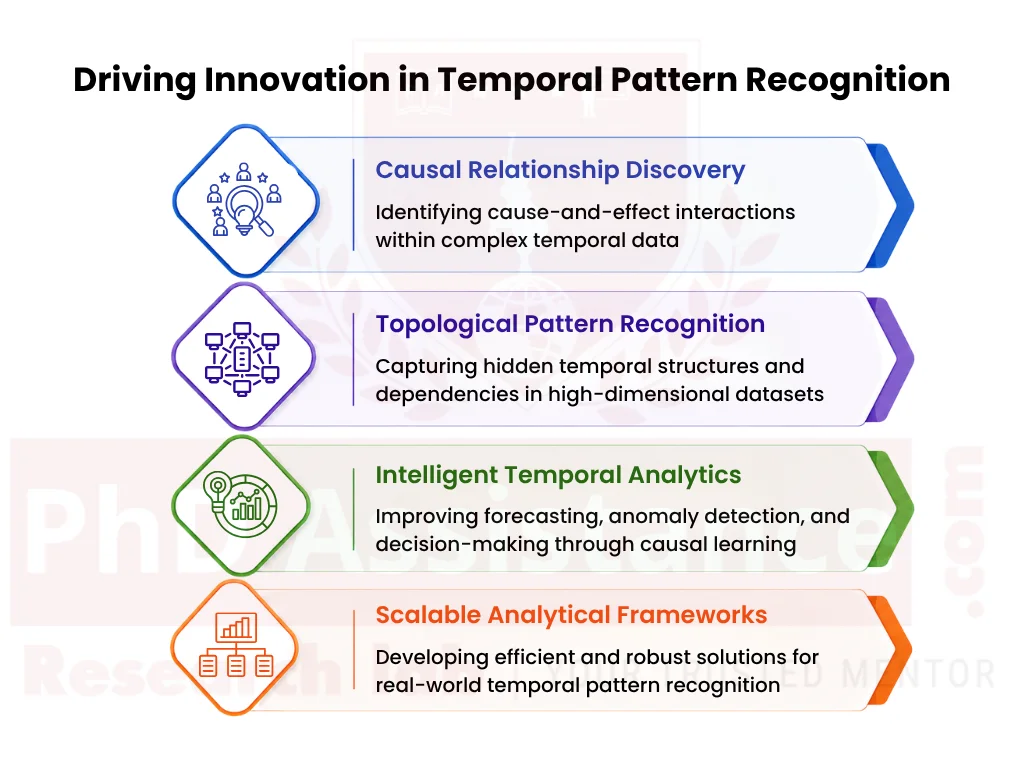
Currently, rapid developments in Artificial Intelligence (AI), Machine Learning (ML) and data mining approaches have dramatically changed temporal data analysis within various domains like healthcare, telecommunications, cyber-security, intelligent systems etc. Emerging developments in causal inference are helping researchers go beyond merely finding correlations and further identify causal influences and enhance predictions. Simultaneously, increases in data availability and computational capacity have also resulted in accelerated progress of Topological Analysis for Temporal Pattern Recognition in terms of discovering the unknown temporal structure and relationship within high-dimensional data. By combining causal inference and topological learning, deeper understanding of temporal patterns has become possible. Despite these progresses, issues like scalability, explainability, privacy and trustworthy causal discovery still pose challenges to actual deployment. Recent research is concerned with effective, secure and explainable causal-topological methods to enable temporal pattern recognition.
Proposed PhD Title 1: Privacy-Preserving Causal-Topological Learning for Temporal Pattern Recognition Using Homomorphic Encryption in Secure Edge Computing
Temporal pattern recognition has become a fundamental task in areas such as healthcare, industrial IoT, telecommunications, and smart cities where streams of huge sequential data are generated constantly. Causality, a new branch of machine learning based on causal inference and topological data analysis (TDA), has provided methods to detect underlying temporal patterns and causal relations within massive, non-linear complex data. In Gharami et al. (2025), topology-driven frameworks can successfully detect anomalies and recognise temporal patterns in multivariate time-series while remaining computationally efficient. Unfortunately, most of the current topology-driven methods are based on unencrypted data, which raises security and privacy concerns in distributed systems. Recently developed technologies like homomorphic encryption, privacy-preserving computation and secure edge computing can support performing analytical tasks over encrypted data. The combination of those techniques with causal-topological learning has opened up a potential avenue for securely recognising temporal patterns.
Problem Statement:
All of the current causal and topological models for temporal learning need direct access to sensitive data during training and inference, which poses great privacy and security threats in distributed computation environments. However, while the performance for pattern recognition is superior, current causal and Topological Machine Learning models do not have mechanisms that incorporate Homomorphic Encryption, Privacy-Preserving Computation and Secure Encrypted Data Processing.s
Research Gap:
So far, most research on topological temporal learning lacks the use of Homomorphic Encryption and Privacy-Preserving Computation in causal inference methods. There has been little research on how to build privacy-preserving causal-topological networks capable of Encrypted Data Processing without sacrificing Temporal Data Mining capabilities.
Research Question:
How to combine Homomorphic Encryption and causal-topological learning to increase the performance of temporal pattern recognition while maintaining privacy-preserving computation and edge computing security?
Outcome:
A novel causal-topological framework is to be developed in this study that performs temporal pattern recognition over encrypted data. We expect our framework will perform well both in terms of security and analytical accuracy, and it will be feasible for deployment over distributed edge computing platforms.
Reference:
Gharami, K., Tasnim, H., Akbaş, M. İ., & Moni, S. S. (2025). Seeing Patterns Differently: Topological Geometry for Anomaly Detection in Multivariate Time Series.
Proposed PhD Title 2. Encrypted Causal Trajectory Discovery for Temporal Pattern Recognition Through Homomorphic Encryption and Privacy-Preserving Computation
Temporal trajectory discovery is becoming more crucial to grasp dynamics from healthcare, bioinformatics, and smart monitoring system. As one consequence, modern approaches based on causal inference are proposed to find cause-and-effect rules that direct system states toward the next state and further describe how system evolves. Yu et al. (2025) designed CASCAT framework and used Structural Causal Model to learn causal trajectories and enhance analysis of temporal state transitions. Such works indeed could help understand temporal patterns but usually work with original, confidential data. With growing concern about data privacy, privacy-preserving computation and homomorphic encryption which performs calculations on encrypted data are becoming highly demanded. The integration of secure encrypted data processing into causal trajectory learning would guarantee trustworthy temporal analysis and achieve privacy protection while boosting decisions in privacy sensitive applications.
Problem Statement:
Currently, most causal trajectory inference frameworks use unencrypted data to learn temporal changes and causal relationships. These frameworks offer more insight and enhanced detection of patterns, but risk revealing confidential data while calculating; also, it does not guarantee data privacy. In fact, the lack of a secure calculation mechanism prevents the adoption of such models in domains like healthcare, genetics, etc., which demand secure computation of temporal data.
Research Gap:
Most current research on causal trajectory inference concentrates on the accuracy of causal discovery in Time Series, ignoring topics like Homomorphic Encryption, Private-Preserving Computation, few researchers work on secure causal trajectory learning directly on encrypted temporal data.
Research question:
To propose a method where Homomorphic Encryption can be applied in combination with causal trajectory inference to enhance temporal pattern discovery while ensuring data privacy?
Result:
In this study, a privacy-preserving causal trajectory method is aimed to be designed to identify the temporal transitions from the encrypted data. The model developed is predicted to be capable of enhancing the discovery of temporal patterns along with secure data analyses.
Reference:
Yu, Y., Nie, W., Zhang, Q., & Li, S. C. (2025). Inferring Causal Trajectories from Spatial Transcriptomics Using CASCAT.
Proposed PhD Title 3. Secure Edge Computing Framework for Causal-Invariant Topological Temporal Pattern Recognition Using Privacy-Preserving Computation
The performance of temporal pattern recognition systems decreases when applied to changing environments, as data distributions shift and the surrounding environment changes. Many works showed the importance of causal-invariant learning on making a model more robust to different operating conditions. In Huang et al. (2025), the authors propose a causal-invariant spatio-temporal representation learning framework to achieve higher performance on pattern recognition and localization on changing environments. However, there are many temporal learning models that do not protect privacy of the sensitive data, while increasing the use of edge computing in real-life applications poses a demand for Secure Edge Computing for intelligent analysis with privacy. Using Homomorphic Encryption, Privacy-Preserving Computation and Encrypted Data Processing can realize a reliable temporal learning system resistant to various environments, also it provides further improvement on Edge Computing Security.
Problem Statement:
Current models of causal-invariant temporal learning are mainly intended to enhance robustness and generalise well across non-stationary environments. But they process sensitive information without appropriate security, and do not support Privacy-Preserving Computation. Since the use of temporal analytics has shifted toward decentralised edge infrastructure, there are important privacy, confidentiality, and Edge Computing Security issues due to the lack of secure learning.
Research Gap:
Current causal-invariant frameworks mostly haven’t incorporated Homomorphic Encryption and Privacy-Preserving Computation with topological temporal learning. Only a few studies have investigated secure edge-based causal-invariant pattern recognition, although it’s in high demand for data privacy.
Research Question:
How can secure edge computing and causal invariant learning be combined in order to gain better privacy-preserving and secure temporal pattern recognition?
Outcome:
The suggested framework will integrate various sources of financial information into a reinforcement learning framework to improve prediction accuracy and trading efficiency.
Reference:
Huang, S., Qin, S., & Liang, C. (2025). Bridge Structural Damage Identification Using Causal-Invariant Spatio-Temporal Representation Learning.
Proposed PhD Title 4. Homomorphic Encryption-Driven Causal Fault Propagation Analysis for Privacy-Preserving Temporal Pattern Recognition
The ability to understand temporal patterns is a core technology for anomaly detection, fault diagnosis, and smart monitoring in distributed computing environments. Some new research can detect fault propagation and uncover causes by causal inference. Xing et al. (2025) combined causal inference and deep learning for anomaly detection and fault localisation and presented a dual-channel deep learning framework. Although these approaches achieve high detection accuracy, they need full access to operational data in the background, which brings privacy and security risks. With the extensive use of distributed infrastructures, the significance of HE, PPC and SEC is to enhance the privacy of data. Hybrid secure Encrypted Data Processing and causal fault analysis could provide smart temporal pattern recognition in a security context, while improving Edge Computing Security.
Problem Statement:
In current causal fault diagnosis systems, it directly accesses the operation and monitoring information and detects anomaly then find out root cause. The accuracy of fault localization of those approaches is greatly enhanced; however, the structure of the localisation system is revealed, and there are no privacy-protecting abilities. Lack of HE and secure analytics limits the application of these methods in distributed systems where confidentiality of data is crucial.
Research Gap:
Almost all research efforts center on performance improvements for fault detection and causality analysis, without much attention to Homomorphic Encryption and Privacy-Preserving Computation. There is very little work that deals with secure causal fault propagation frameworks using encrypted Time Series Pattern Recognition.
Research Question:
To apply HE in causal fault propagation analysis for privacy-preserved temporal pattern detection and fault localization?
Outcome:
This study will design an encrypted causal fault analysis model for secure temporal pattern detection and root-cause identification with better privacy, accuracy and Edge Computing Security.
Reference:
Xing, S., Wang, Y., & Liu, W. (2025). Multi-Dimensional Anomaly Detection and Fault Localisation in Microservice Architectures: A Dual-Channel Deep Learning Approach with Causal Inference for Intelligent Sensing.
Proposed PhD Title 5. Privacy-Preserving Topological-Temporal Transformer Hawkes Framework for Causal Structural Learning and Temporal Pattern Recognition
Transformer networks and Hawkes processes have already been greatly leveraged in the domain of temporal pattern recognition, capturing long-range temporal dependencies and latent causal links in sequences of events. It has also been proven in recent works that incorporating topological information within transformer learning would aid in better discovering the causal structures, as well as temporally predicting future events. Li et al. (2025) introduce the TTCTH (Topological-Temporal Convolution Transformer Hawkes Process), successfully learning the causal links within sophisticated event-driven processes. However, most of these existing frameworks work on plaintext data without securing the learning process and analytic process. Fortunately, the emerging technologies, including Homomorphic Encryption, Privacy-Preserving Computation and Secure Edge Computing, will help facilitate carrying out intelligent analysis. Learning on encrypted data combined with topological-temporal transformers is possible.
Problem Statement:
Topological-temporal transformers and Hawkes processes already achieve high performance in causal discovery and temporal pattern learning. However, these systems generally process plaintext and fail to enable computation over encrypted data. Organisations increasingly require privacy-preserving analysis, yet the absence of Privacy-Preserving Computation and Encrypted Data Processing represents a critical hurdle for deployment.
Research Gap:
The existing transformer-Hawkes structures seldom incorporate HE, PCP, and ED processing in causal structural learning. Meanwhile, the existing secure topological-temporal transformer networks are less common.
Research Question:
Can a privacy-preserving topological-temporal transformer framework enhance causal structural learning while maintaining privacy in temporal pattern recognition?
Outcome:
In this work, we expect to present a secure transformer-Hawkes architecture that allows us to perform causal structural learning on the encrypted temporal data. The transformer-Hawkes model is supposed to enhance the pattern recognition performance.
Reference:
Li, Y., Kong, Y., Yin, S., & Li, J. (2025). Topological-Temporal Convolution Transformer Hawkes Process for Causal Structural Learning in Telecom Networks.
Need assistance finalising your dissertation topic? Selecting a strong, researchable topic can be challenging — but you don’t have to do it alone.
Our research consultants can help refine your ideas, identify literature gaps, and guide you toward a topic that aligns with current academic trends and your programme requirements.
Contact us to begin one-on-one topic development and refinement with PhdAssistance.com Research Lab.
Share this:
Cite this work
PhDAssistance. (n.d.). Virtual Influencers Dissertation Titles Retrieved 30th January 2026, from https://www.phdassistance.com/title/virtual-influencers/
“Virtual Influencers Dissertation Titles, https://www.phdassistance.com/title/virtual-influencers/
“Virtual Influencers Dissertation Titles” PhDAssistance, PhDAssistance, Tuesday, January 30th,2026.
PhDAssistance, n.d. Virtual Influencers Dissertation Titles[Online]. Available at: https://www.phdassistance.com/title/virtual-influencers/ [Accessed January 30th, 2026].
PhDAssistance. Virtual Influencers Dissertation Titles[Internet]. PhDAssistance; [cited 2026 January 30th]. Available from: https://www.phdassistance.com/title/virtual-influencers/
PhDAssistance (n.d.).
Virtual Influencers Dissertation Titles. Retrieved January 30th, 2026, from https://www.phdassistance.com/title/virtual-influencers/
PhDAssistance, Virtual Influencers Dissertation Titles(PhDAssistance, n.d. January 30th accessed 2026.
Study Resources
Free resources to assist you with your university studies!