
- / Title
Reinforcement Learning-Driven Algorithmic Market Strategy DissertationTitles | phdassistance.com
Info: Reinforcement Learning-Driven Algorithmic Market Strategy DissertationTitles | phdassistance.com
Published: 18th June 2026 in Reinforcement Learning-Driven Algorithmic Market Strategy DissertationTitles | phdassistance.com
Share this:
Related Services
Introduction
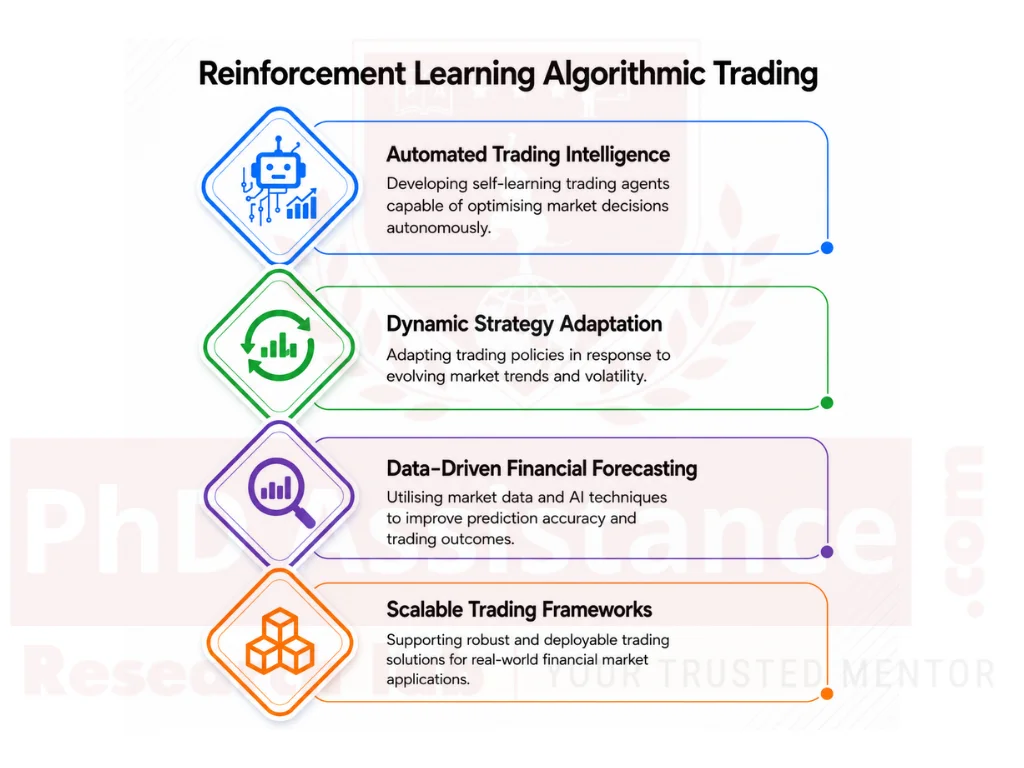
The dramatic development of Artificial Intelligence (AI) and Machine Learning (ML) technologies has revolutionised financial markets, thus leading to Reinforcement Learning becoming an increasingly prevalent technique to design intelligent trading systems. Reinforcement Learning-based trading strategies overcome limitations of rule-based systems through real-time market data learning and adaptation to changing market environments. Moreover, it leads to improved investment performance, optimises portfolio allocation, etc. Due to financial market data and computational availability growing at a significant rate. Hence, Reinforcement Learning Algorithmic Trading has drawn much attention to developing intelligent trading systems via real-time market interaction and continuous learning. Nonetheless, market fluctuations, lack of transparency, risks and operational challenges have impeded them from real applications. As a result, current researches have devoted to creating flexible, transparent, risk-averse and scalable RL frameworks, which boost investment return and enable robust financial decision-making.
Proposed PhD Title 1: Explainable Reinforcement Learning in Finance for Transparent Algorithmic Market Strategy and AI-Based Trading Strategies
The adoption of Reinforcement Learning has quickened the progression of intelligent trading systems that learn optimum market behaviour from evolving financial data. These models are showing encouraging results in portfolio management, market prediction and Algorithmic Market Strategy optimisation. However, most AI-Based Strategies are black-box systems, and the inherent lack of transparency makes stakeholder trust in AI difficult to achieve. Olanrewaju (2025) emphasises that even though the application of AI to trading does improve decision-making and efficiency in trading, the issues of interpretability and regulatory approval of such AI systems remain the major barriers. Machine Learning is generally geared towards optimising prediction, not toward explainability. With more demands by financial bodies for transparency in decisions made, it is imperative to incorporate interpretability into Quantitative Algorithms for a higher level of confidence, governance and implementation.
Problem Statement:
The majority of RL in Finance models are treated as a black box, and their trading decisions cannot be reasoned. The inability of such systems leads to a lack of trust from investors, regulators and other financial institutions. The existing Trading Strategies were designed solely to provide good performance rather than understandability. In this regard, there is a demand for an interpretable algorithmic strategy framework.
Research Gap:
Most of the research is concentrated on optimising profit and performance. Very few research works explore the incorporation of explainable AI mechanisms within RL systems to achieve greater transparency and accountability in trading decisions.
Research Question:
How to enhance transparency and trust in AI-Based Strategies using explainable reinforcement learning?
Outcome:
This study aims to develop an explainable reinforcement learning framework for the generation of interpretable trading signals and transparent decision pathways. The resultant model is expected to gain higher acceptance from regulatory bodies and institutional investors.
Reference:
Olanrewaju, A. G. (2025). Artificial Intelligence in Financial Markets: Optimizing Risk Management, Portfolio Allocation, and Algorithmic Trading.
Proposed PhD Title 2. Deep Reinforcement Learning for Adaptive Algorithmic Market Strategy under Dynamic Market Regimes
Economic events, geopolitical activities, regulation, and investor behaviour cause continuous fluctuations within financial markets. Therefore, the development of adaptable Market Strategy frameworks has become an area of great interest in the quantitative finance field. According to Sun (2025), Reinforcement Learning in Finance has proven to have excellent performance regarding statistical arbitrage, portfolio optimisation, and automated trading. Despite the achievements in Trading Strategies, many are trained by data of the past and are not adaptable to varying market conditions. Generally, the performance of Machine Learning models declines during turbulent market times and under structural variations. Hence, the need to develop adaptable Quantitative Algorithms that can recognise, analyse, and adapt to markets is undeniable.
Problem Statement:
The financial market is a dynamic environment that depends heavily on the economic environment and the prevailing market conditions. Most of the Trading Strategies are trained on historical data and are consequently unable to cope with shifts in market regime and perform poorly during market volatility. So, there is a need to study adaptive Reinforcement Learning models to make the trading performance effective over time.
Research Gap:
There has been little research integrating market regime detection with adaptive policy learning in Reinforcement Learning for a continuous trading optimisation process.
Research question:
How can deep reinforcement learning adapt the trading strategies dynamically in changing market regimes?
Result:
This research will provide a regime-aware reinforcement learning framework that could automatically detect regime changes and modify the trading behaviours, resulting in the stability and profitability enhancement of the trading process.
Reference:
Sun, Y. (2025). A Survey of Statistical Arbitrage Pair Trading with Machine Learning, Deep Learning, and Reinforcement Learning Methods.
Proposed PhD Title 3. Multimodal Reinforcement Learning in Finance for AI-Based Trading Strategies Using Market, News, and Sentiment Data
The wealth of financial news, social media streams, economic reports, and real-time market data has revolutionised how investment decisions are made. Increasingly, Machine Learning Trading applications are incorporating alternative data sources to achieve greater prediction power and market knowledge. Mirzashvili (2025) has shown the increasing importance of AI-powered analytics for decision-making and forecasting in the field of investment. However, most Reinforcement Learning models only use historical prices and technical indicators. Typically, existing Algorithmic Strategy systems use only a limited number of information sources, and they do not fuse these various sources within a single model-based decision framework. This makes the integration of multimodal AI-Based Strategies, which can learn from structured and unstructured financial data, a challenge worth investigating.
Problem Statement:
Existing Machine Learning for Trading models mainly take price and technical-based historical data. Nevertheless, news and sentiment-based information, along with macroeconomic information, are increasingly involved in the financial decision-making process. Current Trading Strategies, however, could not fully exploit these different kinds of data. Thus, it is necessary to develop more generalised multimodal trading schemes.
Research Gap:
Few works have addressed integrating market data, sentiment and news simultaneously into a multimodal reinforcement learning framework for trading purposes.
Research Question:
Can multimodal reinforcement learning enhance the performance of Trading Strategies?
Outcome:
The suggested framework will integrate various sources of financial information into a reinforcement learning framework so that the accuracy of prediction and the trading efficiency are improved.
Reference:
Mirzashvili, A. (2025). Improving Stock Market Analysis and Investment Strategies Using AI-Driven Algorithms: A Field Study.
Proposed PhD Title 4. Risk-Aware Reinforcement Learning for Quantitative Trading Algorithms and Portfolio Optimisation
It is indispensable to know about the role of risk management in modern investment decisions and finance. Through the latest developments in Reinforcement Learning, intelligent systems can be designed for portfolio allocation, trading execution, and asset management. Olanrewaju (2025) discussed how AI technology would gain more importance in portfolio optimisation and financial risk management. Most current Trading Strategies focus on the maximisation of return with negligible attention given to downside risk, volatility, and drawdown controls. Current Quantitative Trading Algorithms do not usually employ a combined mechanism for risk-sensitive learning capable of maintaining both return and stability. Thus, risk-aware market strategy frameworks are being widely focused on.
Problem Statement:
While many quantitative algorithms focus solely on return maximisation and ignore investment risks, traditional reinforcement learning algorithms often do not have mechanisms that deal with volatility, drawdown, and market uncertainty. This significantly weakens performance in the institutional investment environment. As a result, the need for risk-aware Algorithmic Strategy frameworks has become crucial.
Research Gap:
Few works have addressed integrating market data, sentiment and news simultaneously into a multimodal reinforcement learning framework for trading purposes.
Research Question:
Can multimodal reinforcement learning enhance the performance of Trading Strategies?
Outcome:
The suggested framework will integrate various sources of financial information into a reinforcement learning framework so that the accuracy of prediction and the trading efficiency are improved.
Reference:
Olanrewaju, A. G. (2025). Artificial Intelligence in Financial Markets: Optimising Risk Management, Portfolio Allocation, and Algorithmic Trading.
Proposed PhD Title 5. Scalable Reinforcement Learning-Driven Algorithmic Market Strategy for Real-World Financial Market Deployment
The quick rise of Trading Strategies has further ignited interest in the application of reinforcement learning systems in live financial markets. The great success of Reinforcement Learning has shown considerable performance improvements in market prediction, portfolio management and algorithmic trading applications. The influential contribution of AI and quantitative finance to new-era investment management strategies has already been documented by Alao (2025). However, most existing machine learning models are tested under idealised laboratory environments, which do not properly consider real-world financial constraints including transaction costs, liquidity risk, latencies and market impact. For financial institutions that need deployable and operationally feasible solutions, robust Quantitative Algorithms and a framework for Market Strategy need to be developed.
Problem Statement:
A common trend in many Trading Strategies is that they show great performance in simulation but poor results in live trading. Transaction costs, liquidity issues, and latencies are usually disregarded in the model development. There is a mismatch between research performance and practical operational execution. This calls for scalable Reinforcement Learning frameworks for real-world trading.
Research Gap:
Very few studies focus on applying reinforcement learning trading systems under practical operational limitations, including the effects of transaction costs, latencies and liquidity risks.
Research Question:
In what ways can scalable reinforcement learning architectures assist the deployment of AI-Based Trading Strategies in real world applications?
Outcome:
The study aims to construct a deployment-centric reinforcement learning framework, integrating realistic market limitations, thus enhancing scalability, robustness and institutional deployability.
Reference:
Alao, O. (2025). Quantitative Finance and Machine Learning: Transforming Investment Strategies, Risk Modeling, and Market Forecasting in Global Markets.
Need assistance finalising your dissertation topic? Selecting a strong, researchable topic can be challenging — but you don’t have to do it alone.
Our research consultants can help refine your ideas, identify literature gaps, and guide you toward a topic that aligns with current academic trends and your programme requirements.
Contact us to begin one-on-one topic development and refinement with PhdAssistance.com Research Lab.
Share this:
Cite this work
PhDAssistance. (n.d.). Virtual Influencers Dissertation Titles Retrieved 30th January 2026, from https://www.phdassistance.com/title/virtual-influencers/
“Virtual Influencers Dissertation Titles, https://www.phdassistance.com/title/virtual-influencers/
“Virtual Influencers Dissertation Titles” PhDAssistance, PhDAssistance, Tuesday, January 30th,2026.
PhDAssistance, n.d. Virtual Influencers Dissertation Titles[Online]. Available at: https://www.phdassistance.com/title/virtual-influencers/ [Accessed January 30th, 2026].
PhDAssistance. Virtual Influencers Dissertation Titles[Internet]. PhDAssistance; [cited 2026 January 30th]. Available from: https://www.phdassistance.com/title/virtual-influencers/
PhDAssistance (n.d.).
Virtual Influencers Dissertation Titles. Retrieved January 30th, 2026, from https://www.phdassistance.com/title/virtual-influencers/
PhDAssistance, Virtual Influencers Dissertation Titles(PhDAssistance, n.d. January 30th accessed 2026.
Study Resources
Free resources to assist you with your university studies!