
Edge Computing in Healthcare for Real-Time AI Diagnostics SystemsDissertation Topics I phdassistance.com
Info: Edge Computing in Healthcare for Real-Time AI Diagnostics Systems Dissertation Topics I phdassistance.com
Published: 29th may in Edge Computing in Healthcare for Real-Time AI Diagnostics Systems Dissertation Topics I phdassistance.com
Share this:
Related Services
Our academic writing and marking services can help you
Introduction
The healthcare industry has various issues in real-time diagnostics, patient monitoring, medical data security, and healthcare availability. These problems include delayed medical response, a growing number of chronic illnesses, rising cost of healthcare services, and dependency on cloud computing systems. Recent research focuses on new frameworks that develop smart healthcare solutions, fast medical analysis, and patient monitoring applications. Edge Computing in Healthcare is receiving a lot of attention due to its capability to provide real-time diagnostics for patients, AI-assisted healthcare monitoring, intelligent robotics, and healthcare wearables. Moreover, innovations like artificial intelligence, Internet of Things (IoT)-based medical devices, federated learning, and smart healthcare-based personalised AI are aiding healthcare professionals in making better decisions regarding patients’ health, enabling predictive analytics for healthcare, and providing decentralised yet secure healthcare services.
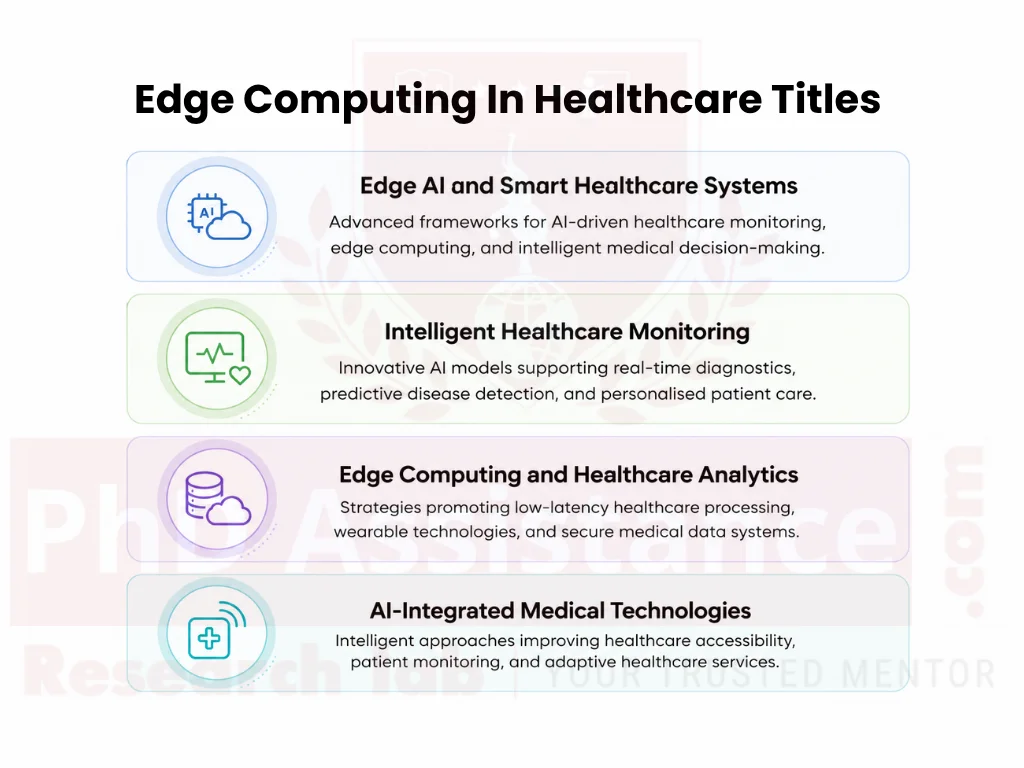
Proposed PhD Topic 1: Edge AI-Based Real-Time Patient Diagnostics Systems for Intelligent Smart Healthcare Monitoring and Medical Decision-Making
Background Context:
The growing application of edge computing and artificial intelligence in healthcare technology has led to significant improvements in modern healthcare monitoring and diagnostic techniques. Typical cloud-based healthcare systems often suffer from latency issues, limited bandwidth, and security risks, resulting in the inefficiency of emergency medical services and ongoing health treatments. Increasing attention is being paid to artificial intelligence-based healthcare monitoring, edge computing for medical devices, and intelligent Internet of Things-based healthcare systems. As reported by Veluru (2025), edge computing and artificial intelligence-based technologies improve healthcare efficiency due to localisation, reduced latency, and intelligent analytics. Real-time diagnostics with wearable devices and edge AI solutions lead to better healthcare decisions.
PhD-Level Verification:
Much existing research has investigated edge-AI applications and the Internet of Things in the health care system. Yet, there has not been any substantial research that has explored how edge-AI technology can be used with wearable devices for diagnostic predictions, along with diagnostics. The current health care monitoring systems pose some issues, such as scalability, adaptation, decentralisation, and decision-making.
Research Questions:
PhD-Level Contributions:
Suggested Readings:
Burnstine, A. (2025). The Role of Artificial Intelligence in Transforming Physical and Online Fashion Retail. https://ccsenet.org/journal/index.php/ijbm/article/view/0/51375
Proposed PhD Topic 2: Intelligent Edge Computing Frameworks for Remote Healthcare Monitoring and Predictive Disease Diagnosis Systems
Background Context:
The emerging need for convenient and effective remote healthcare services has led to increased adoption of artificial intelligence. Scientists are examining ways through which the use of edge computing technology, IoT healthcare equipment, and predictive analytics can enhance remote patient monitoring and predict disease conditions. Conventional healthcare technologies depend on centralised cloud computing infrastructure, a factor that may cause latency problems and raise some security concerns in handling sensitive patient information. The availability of smart healthcare technologies using artificial intelligence and edge-based healthcare technology enables timely diagnosis, distributed processing, and intelligent healthcare decisions. According to Akbar and Ikhlaq (2025), combining edge AI with IoT technologies has greatly enhanced predictive healthcare.
PhD-Level Verification:
Whereas earlier research has considered IoT-based health care systems and disease prediction models, not much attention has been paid to building a health care system that uses predictive analytics, edge intelligence, health care automation, and remote patient monitoring. There is no interoperable and decentralised architecture along with fast analysis of health data.
Research Questions:
PhD-Level Contributions:
Suggested Readings:
Moreira, S., et al. (2025). Circular Economy Practices in Fashion Design Education: The First Phase of a Case Study. https://www.mdpi.com/2071-1050/17/3/951
Proposed Dissertation topic 3: Edge AI for Hospitals: Intelligent Robotic Healthcare Systems for Real-Time Medical Automation and Patient Care
Background Context:
Progresses in artificial intelligence, robotics, machine learning, and edge computing are contributing towards automation and intelligent hospital systems. In modern times, there is a demand for intelligent robot systems that can be used for assistance during surgery, rehabilitation services, health monitoring, and other health automation processes. Traditional robot health systems rely on central processing using cloud computing, and this creates a delay in communication. Thus, edge-based AI is being explored in hospital systems to address issues such as low-latency processing, intelligent health care automation, and effective decision-making. As stated by Sanam & Shah (2025), intelligent robots, along with edge computing, contribute towards improved health services.
PhD Level Verification:
The current literature is mostly concerned about the individual applications of robotics or AI in health care. Few studies combine the elements of robotics, edge computing with AI, machine learning, and real-time health care analytics within an intelligent hospital automation system.
Research Questions:
PhD-Level Contributions:
Suggested Readings:
Burnstine, A.P., & Ghattas, R. (2025). Assessing the Sustainable Circular Fashion Supply Chain as a Model for Achieving Economic Growth in the Global Market. https://www.mdpi.com/2071-1050/17/19/8558
Proposed Dissertation Topic 4: AI-Integrated Wearable Healthcare Systems Using Edge Computing for Personalised Patient Monitoring and Rehabilitation
Background Context:
The emergence of wearable healthcare technology has provided more scope for personalised medicine and continuous patient monitoring. Many researchers have been conducting studies related to applications of artificial intelligence, biosensors, and edge computing in health care analytics and monitoring. The healthcare systems based on wearables use cloud technologies. This may cause some delays in health care processing, along with other issues like privacy issues. Edge computing of medical devices, sensors, and AI analytics helps in offering localised health care processing, quick health care delivery, and predictive patient monitoring. As noted by Xi et al. (2025), there have been significant improvements in chronic disease management, personalised health care, and intelligent rehabilitation services.
PhD-Level Verification:
The current research is mainly concentrated either on wearable monitoring devices or on AI health care analytics alone. The integration of wearable health care technologies, edge artificial intelligence (AI), federated learning, predictive health care analytics, and personalised rehabilitation systems into an intelligent health care eco-system is rarely seen in present. There are several difficulties faced by existing systems, including privacy protection.
Research Questions:
Contributions at the PhD-Level:
Suggested Readings:
Hardabkhadze, I. (2025). Role of Culture in Transformation Processes of the Fashion Industry Ecosystem. http://culture-art-knukim.pp.ua/article/view/340331 .
Proposed Dissertation Topic 5: Smart Healthcare AI Solutions for Real-Time Medical Analytics, Secure Edge Intelligence, and Intelligent Healthcare Systems
Background Context:
The rapid growth in IoT, artificial intelligence, and smart healthcare systems has increased the need for secure and real-time healthcare analytics. The modern healthcare system requires intelligent systems that can process patients’ data without latency and provide high security protection. Traditional cloud-based healthcare systems have been known to experience several issues, such as dependency on bandwidth and cybersecurity, and delayed healthcare analytics. Scientists have been looking for ways to develop smart healthcare AI solutions and edge intelligence techniques. According to Bargavi et al. (2025), edge AI technologies have improved the intelligent healthcare system by providing real-time and predictive healthcare analytics.
PhD-Level Verification:
Though earlier studies have covered edge AI architectures and healthcare monitoring systems, very few have investigated secure edge intelligence, federated learning, decentralised healthcare analytics, and AI-powered healthcare decision making in scalable healthcare ecosystems. Current healthcare systems also suffer from deficiencies in adaptive intelligence, security, real-time analytics, and secure decentralized AI-powered healthcare processing.
Research Questions:
PhD-Level Contributions:
Suggested Readings:
Faludi, J. (2025). Sustainable Fashion, Circularity and Consumer Behaviour – Systematic Review and a Social Marketing Research and Policy Agenda. https://journals.sagepub.com/doi/10.1177/15245004241309660
Need assistance finalising your dissertation topic? Selecting a strong, researchable topic can be challenging — but you don’t have to do it alone.
Our research consultants can help refine your ideas, identify literature gaps, and guide you toward a topic that aligns with current academic trends and your programme requirements.
Contact us to begin one-on-one topic development and refinement with PhdAssistance.com Research Lab.
Share this:
Cite this work
PhDAssistance. (n.d.). Cybersecurity in business Dissertation Topics Retrieved January 28th, from https://www.phdassistance.com/topic/cybersecurity-business/
Jalolova, M., and Musawwir, M. “Cybersecurity in business Dissertation Topics for PhD Scholars.” PhDAssistance, https://www.phdassistance.com/topic/cybersecurity-business/ Accessed 28th January 2026.
Jalolova, M., and Musawwir, M., n.d. Cybersecurity in business Dissertation Topics for PhD scholars. [online] Available at: https://www.phdassistance.com/topic/cybersecurity-business/ [Accessed 28th January 2026].
Jalolova M., Musawwir M. Cybersecurity in business Dissertation Topics for PhD scholars [Internet]. PhDAssistance; [cited 2026 28th January]. Available from: https://www.phdassistance.com/topic/cybersecurity-business/
Jalolova, M., and Musawwir, M. (n.d.). Cybersecurity in business Dissertation Topics for PhD scholars. Retrieved 28th January 2026, from https://www.phdassistance.com/topic/cybersecurity-business/
Jalolova, M., and Musawwir, M., Cybersecurity in business Dissertation Topics (n.d.) https://www.phdassistance.com/topic/cybersecurity-business/ accessed 28th January 2026.
Study Resources
Free resources to assist you with your university studies!