
Critical Review of A comprehensive quantitative evaluation of global finance research: institutions, scholars, and citations
Introduction
A critical review of finance research poses significant challenges to research scholars, including measuring research productivity, citation impact, organisational effectiveness, and scholarly impact in various academic environments globally. For the last couple of years, financial research has become very important because of its interdisciplinary nature, ranking process, and internationalisation of research. Traditional finance research evaluation has focused on publication numbers and journal ranking, while modern research has increasingly centred on bibliometric analysis and citations.
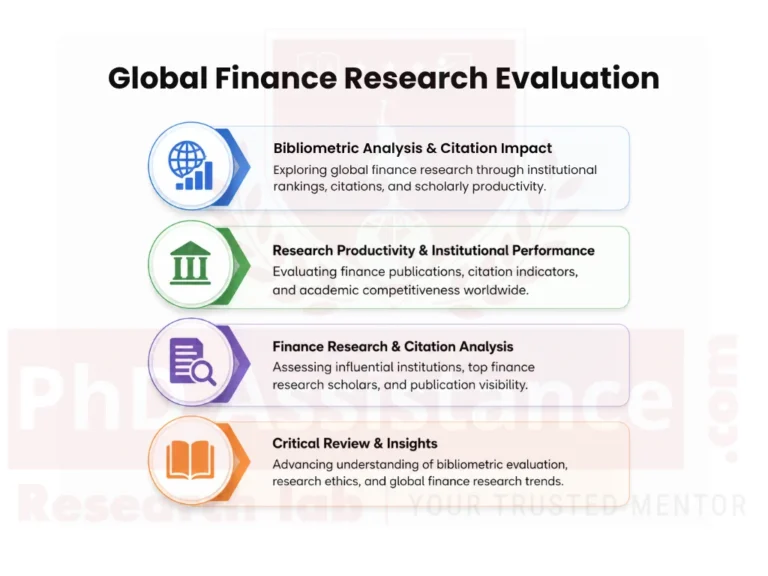
The Global Finance Research Evaluation analyses institutional research performance, key finance researchers, citation efficiency, and academic publications in global finance using quantitative methods. This study has made valuable contributions towards the understanding of the trends, competition, and citation-based evaluation frameworks of finance research globally. Moreover, it demonstrates the importance of citation analysis and data-driven systems for determining influential research institutions and Top finance researchers.
Summary of the article
This study seeks to investigate the global state of financial research by analysing institutions, citation rankings, individual productivity, and the impact of journals within the finance studies. This paper seeks to assess the research performance of universities, researchers, and journals based on bibliometric analysis.
The paper highlights key issues such as Finance research productivity, citation analysis, evaluation of institutional research, global finance publications, and scholarly cooperation in the field of finance. The authors employ bibliometric analysis to determine key finance institutions, cited scholars, and research trends.
In addition, the article highlights the extent to which citation analyses and publication-based assessment approaches influence the measurement of academic impact, research visibility, and competitiveness in finance research. Moreover, the article provides insight into the ways in which global finance research assessment helps identify emerging trends in finance research.
Critique
Significance and contribution of the field
Firstly, the article makes a major contribution to finance bibliometrics by the objective quantification of finance literature worldwide, institutional productivity, and citation impact. Secondly, the paper enriches debates around topics such as the quality of research, institutional ranking, and citations, among others, within the realm of finance.
The valuable aspect of the article is its application of bibliometrics to evaluate institutional performance, productivity of researchers, and citations, among other variables, in the domain of finance. The article integrates citation indicators and institutional rankings alongside researcher productivity.
The results support the previous literature reviews by Podsakoff et al. (2008) in terms of studying the citation impact and influence of management and financial research performed by top finance research scholars. Likewise, Tahai and Meyer (1999) stressed the significance of reputational effects, journal visibility, and citations to determine business and financial research.
On the contrary, although the paper makes elaborate arguments about citation measures and productive performance, it does not include information about qualitative impact, interdisciplinarity, or industrial application of financial research. Conversely, Serenko et al. (2011) proposed that citation metrics might fail to reflect innovation, impact, or quality of research in the field of academic finance.
Methodology and research design
The authors use a quantitative bibliometric and citation-based method of measuring performance in global finance research. The methodology entails measuring the number of publications made by institutions, citations, research productivity, and the influence of the research through citation indicators.
Some of the strengths of the methodological approach are the multi-dimensional assessment of research productivity that involves rankings, citations, performance, and influence of research. This methodology has been used previously in other bibliometric studies conducted by Harzing and van der Wal (2009).
In addition, the paper contributes to the field of Citation analysis in finance through the combination of quantitative and institutional performance measures for evaluation purposes. This method allows for greater objectivity and makes comparisons possible between global financial institutions.
Nevertheless, the article provides little consideration of the methodological problems that exist with citation rankings. This includes issues of self-citations, geographic bias in publication, and data collection. Unlike Moed (2005), who pointed out that citation evaluation systems may not capture the emergence of new scholars or interdisciplinary research areas, this paper could have done better.
Theoretical and Interdisciplinary Analysis
The combination of bibliometric theory, citation analysis, and institution-level research evaluations was the contribution made by this research. The paper provides a successful integration of financial research evaluations, publication metrics, and productivity metrics frameworks under the conditions of global evaluations.
The article shows that the use of quantitative research evaluation methods allows for better comprehension of the competitiveness of institutions, impact on the international research environment, and cooperation patterns of academic institutions. The theoretical insights presented in the paper are relevant to the Garfield citation indexing theory.
In addition, the authors have made some very good connections between their bibliometric research in finance and international debates on university rankings, publishing, and research funding allocations. Such issues have been discussed previously by Bornmann & Daniel (2008).
Though the article is rather informative, it does not touch upon some aspects that could be considered from a more ethical perspective. These include such issues as overpublishing, citation manipulation, and research-driven academics. Further analysis on these topics from the perspective of research ethics, knowledge diversification, and practical finance would contribute to the theoretical background of the work.
Ethical Considerations
The paper mentions several ethical issues associated with citation assessment systems, productivity measures for scholars, and competition among academics in finance research environments. The research notes the rise of an environment where institutional rankings and citation performance play a key role in determining recognition, funding prospects, and research visibility.
The paper shows that open frameworks for bibliometric evaluation can enhance ethical practices in the assessment of finance research. Citation analysis helps in recognising top scholars and fostering quality research in finance journals.
But the paper is insufficient in terms of discussing issues related to ethical considerations concerning citation inflation, self-citations, pressures for publications, and bias toward researchers from the developing world. These kinds of issues have also been identified by Adler & Harzing (2009), who have raised concerns about the negative impact that such reliance on citation metrics may have on creativity in research and its diversity.
Writing Style and Structure
The text reflects a consistent style of professional academic writing in describing bibliometric analysis, citation evaluation, and research productivity within the context of institutional finance studies. The structure of the sections dealing with citation and evaluation analysis makes reading easier.
The authors succeed in explaining quantification schemes in comprehensible ways for researchers in the field of finance studies and bibliometrics. The use of theoretical explanations and citation evaluation enhances the scholarly value of the article.
Nevertheless, some parts feature repetitive explanations of citation metrics and productivity indicators. Further elaboration on practical considerations for policy makers, editors, and research institutions would have added practicality to the paper. Overall, the paper remains highly professional and academic.
Conclusion
The current paper makes important contributions to the literature on evaluating Global finance research trends, especially as it relates to aspects such as Institutional productivity, bibliometric analysis of finance research, assessment of citation impact and visibility of scholarly work. The findings enhance knowledge on research productivity, global institutional competitiveness and frameworks of evaluation through citations.
The current findings find strong support from previous scholarly works done by Podsakoff et al. (2008), Harzing & van der Wal (2009), Bornmann & Daniel (2008) and Moed (2005), all of which underscore the increasing significance of bibliometric evaluations, citation analysis and research visibility in different academic fields.
Despite the issues that have arisen with biases, the qualitative impact assessment process, as well as ethical governance problems, this paper still has significant findings to offer regarding the emerging trends in global finance research, institutional ranking methods, and the role of Academic finance publications in global scholarly communities.
“Are you facing challenges in writing a high-quality critical review for your research? The PhD Assistance Research Lab offers specialised guidance tailored to doctoral scholars and early-career researchers.”
Reference
- Chan, K.C., Hsu, YT., Lin, CY. et al. A comprehensive quantitative evaluation of global finance research: institutions, scholars, and citations. Rev Quant Finan Acc (2026). https://doi.org/10.1007/s11156-026-01491-z.
- Adler, N. J., & Harzing, A. W. (2009). When knowledge wins: Transcending the sense and nonsense of academic rankings. Academy of Management Learning & Education, 8(1), 72–95.
- Bornmann, L., & Daniel, H. D. (2008). What do citation count measure? A review of studies on citing behavior. Journal of Documentation, 64(1), 45–80.
- Garfield, E. (1972). Citation analysis as a tool in journal evaluation. Science, 178(4060), 471–479.
- Harzing, A. W., & van der Wal, R. (2009). A Google Scholar h-index for journals: An alternative metric to measure journal impact. Journal of the American Society for Information Science and Technology, 60(1), 41–46.
- Moed, H. F. (2005). Citation analysis in research evaluation. Springer.
- Podsakoff, P. M., MacKenzie, S. B., Podsakoff, N. P., & Bachrach, D. G. (2008). Scholarly influence in the field of management: A bibliometric analysis. Journal of Management, 34(4), 641–720.
- Serenko, A., Bontis, N., Booker, L., Sadeddin, K., & Hardie, T. (2011). A scientometric analysis of knowledge management and intellectual capital academic literature. Journal of Knowledge Management, 14(1), 3–23.
- Tahai, A., & Meyer, M. J. (1999). A revealed preference study of management journals’ direct influences. Strategic Management Journal, 20(3), 279–296.