
Critical Review of Open Science and Reproducibility Practices in Software Engineering Research
Introduction
Conducting critical reviews often poses many problems for researchers when assessing theory, comparing prior studies, and analysing methodology. Such issues in software engineering are very much related to the aspects of reproducibility, transparency, and availability of research artefacts.
In the last few years, open science in software engineering research has become significant owing to the increased dependency of software engineering communities on reproducible experiments, accessible data, and transparency practices. Traditionally, software engineering experiments have encountered reproducibility problems due to the nonavailability of data and the lack of adequate documentation of methods. This paper focuses on the use of transparency frameworks, reproducibility techniques, and artefact evaluation in software engineering research.
Specifically, the study significantly adds to ICSE reproducibility research by providing insight into how artefact evaluation systems improve validation procedures and collaborative science processes in empirical software engineering investigations.
Summary of the article
The paper studies the issues of replicability and transparency within the context of empirical software engineering research. The paper aims to analyse ways in which researchers disclose their source codes, datasets, replication packages, and experiments in order to enhance scientific credibility and methodological soundness.
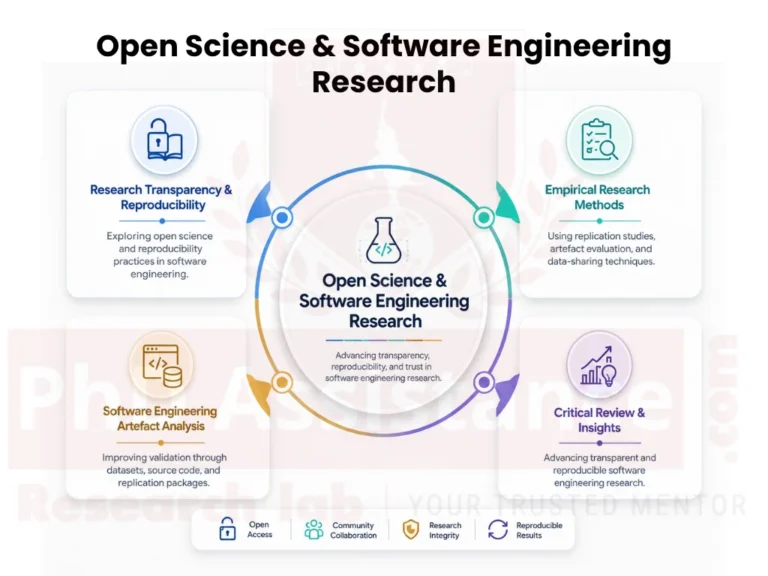
It addresses gaps in open science in software engineering, systems for software engineering artifact evaluation, transparency in software engineering experiments, frameworks for replicable software engineering research, and access to datasets and code archives.
It further emphasises that reproducibility is beneficial to software engineering research because of its ability to independently verify the results through the process of replication. Moreover, the paper under discussion stresses the role of artefact evaluation systems in making researchers more accountable for sharing their datasets and source code. It is important to note that open science can be helpful to software engineers in terms of collaboration and sustainability.
Critique
Significance and contribution of the field
This paper contributes significantly to open science in software engineering by examining the interactions between frameworks, transparency, validation, and the sharing of artefacts for achieving reproducibility in this field of scientific studies.
Moreover, this article supports the existing debates on reliability and collaborative verification in software engineering investigations. In particular, the results align with those of Collberg and Proebsting, where computational reproducibility is noted as a key issue. Furthermore, Munaiah et al. found that there is a lack of information about the artefacts in some GitHub repositories.
One of the key strengths of the paper is the inclusion of the evaluation of software engineering artefacts and the benefits that can be derived from structured artefact sharing on validation, scientific collaboration, and reliability of experiments. One of the key contributions of the paper to research transparency in software engineering is the emphasis placed on openness with respect to data, reporting, replicability packages, and collaborative verification.
While the paper discusses reproducibility efforts that have been implemented in conferences, it does not mention the industrial software engineering setting much at all. As Peng (2011) and Nosek et al. (2015) note, achieving reproducibility requires not only that data sets be available in perpetuity, but also that there be a means of verifying their execution within a collaborative environment, as well as maintaining the research artefacts on an ongoing basis. The paper would have benefited from incorporating issues concerning reproducibility in the industrial research environment.
Methodology and research design
A systematic empirical literature review approach is employed to examine issues related to reproducibility and transparency in empirical software engineering publications. This work examines conference papers, data sets, replication artefacts, and artefact repositories relating to software engineering studies.
The major strength of the methodology is the multidimensional evaluation of the reproducibility processes, which include factors such as artefact availability, code availability, support for replication, and adherence to transparency principles. This methodology is consistent with the work done by Hilton et al., who investigated the availability of replication packages in software engineering conferences and found discrepancies in transparency requirements.
Further, it contributes to reproducible software engineering research that the authors combine a reproducibility verification framework with an artefact evaluation system. This combination adds value to software engineering studies because they become validated and transparent. The weakness of this paper is the lack of discussion about organisational barriers to adopting such an approach, researchers’ opinions, and industry limitations. Kitchenham et al. argued that there should also be an organisational perspective to empirical software engineering research.
Theoretical and Interdisciplinary Analysis
The integration of the theory of reproducibility, transparency principles, and empirical software engineering is a good contribution provided by the article. This paper shows that the application of open science in software engineering ensures credibility, accessibility, transparency, and future scientific validation of the work being done.
The paper has successfully integrated software engineering, empirical research methods, the policy of open science, and computational reproducibility approaches. The theoretical arguments in the paper align well with the arguments by Peng, who claims that reproducibility requires access to code, transparency of procedures, and availability of data. Likewise, Nosek et al. stated that open science enhances the integrity of science by decreasing publication bias.
The article enhances the debate about transparency in software engineering by demonstrating the positive impacts that result from artefact transparency in collaboration for verification, replicability of experiments, and accountability within science. The article doesn’t include a discussion about the intellectual property rights, ethics, and industrial concerns.
Ethical Considerations
These problems have been identified as ethical concerns surrounding transparency, reproducibility, accessibility, and scientific accountability within software engineering studies. As per the research, the unavailability of data and incomplete documentation of the methodology decreases the credibility of scientific work, denies others from verifying the experiments, and ultimately hampers the process of research transparency.
According to the analysis, promoting ethical practice for science involves making data sets, execution codes, and replications available for public use. This is because having an open system for artefact evaluations increases trustworthiness, accountability, and scientific cooperation among software engineering practitioners.
Nevertheless, this research does not discuss in detail the problems concerning intellectual property rights, confidentiality in business operations, and the sustainability of open-source artefact repositories. More research is necessary into ethical considerations regarding software limitations imposed by corporations and data security issues.
Writing Style and Structure
The article contains writing that shows structure in an academic sense. The structure is based on the organisation of parts such as reproducibility, artefact evaluation systems, empirical methods, and transparency issues in the field of software engineering research.
The reproducibility information provided is clearly explained from a technical and conceptual viewpoint; therefore, it is easy to understand for scholars researching software engineering. Analysis of concepts with theoretical discourse makes it academically sound. However, there are repetitive descriptions related to transparency criteria and methods.
Nevertheless, the paper succeeds in emphasising the significance of reproducibility, openness, and collaboration in the scientific verification process in software engineering research. The writing in this paper is very professional and academic.
Conclusion
This study provides important contributions to the field of open science in software engineering research, especially in transparency frameworks, reproducibility tools, and artefact evaluation, which contribute to enhancing the scientific credibility of empirical software engineering studies.
This work also makes an important contribution to the field of ICSE reproducibility by emphasising the importance of accessible datasets, executable artefacts, and collaborative verification mechanisms in enhancing research reliability.
Findings are well corroborated by other prior research conducted by Collberg and Proebsting, Munaiah et al., Peng, and Nosek et al., all of whom together emphasise the importance of transparency, accessibility, and reproducibility in the scientific environment. Despite the limitations that exist in the article regarding the challenges in industrial reproducibility and ethical governance, it is evident that the article has much value in promoting reproducibility in software engineering research.
“Are you facing challenges in writing a high-quality critical review for your research? The PhD Assistance Research Lab offers specialised guidance tailored to doctoral scholars and early-career researchers.”
Reference
- Collberg, C., & Proebsting, T. A. (2016). Repeatability in computer systems research. Communications of the ACM, 59(3), 62–69.
- Gonzalez-Barahona, J. M., & Robles, G. (2012). On the reproducibility of empirical software engineering studies based on data retrieved from development repositories. Empirical Software Engineering, 17(1–2), 75–89.
- Hilton, M., Nelson, N., Tunnell, T., Marinov, D., & Dig, D. (2016). Trade-offs in continuous integration: Assurance, security, and flexibility. In Proceedings of the 2016 ACM SIGSOFT International Symposium on Foundations of Software Engineering (pp. 197–207).
- Kitchenham, B., Dyba, T., & Jorgensen, M. (2004). Evidence-based software engineering. In Proceedings of the 26th International Conference on Software Engineering (pp. 273–281).
- Munaiah, N., Kroh, S., Cabrey, C., & Nagappan, M. (2017). Curating GitHub for engineered software projects. Empirical Software Engineering, 22(6), 3219–3253.
- Nosek, B. A., et al. (2015). Promoting an open research culture. Science, 348(6242), 1422–1425.
- Peng, R. D. (2011). Reproducible research in computational science. Science, 334(6060), 1226–1227.