
Critical Review of The Role of Data Science in Optimising Project Efficiency and Innovation in U.S. Enterprises
Introduction
The main problems that many researchers face in critical review include evaluating theoretical paradigms, comparing previous research, and analysing methodology. There is also a need for researchers to critically evaluate empirical evidence and adopt an interdisciplinary perspective in digital transformation and organisational studies.
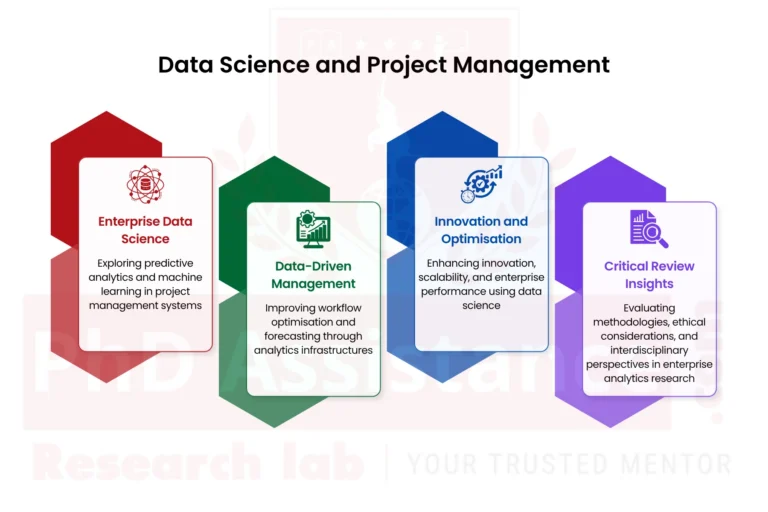
In recent years, Data Science in Project Management has become important as enterprises increasingly rely on predictive analytics, machine learning systems, and data-driven infrastructures to improve operational efficiency and innovation scalability. Traditional project management systems often face challenges in handling large-scale organisational data, leading to inefficiencies in forecasting and workflow management. The article “The Role of Data Science in Optimising Innovation in U.S. Enterprises” examines how Data Science in the USA improves organisational efficiency through enterprise data science capability (EDSC).
This research incorporates dynamic capabilities theory and socio-technical system theory in its framework to understand the benefits that predictive analytics, governance systems, and MLOps have on organisational performance. Additionally, this paper outlines how data-driven project management facilitates agility and transparency in workflows, while setting enterprise project optimisation as an outcome of analytics maturity through data science for business.
Summary of the article
The paper investigates the impact of an organisation’s data science capabilities on its operational performance and innovation. In this research, the concept of enterprise data science capabilities includes such aspects as analytics infrastructure, governance, machine learning, predictive analytics, and workforce capabilities for analytics. The research states that those firms can complete projects quickly and efficiently and perform better at innovation.
The study emphasises the Project Management with data science, Predictive Analytics and Machine Learning to optimise workflow, forecast projects, and improve quality management processes. Further, the importance of Project Management in making decisions in real time and optimising performance within organisations is emphasised. RBV, Dynamic Capabilities, and socio-technical systems are some of the theories used in the study to discuss Enterprise Project Optimisation’s contributions to sustainable growth.
Critique
Significance and contribution of the field
This paper provides an important contribution to the literature on the topic of “Data Science in U.S. Enterprises” by analysing the interrelation between enterprise analytics, organisational learning, innovation management, and project optimisation.
This paper is consistent with the theory presented in the work of Mikalef et al. (2020). The authors stated that analytics capability improves the agility and performance of organisations. Also, the paper is relevant to the works of Gupta and George (2016), who defined analytics capability as a strategic organisational resource.
The crucial strength in the article is the analysis of the concept of Project Efficiency and Innovation using key indicators like cycle time reduction, cost stability, defect minimisation, and innovation productivity. Another strength in the article is its contribution to Data Science for Innovation through the use of predictive analytics and machine learning systems for enterprise-level optimisation and adaptability.
The weakness in the article is that it is mostly geared towards large enterprises without giving any attention to the issues associated with analytics adoption in small and medium-sized enterprises. According to studies conducted by Wamba et al. (2017), SMEs are faced with infrastructural and technological constraints while implementing analytics.
Methodology and research design
This research relies on sound methodology, which includes DiD analysis, Structural Equation Modelling (SEM), Confirmatory Factor Analysis, and Instrumental Variables (IV) regression analysis.
One of the key strengths of this research methodology is that enterprise data science capability has been seen as multidimensional, encompassing good governance, infrastructure maturity, analytics integration, and data analytics talent. In addition, sound methodological reliability has been achieved through robustness tests, measurement invariance, and event study analyses.
This research methodology is consistent with Chen et al. (2012) in their recommendation that capability measurement with multiple dimensions enhances studies involving analytics performance. This research, however, lacks qualitative perspectives on organisational culture, adaptability of employees, and leadership difficulties involved when implementing analytics. Digital transformation research by Kane et al. (2019) reveals that the success of digital transformation requires organisational culture and adaptability among leaders.
Theoretical and Interdisciplinary Analysis
The inclusion of RBV, Dynamic Capabilities Theory, and socio-technical systems theory is among the greatest achievements. This article successfully shows how Data Science for Business acts as an organisation’s strategic capability to enhance the performance of its operations and innovation capabilities.
The interdisciplinarity of this article is obvious due to the involvement of organisational theory, project management, data science, innovation management, and digital transformation literature. In the case of Enterprise Project Optimization, this article pushes project management studies further by considering analytics systems as strategic infrastructure rather than a mere operational tool.
The theoretical review is consistent with the research of Gupta and George (2016), who contend that the adoption of analytics capabilities into governance and organisational knowledge creates a sustainable competitive advantage for the business organisation. The same view was adopted by Teece (2018), who contends that organisations’ capacity to reconfigure technologies and learn adaptively determines their competitiveness in digital economies.
On the other hand, there is not much critical discussion on workforce dislocation and ethical governance issues concerning AI-powered enterprise systems. According to studies by Dwivedi et al. (2023), there is a need for effective governance frameworks in AI-enabled enterprise systems.
Ethical Considerations
These issues include biases, data governance, model transparency, explainability of artificial intelligence, and analytical accountability. According to the study, machine learning models can develop biased outputs based on imbalanced training data, and thus, it is crucial to pay attention to the quality of data governance.
The analysis is consistent with Akter et al. (2022), where the importance of responsible AI governance is stated to preserve organisational trust and mitigate algorithmic bias in enterprise analytics tools.
In addition to this, the article explains that explainable AI and transparency of the analytics system play a significant role in increasing organisational trust and reliability of the decision-making process. Also, accountability in analytics is considered critical for ensuring ethical and functional management of the enterprise analytics tool. But the article lacks an adequate explanation of the issues of AI ethics compliance, workforce surveillance, and data privacy requirements in an enterprise analytics setting.
Writing Style and Structure
The article reflects structured academic writing. The topics are well proposed into enterprise analytics capability, governance systems, innovation management, predictive analytics, and quantitative methods. The application of theoretical models makes the text more readable.
On the one hand, the article successfully combines analytical explanations and managerial interpretations. Thus, enterprise analytics-related information becomes comprehensible for managers who research business processes. On the other hand, some passages include very technical language associated with predictive analytics architectures and machine learning systems.
Conclusion
The research paper contributes significantly to academic knowledge about Data Science by investigating how analytics capabilities improve the efficiency, scale, and adaptability of operations within U.S.-based organisations.
The current research contributes significantly to the literature surrounding Project Efficiency, as it highlights the contributions of predictive analytics, governance frameworks, analytics skills, and machine learning platforms to improving enterprise efficiency. The theoretical background offered by the application of RBV, Dynamic Capabilities Theory, and Socio-Technical Systems Theory is very robust.
Findings from the article are supported by the works of Mikalef et al. (2020), Gupta & George (2016), and Teece (2018), which highlight the significance of analytic capability and adaptability within the context of digital transformations. Even with certain weaknesses in qualitative and ethical aspects, the article provides useful information on Data Science for Business Innovation.
“Are you finding difficulties in writing an excellent critical review for your research paper? The PhD Assistance Research Lab provides professional support designed specifically for PhD students.”
Reference
- Raj, M. W. Z. (2025). The role of data science in optimising project efficiency and innovation in U.S. enterprises. Journal of Data Science and Digital Transformation, 12(3), 145–168.
- Akter, S., Dwivedi, Y. K., Sajib, S., Biswas, K., Bandara, R. J., & Michael, K. (2022). Algorithmic bias in machine learning-based marketing models. Journal of Business Research, 144, 201–216.
- Chen, H., Chiang, R. H. L., & Storey, V. C. (2012). Business intelligence and analytics: From big data to big impact. MIS Quarterly, 36(4), 1165–1188.
- Gupta, M., & George, J. F. (2016). Toward the development of a big data analytics capability. Information & Management, 53(8), 1049–1064.
- Mikalef, P., Boura, M., Lekakos, G., & Krogstie, J. (2019). Big data analytics capabilities and innovation: The mediating role of dynamic capabilities and moderating effect of the environment. British Journal of Management, 30(2), 272–298.
- Teece, D. J. (2018). Business models and dynamic capabilities. Long Range Planning, 51(1), 40–49.
- Wamba, S. F., Gunasekaran, A., Akter, S., Ren, S. J. F., Dubey, R., & Childe, S. J. (2017). Big data analytics and firm performance: Effects of dynamic capabilities. Journal of Business Research, 70, 356–365.