
How to Design a PhD Research Methodology in India Engineering: Applying AI, Cyber-Physical Systems and Automation
- Home
- Academy
- PhD Part Dissertation
- How to Design a PhD Research Methodology in India Engineering: Applying AI, Cyber-Physical Systems and Automation
Sustainable Practices in Environmental Science
- Identifying Engineering Research Gaps in AI and Industrial Automation Systems
- Structuring Intelligent Cyber-Physical System Models for Engineering Research
- Integrating AI Algorithms and Automation Technologies into Methodological Development
- Building Scalable and Technically Valid Engineering Research Methodologies
- Applying AI-Driven Empirical Modelling and Industrial Analytics Techniques
- Analysing Engineering Outcomes within Industry 4.0 and Automation Environments
- Conclusion

Recent Post
Introduction
PhD students studying Engineering in India are more often engaged in devising methodologies that incorporate artificial intelligence, cyber-physical systems, industrial automation, robotics, smart manufacturing, and Industry 4.0 technologies. Contemporary engineering research demands a methodology that can manage computational modelling, intelligent control systems, and real-time industry analysis. Consequently, universities require engineers to formulate sound research frameworks in engineering research.
With the increasing prevalence of AI-Based Engineering Research, there have been significant changes in how doctoral students devise approaches like predictive maintenance, intelligent manufacturing, autonomous systems, and smart infrastructures. Similarly, Cyber Physical Systems Research in India necessitates incorporating IoT architectures, embedded systems, machine learning, and industrial automation into engineering research.
Professional PhD dissertation methodology writing services in India assist researchers in building methodologies that incorporate artificial intelligence modelling, automated analytics, simulation verification, and industrial experiments. This technology provides the basis for the modern Research Methodology for PhD and Engineering PhD Research Design in India.
What you will learn?
1. Identifying Engineering Research Gaps in AI and Industrial Automation Systems
PhD students studying Engineering in India tend to concentrate on finding deficiencies in technology associated with artificial intelligence, industrial automation, robots, and smart manufacturing systems. Contemporary engineering research issues should come out of industrial inefficiencies, automation, difficulties in predicting maintenance, and intelligent system errors.
Research gaps should be based on high-impact engineering journals, Industry 4.0 and industrial automation. Engineering variables must be measurable using artificial intelligence systems, industrial data and computational algorithms. Methodologies must also reflect industrial optimisation, smart infrastructure and engineering reliability in real time.
Example: Research by Lee et al. (2015) on cyber-physical manufacturing architectures identified that the lack of standardised automation models and engineering parameters had greatly impacted the effectiveness of smart manufacturing operations. The study indicated the need for having well-defined research questions in engineering before any methodological approach.
2. Structuring Intelligent Cyber-Physical System Models for Engineering Research
Current Research on Cyber-Physical Systems in India now relies more and more on the use of embedded systems, sensor network systems, IoT system architecture, artificial intelligence, and cloud-edge computing systems in its engineering environment. CPS functions through the interactivity of computational intelligence with physical engineering structures, which makes it very complex.
Innovations in engineering have incorporated intelligent sensor technology, automation, machine learning algorithms, and communication infrastructure. Scientists have to figure out the relationships among automation reliability, system intelligence, and efficiency to improve performance and scalability within engineering.
Example: According to Rajkumar et al. (2010), communication synchronisation is essential for cyber-physical systems in which embedded sensors communicate with intelligent controllers and industrial systems. Weak integration frameworks had a direct impact on automation reliability and engineering scalability.
3. Integrating AI Algorithms and Automation Technologies into Methodological Development
AI algorithms, automation, robotics, digital twins, and prediction analysis are becoming more essential to engineering problem-solving methodologies. The modern methodology for automation research is embedded within the framework of “Modern Automation Research Methodology for PhD,” which encompasses machine learning models, industrial control systems, and engineering simulations.
AI models like deep neural networks, CNNs, and random forests are employed by researchers for engineering predictions and industrial optimisation. For automated systems, there is a need for interaction between IoT structures, robotic controllers, programmable logic control systems, and cloud-to-edge computing platforms in order to provide real-time engineering analytics.
Example: Tao et al. (2018) created manufacturing systems using the concept of digital twins and showed that automation environments with AI significantly enhance predictive maintenance, industry monitoring, and optimisation. These researchers revealed that studies conducted in engineering using automation require consistent real-time validation and monitoring.
4. Building Scalable and Technically Valid Engineering Research Methodologies
The research methodology establishes a direct connection between research objectives and the conceptual framework and analytical methods. The system maintains internal validity through precise result evaluation and external validity through its capacity to apply research findings to various situations.
Experimental, simulation, or a combined methodology design can be selected by researchers based on the goals and objectives of industrial automation. Validation methodologies should encompass sensitivity analysis, reliability analysis, Monte Carlo Simulation, and robustness benchmarking.
Example: According to Monostori et al. (2016), cyber-physical manufacturing systems enhance intelligent automation using adaptive control systems, real-time monitoring, and autonomous industrial decision-making. This study found that scalable methodological validation is critical for preserving engineering reliability and automation effectiveness in an Industry 4.0 setting.
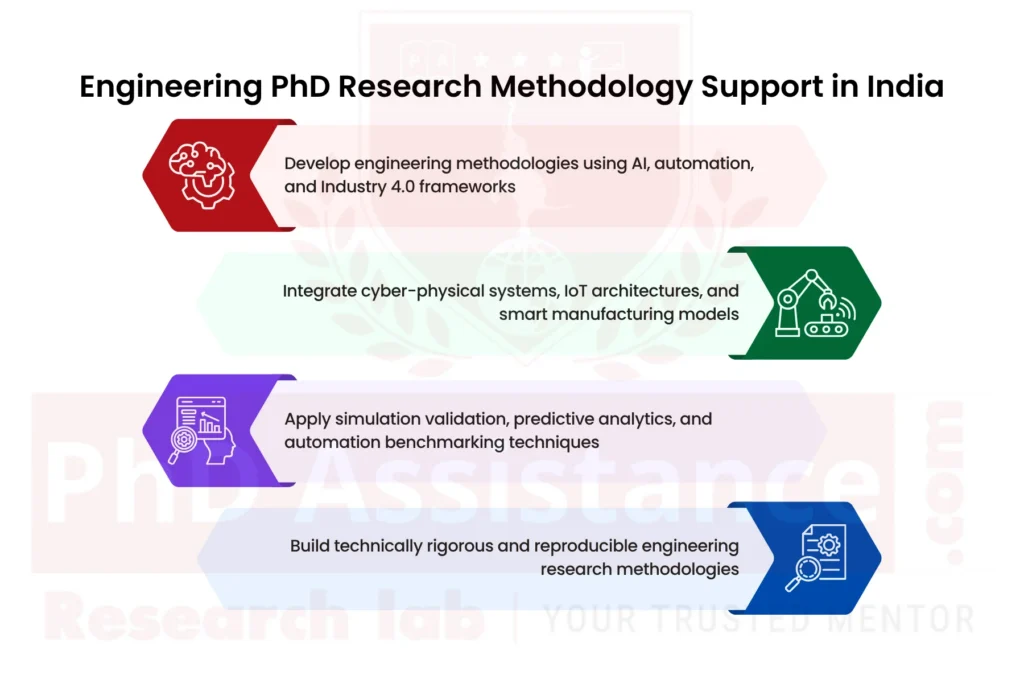
5. Applying AI-Driven Empirical Modelling and Industrial Analytics Techniques
Empirical models for engineering use AI-based predictive systems, industrial analytics, automation optimisation, and engineering statistics approaches to analyse large industrial datasets and operations. Academicians performing Cyber-Physical Systems Research India are now using advanced computational modelling methods for optimising engineering systems and industrial automation systems.
Regression analyses, optimisation routines, anomaly detection systems through AI, and digital twin models are often employed for improving predictability and fault detection capabilities. XAI methods like SHAP are used as well to enhance model explainability within engineering automation systems.
Example: According to Lundberg and Lee (2017), SHAP values enhance the interpretability of machine learning by attributing the roles of each in the predictive artificial intelligence system. The study underscores the significance of Explainable Artificial Intelligence to ensure transparency and accountability in industrial automation.
6. Analysing Engineering Outcomes within Industry 4.0 and Automation Environments
Engineering results need to be interpreted in relation to other automation processes, AI technologies, and Industry 4.0 studies to ascertain the technical significance of the findings. This will enable them to determine the extent to which engineering models enhance the accuracy and effectiveness of their results against existing intelligent systems.
Findings should address the contribution of intelligent automation towards enhancing productivity, predictive maintenance, operations optimisation, and real-time decisions in an engineering environment. AI-Based Engineering Research in India needs to focus on the contribution of automation systems and cyber-physical infrastructure towards improving engineering reliability.
The methodological limitations concerning the complexity of simulations, scalability, issues with interpreting artificial intelligence and the difficulties of implementing them in industry should also be critically analysed. The author should address the future implications for robotics, smart infrastructure, autonomous systems, and other applications in industry as well.
Conclusion
The methodology used in the Engineering PhD Research Design India should include elements of artificial intelligence, cyber-physical systems, industry automation, and advanced computation. Any modern engineering methodology must provide intelligent automation, real-time industrial processes, predictive modelling, and computational replicability to solve Industry 4.0 engineering problems.
The combination of artificial intelligence modelling, automation tools, digital twin, and cyber-physical systems ensures methodological robustness and industrial relevance in PhD research for engineering students. PhD dissertation methodology writing assistance in India helps researchers develop sound research methodologies grounded in contemporary engineering innovations and industrial advancements.
The scholars involved in AI-Based Engineering Research India, Cyber-Physical Systems Research, and Automated Research Methodology for PhD can definitely enhance the quality of their research by following proper methodologies, creating reproducible computing systems, and developing automated validations.
References
- Lee, J., Bagheri, B., & Kao, H. A. (2015). A cyber-physical systems architecture for Industry 4.0-based manufacturing systems. Manufacturing Letters, 3, 18–23. https://doi.org/10.1016/j.mfglet.2014.12
- Rajkumar, R., Lee, I., Sha, L., & Stankovic, J. (2010). Cyber-physical systems: The next computing revolution. Proceedings of the 47th Design Automation Conference, 731–736. https://doi.org/10.1145/1837274.1837461
- Tao, F., Cheng, J., Qi, Q., Zhang, M., Zhang, H., & Sui, F. (2018). Digital twin-driven product design, manufacturing and service with big data. The International Journal of Advanced Manufacturing Technology, 94(9–12), 3563–3576.
- Monostori, L., Kádár, B., Bauernhansl, T., Kondoh, S., Kumara, S., Reinhart, G., Sauer, O., Schuh, G., Sihn, W., & Ueda, K. (2016). Cyber-physical systems in manufacturing. CIRP Annals, 65(2), 621–641
- Lundberg, S. M., & Lee, S.-I. (2017). A unified approach to interpreting model predictions. Advances in Neural Information Processing Systems, 30, 4765–4774. https://doi.org/10.1016/j.cirp.2016.06.00