
Digital Twins in Smart Manufacturing for Industry 4.0 Optimisation Dissertation Topics I phdassistance.com
Info: Digital Twins in Smart Manufacturing for Industry 4.0 Optimisation Dissertation Topics I phdassistance.com
Published: 30th March in Digital Twins in Smart Manufacturing for Industry 4.0 Optimisation Dissertation Topics I phdassistance.com
Share this:
Related Services
Our academic writing and marking services can help you
Introduction
Researchers in Digital Twins for Smart Manufacturing face challenges when they try to find their most suitable PhD research topics. PhD Assistance provides professional guidance for choosing doctoral research topics that offer both academic merit and industrial relevance. The research team assists scholars in the field of Digital Twins in Smart Manufacturing by providing them with specialised research fields to study, which include predictive maintenance systems, smart manufacturing optimisation, Industrial IoT integration, quality control analytics, and Industry digital transformation frameworks. The research experts verify that every research topic meets the requirements of current research trends and university standards, and future publication possibilities. Our topic selection service helps scholars find new research paths that result in important academic success and significant industrial impact.
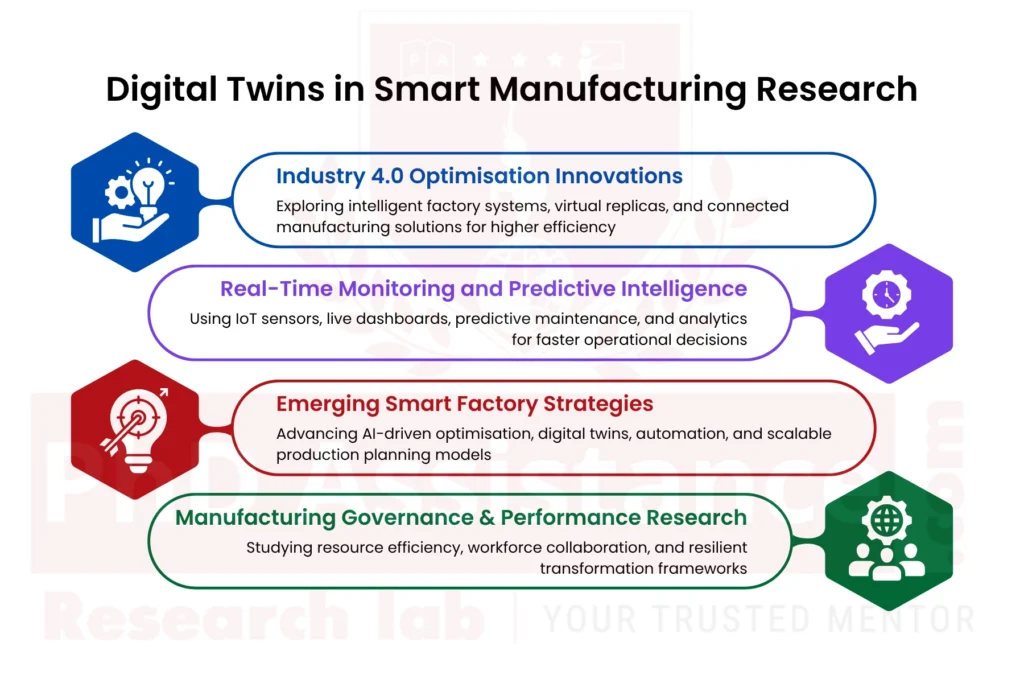
Digital Twins in Smart Manufacturing for Industry 4.0 Optimisation Dissertation Topics I phdassistance.com
Proposed PhD Topic 1: Developing Real-Time Digital Twins from Smart Manufacturing for Predictive Maintenance and Downtime Reduction in Industry 4.0 Optimisation
Background Context:
Digital Twins from Smart Manufacturing become crucial for enhancing machine reliability and production continuity as well as operational efficiency in all Industry 4.0 systems. Modern factories increasingly use sensors, Digital Twins technology to monitor machine performance, identify operational problems and forecast equipment failures before they happen. The systems enable organisations to implement maintenance systems that protect their operations while decreasing their maintenance expenses. Manufacturing facilities continue to use maintenance systems that operate after equipment breakdowns or according to prearranged schedules, thus causing unplanned production halts and decreasing asset productivity. Fantozzi et al. (2025) demonstrate that Digital Twin Technology Industry 4.0 provides substantial advancements to predictive maintenance systems, but businesses still lack real-time maintenance systems that integrate current data with analytical tools and automatic decision-making capabilities.
PhD-Level Verification:
Existing studies focus their research on two distinct areas, which are isolated predictive maintenance systems and single-machine case studies. The research on scalable Digital Twin Applications, which enables enterprise-wide predictive maintenance, cross-machine coordination and intelligent maintenance scheduling, remains insufficient. The development of a strong framework is essential for the successful integration of maintenance forecasting with production planning and operational efficiency objectives.
Research Questions:
PhD-Level Contributions:
Suggested Readings:
Fantozzi, I. C., Santolamazza, A., Loy, G., & Schiraldi, M. M. (2025). Digital Twins: Strategic Guide to Utilize Digital Twins to Improve Operational Efficiency in Industry 4.0. Future Internet, 17(1), 41. https://doi.org/10.3390/fi17010041
Proposed PhD Topic 2: Designing Data-Driven Digital Twin Technology Industry Models for Smart Manufacturing Optimisation and Resource Efficiency
Background Context:
The manufacturing industry needs to increase its productivity while it needs to reduce both waste and energy consumption, operational downtime and resource waste. Digital Twins of Smart Manufacturing create virtual replicas of production systems that allow managers to test multiple operational scenarios without interrupting real production. The systems enable operators to monitor equipment in real time while they identify production bottlenecks and use data to optimise machine operations, labour, and material handling. Fantozzi et al. 2025 Digital Twin systems provide organisations with better throughput and process visibility and improved decision-making capabilities. Many factories do not have access to intelligent optimisation models that use real-time production data to develop strategic planning needs.
PhD-Level Verification:
The current study investigates resource optimisation research, which includes three specific areas of scheduling, energy management and labour planning. The existing research lacks studies that investigate complete Digital Twin Technology Industry systems that manage multiple factory operations, including workforce management, equipment usage, material handling and energy performance assessment.
Research Questions:
- How do Digital Twins for Smart Manufacturing help factories control their resources more efficiently?
- Which methods use Digital Twin simulations to achieve better energy and material efficiency?
- How to implement the Smart Manufacturing Optimization results in higher production output?
PhD-Level Contributions:
Suggested Readings:
Fantozzi, I. C., Santolamazza, A., Loy, G., & Schiraldi, M. M. (2025). Digital Twins: Strategic Guide to Utilize Digital Twins to Improve Operational Efficiency in Industry 4.0. Future Internet, 17(1), 41. https://doi.org/10.3390/fi17010041
Proposed Dissertation topic 3: Developing Human-Centric Digital Twin in Manufacturing for Workforce Collaboration and Smart Factory Performance
Background Context:
The main goal of Industry 4.0 needs automation because organisations depend on their employees to perform essential tasks, which include making decisions and maintaining operational ability, delivering quality assurance and meeting system development needs. The production output of workers depends on their skills, their ability to manage their work tasks, their capacity to control work-related stress and their power to resolve workplace difficulties. Digital Twins function in Smart Manufacturing systems by using data from machines and sensors, and equipment systems, but they cannot monitor workforce activities and human performance variations. Fantozzi et al. (2025) find that current Digital Twin systems have insufficient inclusion of human elements. Future smart factories require intelligent models that can simulate machine performance and demonstrate employee interactions for complete system output.
PhD Level Verification:
Digital Twin applications in manufacturing today use digital twin technology to monitor equipment and automate manufacturing processes while excluding integration of their workforce. Researchers need to study human-centric Digital Twin frameworks that use operator behaviour data, ergonomic information, productivity metrics and human-machine interaction data to create actual manufacturing simulations.
Research Questions:
PhD-Level Contributions:
Suggested Readings:
Fantozzi, I. C., Santolamazza, A., Loy, G., & Schiraldi, M. M. (2025). Digital Twins: Strategic Guide to Utilize Digital Twins to Improve Operational Efficiency in Industry 4.0. Future Internet, 17(1), 41. https://doi.org/10.3390/fi17010041
Proposed Dissertation Topic 4: Investigating Industrial IoT and Digital Twins for Real-Time Quality Control and Defect Reduction in Smart Manufacturing
Background Context:
Modern manufacturers who produce goods in sectors that need exact production results and complete adherence to regulations use product quality as their main method to gain market advantage. Smart factories use Industrial IoT and Digital Twins to track production quality and collect machine operational data while they monitor process changes in real time. The technologies enable manufacturers to stop defects from happening while they decrease expenses associated with reprocessing work. The research by Fantozzi et al. (2025) shows that AI-based Digital Twins systems decrease product defects in significant ways. Many quality systems still operate independently from real-time production information because they do not implement closed-loop response systems.
PhD-Level Verification:
Most quality management research focuses on inspection methods or post-production defect analysis. The existing research base provides limited studies that investigate how Industrial Internet of Things technology and Digital Twin technology work together to establish continuous closed-loop systems that predict quality failures while simultaneously improving operational efficiency through real-time process adjustments.
Research Questions:
Contributions at the PhD-Level:
Suggested Readings:
Fantozzi, I. C., Santolamazza, A., Loy, G., & Schiraldi, M. M. (2025). Digital Twins: Strategic Guide to Utilise Digital Twins to Improve Operational Efficiency in Industry 4.0. Future Internet, 17(1), 41. https://doi.org/10.3390/fi17010041
Proposed Dissertation Topic 5: Building Scalable Industry Digital Transformation Frameworks Using Digital Twins from Smart Manufacturing for End-to-End Factory Integration
Background Context:
Manufacturers implement automation tools, ERP systems, IoT platforms and analytics software as separate solutions, which create digital systems that remain incompatible with each other. The security weakness affects all aspects of production, maintenance and supply chain management, and planning operations. Digital Twins from Smart Manufacturing provide a complete solution that unifies physical processes with digital operational intelligence throughout the entire organisation. The systems provide decision makers with unified decision-making capabilities because they can access real-time operational data and total system performance enhancements. Fantozzi et al. (2025) observe that present implementations still focus on individual assets instead of complete enterprise system models.
PhD-Level Verification:
A research gap occurs because there are no established Digital Transformation frameworks for Industry 4.0 that use Digital Twin Technology to connect all enterprise systems. Existing studies often focus on specific machines or production lines rather than end-to-end integration across operations, logistics, maintenance and strategic planning. The industrial sector requires more interoperable models that possess greater scalability than existing systems.
Research Questions:
PhD-Level Contributions:
Suggested Readings:
Fantozzi, I. C., Santolamazza, A., Loy, G., & Schiraldi, M. M. (2025). Digital Twins: Strategic Guide to Utilize Digital Twins to Improve Operational Efficiency in Industry 4.0. Future Internet, 17(1), 41. https://doi.org/10.3390/fi17010041
Need assistance finalising your dissertation topic? Selecting a strong, researchable topic can be challenging — but you don’t have to do it alone.
Our research consultants can help refine your ideas, identify literature gaps, and guide you toward a topic that aligns with current academic trends and your programme requirements.
Contact us to begin one-on-one topic development and refinement with PhdAssistance.com Research Lab.
Share this:
Cite this work
PhDAssistance. (n.d.). Cybersecurity in business Dissertation Topics Retrieved January 28th, from https://phdassistance.com/topic/cybersecurity-business/
Jalolova, M., and Musawwir, M. “Cybersecurity in business Dissertation Topics for PhD Scholars.” PhDAssistance, https://phdassistance.com/topic/cybersecurity-business/ Accessed 28th January 2026.
Jalolova, M., and Musawwir, M., n.d. Cybersecurity in business Dissertation Topics for PhD scholars. [online] Available at: https://phdassistance.com/topic/cybersecurity-business/ [Accessed 28th January 2026].
Jalolova M., Musawwir M. Cybersecurity in business Dissertation Topics for PhD scholars [Internet]. PhDAssistance; [cited 2026 28th January]. Available from: https://phdassistance.com/topic/cybersecurity-business/
Jalolova, M., and Musawwir, M. (n.d.). Cybersecurity in business Dissertation Topics for PhD scholars. Retrieved 28th January 2026, from https://phdassistance.com/topic/cybersecurity-business/
Jalolova, M., and Musawwir, M., Cybersecurity in business Dissertation Topics (n.d.) https://phdassistance.com/topic/cybersecurity-business/ accessed 28th January 2026.
Study Resources
Free resources to assist you with your university studies!