
Critical Review of Chatbots and academic writing for doctoral students
Introduction
The study situates itself within the broader discourse of AI in writing, which demonstrates how new technologies offer students formative assessment tools for their academic growth. The article investigates whether AI-based systems serve as successful digital supervisors that help PhD students who struggle with understanding their writing requirements and want to enhance their research communication skills.
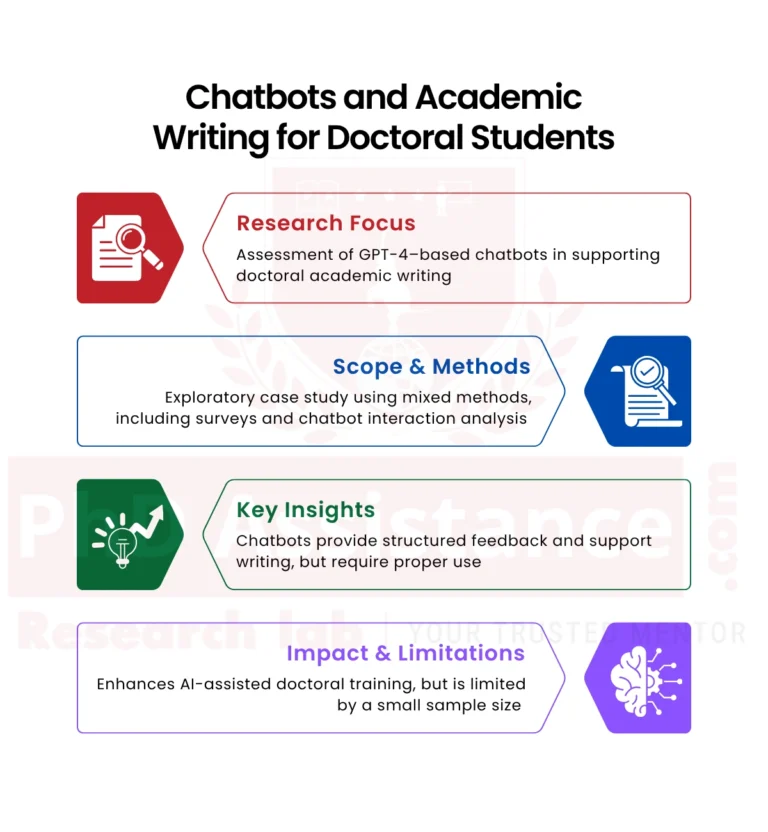
The growing role of chatbots in academic writing for doctoral students was investigated in the study, particularly focusing on a GPT-4-based synopsis chatbot designed to support PhD candidates in Norway. As doctoral education develops, its complexity increases through the implementation of article-based dissertation requirements, which create difficulties for scholars who must produce academic writing in structured formats.
The critical review assesses the article through its theoretical framework and research methodology, and research findings, which demonstrate how AI tools support PhD writing at modern higher education institutions.
Summary of the article
It conducts an exploratory case study that examines the effectiveness of a GPT-4-based synopsis chatbot that was developed for doctoral education. The chatbot use in doctoral research follows institutional guidelines and academic literature to deliver feedback that matches specific domains and particular situations.
The doctoral students face challenges in meeting article-based dissertation requirements because they cannot achieve the academic standards that differ across their study fields. The study examines how chatbots can function as organised support systems for doctoral students who conduct research.
The chatbot operates as a formative assessment tool because it functions correctly with predefined prompts that include chain-of-thought prompting. The study shows that supervisors who hold different views about AI’s impact on academic writing demonstrate two opposing perspectives. The chatbot shows potential to assist doctoral writing tasks yet its success relies on correct implementation and active user participation.
Critique
Significance and contribution of the field
It establishes an important educational technology advancement through its research on academic writing chatbots for PhD students, which changes feedback systems and improves doctoral training programs. The research presents AI as a new type of academic support system that functions as a digital supervisor.
The challenges doctoral students face when they write academic papers based on their two major research fields. The research investigates article-based dissertations as a specific research field that has grown in importance within doctoral education.
Results are limited to Norway because it studies this specific geographic region. The important results need further investigation across different educational systems to assess their global impact on doctoral writing.
Methodology and research design
An exploratory case study design was used, which includes formative dialogue research, pilot surveys and chatbot development and digital fieldwork. The research uses a mixed-method approach, which enables researchers to study how doctoral students use chatbots for their academic writing tasks.
The research methodology gains strength through the collection of qualitative and quantitative data, together with a descriptive and procedural prompt assessment of chatbot functionality. The distinction between these prompting methods provides valuable insight into how AI chatbot for thesis writing can support different levels of cognitive engagement.
The limitations despite its existing strengths. The author conducted the primary evaluation of chatbot responses, which created bias in the assessment results. The study findings face limitations because the research design has an exploratory approach and the sample size remains restricted. Main research needs to use independent validation methods together with larger data sets to achieve better research methods.
Argumentation and Use of Evidence
A coherent argument supporting the integration of AI in academic writing through the use of chatbots as formative assessment tools. The authors successfully connect their research results to existing feedback theories, which include the feed-up feedback and feed-forward models.
It establishes its claims through two forms of evidence, which include pilot survey data and metrics that measure chatbot performance. The research shows that PhD students can use chatbots as they provide organised support for writing tasks that demand critical analytical abilities.
The dependency on its internal evaluation methods because it lacks enough external validation tests. The study’s findings stay weak because the research lacks longitudinal studies that track academic results. PhD students would benefit from better evidence of AI writing tools through this data inclusion.
Ethical considerations and omissions
This identifies multiple ethical issues that AI creates for academic writing because it leads to academic integrity violations and students who depend on AI to produce false or misleading results. The research needs of PhD candidates show that their academic supervisors doubt the effectiveness of chatbots because they believe artificial intelligence will damage students’ ability to learn and think critically. The issues become especially critical because doctoral programs require students to conduct research and develop independent thinking skills.
Writing Style and Structure
It is organised into distinct sections, which present its research problem and methodology, research results and their subsequent discussion. The combination of theoretical and empirical components creates a better understanding and consistent flow.
The explanation of key concepts, such as formative assessment and AI-supported feedback, provides a strong foundation for understanding the role of chatbots in academic writing for PhD students. The text contains high theoretical density, which makes it difficult for readers who lack knowledge about educational theory and AI applications to understand.
The technical sections of the chatbot documentation contain extensive details that create difficulties for users who need to read the text. The academic content requires a shorter format, which will make it easier for people to understand while maintaining its scholarly value.
Conclusion
The research demonstrates how chatbots assist doctoral students in their academic writing work because it shows how artificial intelligence improves feedback systems and assists doctoral research work. The article presents a new understanding of doctoral education by introducing AI as a digital supervisor that will supervise future academic studies.
The findings show that AI tools for PhD writing purposes, which include AI chatbot for dissertation writing, can help doctoral students improve their academic writing skills and assist them in solving research problems. The system needs proper implementation, together with user training and regular human monitoring, to function effectively.
Future research should focus on three areas, which include expanding empirical validation, developing cross-cultural applications and solving ethical problems that exist with AI academic writing systems. The study will show how doctoral students can use chatbots to enhance their research work, which will benefit their entire educational process.
Reference
Krumsvik, R. J. (2025). Chatbots and academic writing for doctoral students. Education and Information Technologies, 30, 9427–9461. https://link.springer.com/article