
- / Title
Pharmacokinetics and Pharmacodynamics Titles | phdassistance.com
Info: 1557 words(1 pages) Pharmacokinetics and Pharmacodynamics Titles | phdassistance.com
Published: 04th April 2026 in Pharmacokinetics and Pharmacodynamics Titles | phdassistance.com
Share this:
Related Services
Introduction
Pharmacology serves as an essential scientific field that enables clinical pharmacology to demonstrate how drugs are processed by the body and how they create medical benefits. The field of pharmacokinetics studies how drugs get absorbed into the body and spread throughout it, are broken down through metabolic processes, and are eliminated from the body. The two fields of pharmacokinetics and pharmacodynamics work together to determine the correct drug dosage because they help establish effective drug treatment while reducing harmful effects. The process of predicting how patients will react to drugs becomes difficult because multiple factors, which include age, genetic makeup, existing medical conditions and body composition differences, impact individual patient responses. The existing pharmacokinetics and pharmacodynamics modelling methods do not accurately represent real-world situations, so there is a need to develop more comprehensive modelling systems that will enhance treatment results and enable customised medical treatment.
Proposed PhD Title 1: Developing an Integrated Framework for Pharmacokinetics and Pharmacodynamics in Special Patient Populations
The study of pharmacokinetics, together with pharmacodynamics, creates essential knowledge required to study drug movements throughout different types of patients. The therapeutic effect of a drug depends on its exposure to the drug which is measured through the drug concentration and response that shows different patterns in special populations of patients who are critically ill or obese. Marguerite L. Monogue et al. (2026) in Open Forum Infectious Diseases show that clinical studies fail to account for pharmacokinetics parameters and special population studies which results in incorrect dosing results. The PKPD relationships provide essential information for doctors to determine proper medication dosages according to Craig W. Craig (1998) in Clinical Infectious Diseases. Current pk pd analysis in drug uses pharmacokinetic and pharmacodynamic modeling yet it does not incorporate real-world variability into its systems.
Problem Statement:
The existing methods for handling patient variability problems need further development although pharmacokinetics and pharmacodynamics have made progress since their inception. The existing methods for predicting drug concentration and drug response patterns remain limited because they use PK-PD modeling together with actual clinical data. The existing models fail to achieve their purpose because they cannot handle the intricate nature of pharmacodynamics dose response relationships, which results in a higher probability of treatment failure and toxic reactions and diminished clinical outcomes.
Research Gap:
There is a lack of integrated frameworks combining PK-PD modeling with patient-specific variability and real-world clinical data.
Research Question:
How can integrated PK–PD frameworks improve the drug concentration and response relationship across diverse patient populations?
Outcome:
The study will develop a comprehensive framework that enhances pharmacokinetics parameters evaluation, improves dose optimisation, and supports better clinical decision-making.
Reference:
Monogue, M. L., Sanders, J. M., Mercuro, N. J., Hodge, C. K., Golnabi, E., Carettini, T., Yen, C. F., & Cutrell, J. B. (2026). Antimicrobial pharmacokinetic and pharmacodynamic considerations in special populations: A call to action. Open Forum Infectious Diseases. https://doi.org/10.1093/ofid/ofag093
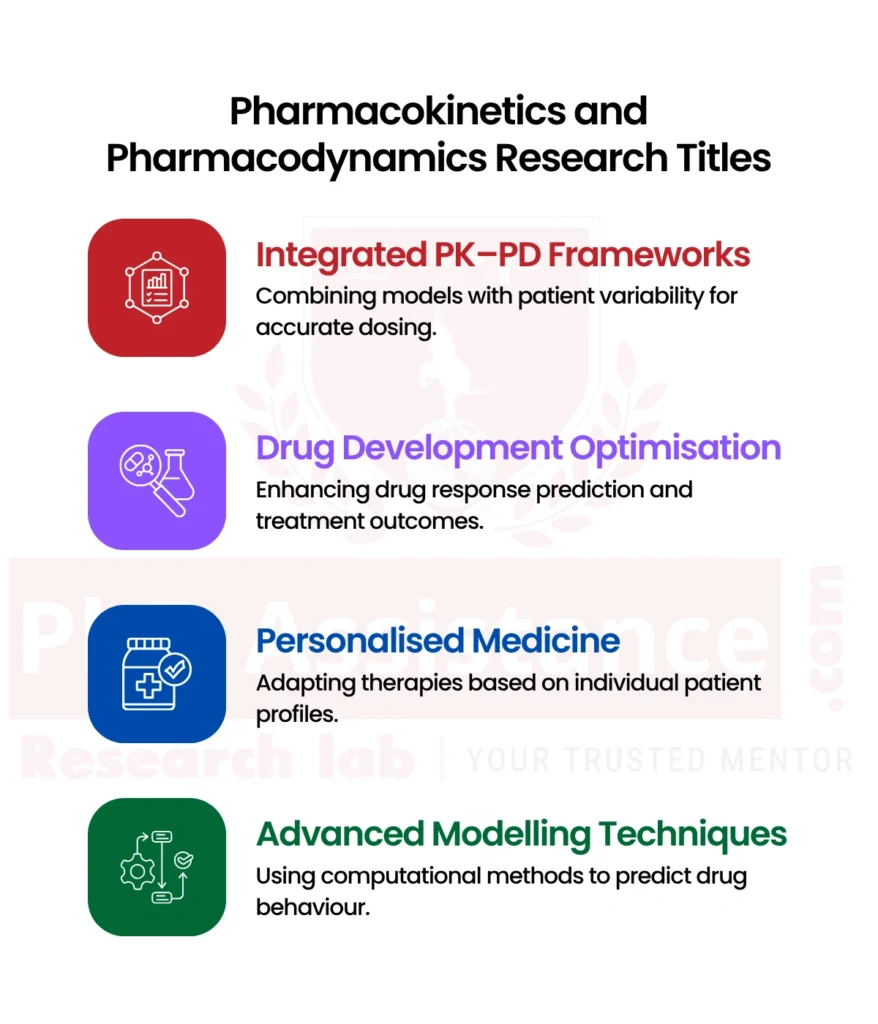
Proposed PhD Title 2. Pharmacokinetics and Pharmacodynamics Modeling for Optimising Drug Development and Therapeutic Outcomes
Pharmacokinetics and pharmacodynamics serve as essential components for contemporary drug development because they create the foundation for understanding how drug concentrations affect therapeutic responses. M. Danhof et al. (2007) in Annual Review of Pharmacology and Toxicology highlight that mechanism-based PK–PD models are essential for understanding drug action but remain limited in real-world application. The current pk pd analysis in drug development uses simplified datasets according to Marguerite L. Monogue et al. (2026) in Open Forum Infectious Diseases which results in diminished accuracy for predictions. The medical field uses pharmacokinetic and pharmacodynamic models for research purposes yet researchers encounter difficulties when they attempt to apply pharmacodynamics in the medical setting.
Problem Statement:
Current drug development processes depend on basic PK–PD models which do not account for actual patient variability and specific patient characteristics. The pk pd analysis accuracy suffers from this limitation because it decreases the understanding of how drug concentrations relate to their effects. The incorrect pharmacodynamic modelling of dose-response relationships prevents effective dosing development and raises the chances of negative outcomes.
Research Gap:
There is insufficient application of pharmacokinetic parameter evaluation in real-world and clinical settings during drug development.
Research Question:
How can PK–PD modelling enhance the dose response relationship, pharmacodynamics, and improve drug development processes?
Outcome:
The research will improve modelling approaches and strengthen PK-PD analysis in drug development, leading to safer and more effective therapeutic strategies.
Reference:
Monogue, M. L., Sanders, J. M., Mercuro, N. J., Hodge, C. K., Golnabi, E., Carettini, T., Yen, C. F., & Cutrell, J. B. (2026). Antimicrobial pharmacokinetic and pharmacodynamic considerations in special populations: A call to action. Open Forum Infectious Diseases. https://doi.org/10.1093/ofid/ofag093
Proposed PhD Title 3. Evaluating Pharmacokinetics Parameters and Pharmacodynamics for Personalised Medicine Approaches
The development of personalized medicine relies on pharmacokinetics testing which assesses individual patient characteristics. N. H. G. Holford and Lewis B. Sheiner established in their 1981 Clinical Pharmacokinetics study that pharmacodynamic dose response variability serves as the primary element for designing personalized treatments. The study published by Marguerite L. Monogue and her co-authors in Open Forum Infectious Diseases demonstrates that researchers have not yet thoroughly investigated patient-specific PK-PD variability. The drug development process uses PK-PD to assess pk pd analysis yet the system currently lacks proper connection to personalized healthcare information.
Problem Statement:
The absence of personalized methods in pharmacokinetics and pharmacodynamics research Drains the capacity to create customized treatment solutions. The current models do not successfully combine pharmacokinetic parameters with their assessment process to predict individual drug concentration and drug response relationships which leads to erratic clinical results.
Research Gap:
There is limited integration of pharmacokinetics parameters and evaluation with individual pharmacodynamic responses in personalised medicine frameworks.
Research Question:
How can PK–PD modelling improve personalised treatment strategies and dose-response relationship pharmacodynamics?
Outcome:
The study will develop a personalised PK–PD framework that enhances treatment precision, improves patient outcomes, and advances clinical pharmacology research.
Reference:
Monogue, M. L., Sanders, J. M., Mercuro, N. J., Hodge, C. K., Golnabi, E., Carettini, T., Yen, C. F., & Cutrell, J. B. (2026). Antimicrobial pharmacokinetic and pharmacodynamic considerations in special populations: A call to action. Open Forum Infectious Diseases. https://doi.org/10.1093/ofid/ofag093
Proposed PhD Title 4. Investigating Drug Concentration and Response Relationship Using Advanced PK–PD Modeling Techniques
The relationship between drug concentration and response determines both drug efficacy and safety, which are essential elements in pharmacological studies. Hartmut Derendorf and Bernd Meibohm (1999) in Pharmaceutical Research highlight the importance of PK–PD modelling in predicting therapeutic outcomes. The research conducted by Marguerite L. Monogue and her colleagues in 2026 Open Forum Infectious Diseases demonstrates that treatment outcomes depend on how pharmacokinetic parameters and evaluation methods differ. Drug development currently lacks complete implementation of advanced PK-PD techniques through its existing PK-PD analysis methods.
Problem Statement:
Existing PK–PD models lack the necessary capabilities to accurately model complex biological systems which exhibit patient-specific differences. The study results in an incomplete understanding of how drug concentration affects response because pk pd analysis does not fully work in drug development.
Research Gap:
There is limited use of advanced computational and modelling approaches in pharmacokinetics evaluation.
Research Question:
How can advanced PK–PD modelling techniques improve the prediction of drug response and optimise therapeutic outcomes?
Outcome:
The research will develop enhanced modelling techniques that improve understanding of dose response relationship pharmacodynamics, and support better clinical decision-making.
Reference:
Monogue, M. L., Sanders, J. M., Mercuro, N. J., Hodge, C. K., Golnabi, E., Carettini, T., Yen, C. F., & Cutrell, J. B. (2026). Antimicrobial pharmacokinetic and pharmacodynamic considerations in special populations: A call to action. Open Forum Infectious Diseases. https://doi.org/10.1093/ofid/ofag093
Proposed PhD Title 5. Enhancing PK–PD Analysis in Drug Development Through Data-Driven Pharmacokinetics and Pharmacodynamics Models
The study of pharmacokinetics, together with pharmacodynamics, is an essential element of drug development. The authors D. R. Mould and R. N. Upton 2013 present their findings in CPT: Pharmacometrics & Systems Pharmacology, which shows that the use of model-based methods represents the fundamental requirement for bettering pk pd analysis during drug development. The study conducted by Marguerite L. Monogue and her coauthors in 2026 in Open Forum Infectious Diseases demonstrates the requirement for better data integration methods together with advanced modelling solutions. The integration of pharmacokinetic and pharmacodynamic modelling together with data-driven methods enables better evaluation of pharmacokinetics, together with drug response assessment.
Problem Statement:
The absence of data-driven methods combined with PK–PD modelling approaches leads to reduced accuracy and reliability of pk pd analysis used in drug development. The gap prevents researchers from comprehending the complete relationship between dose response and pharmacodynamics which decreases the success rate of drug development methods.
Research Gap:
There is limited use of advanced computational and modelling approaches in pharmacokinetics evaluation.
Research Question:
How can advanced PK–PD modelling techniques improve the prediction of drug response and optimise therapeutic outcomes?
Outcome:
The research will develop enhanced modelling techniques that improve understanding of dose response relationship, pharmacodynamics and support better clinical decision-making.
Reference:
Monogue, M. L., Sanders, J. M., Mercuro, N. J., Hodge, C. K., Golnabi, E., Carettini, T., Yen, C. F., & Cutrell, J. B. (2026). Antimicrobial pharmacokinetic and pharmacodynamic considerations in special populations: A call to action. Open Forum Infectious Diseases. https://doi.org/10.1093/ofid/ofag093
Need assistance finalising your dissertation topic? Selecting a strong, researchable topic can be challenging — but you don’t have to do it alone.
Our research consultants can help refine your ideas, identify literature gaps, and guide you toward a topic that aligns with current academic trends and your programme requirements.
Contact us to begin one-on-one topic development and refinement with PhdAssistance.com Research Lab.
Share this:
Cite this work
PhDAssistance. (n.d.). Virtual Influencers Dissertation Titles Retrieved 30th January 2026, from https://www.phdassistance.com/title/virtual-influencers/
“Virtual Influencers Dissertation Titles, https://www.phdassistance.com/title/virtual-influencers/
“Virtual Influencers Dissertation Titles” PhDAssistance, PhDAssistance, Tuesday, January 30th,2026.
PhDAssistance, n.d. Virtual Influencers Dissertation Titles[Online]. Available at: https://www.phdassistance.com/title/virtual-influencers/ [Accessed January 30th, 2026].
PhDAssistance. Virtual Influencers Dissertation Titles[Internet]. PhDAssistance; [cited 2026 January 30th]. Available from: https://www.phdassistance.com/title/virtual-influencers/
PhDAssistance (n.d.).
Virtual Influencers Dissertation Titles. Retrieved January 30th, 2026, from https://www.phdassistance.com/title/virtual-influencers/
PhDAssistance, Virtual Influencers Dissertation Titles(PhDAssistance, n.d. January 30th accessed 2026.
Study Resources
Free resources to assist you with your university studies!