
- / Title
Information Technology Law Titles | phdassistance.com
Info: 1557 words(1 pages) Information Technology Law Titles
Published: 25th march 2026 in Information Technology Law Titles
Share this:
Related Services
Introduction
Information technology and healthcare systems have experienced rapid development through data-driven technologies, which created complex systems that require data governance measures, privacy protection and regulatory compliance standards. Effective governance exists as the key element that enables systems to maintain control over their data management and user interaction processes, according to Pan et al. (2025). The Digital Personal Data Protection (DPDP) Act 2023 establishes a new legal framework because there exists an urgent requirement for enhanced data protection measures and accountability standards, which particularly affect the healthcare sector. The developments proceed to parallel the research area of Information Technology Law and Policy research, which studies how legal systems interact with technological systems and data management systems. Existing research studies three different aspects of regulation and technology and operations separately, which creates disjointed research methods that demonstrate the necessity for unified governance frameworks that improve operational efficiency, build trust and sustain environmental balance.
Proposed PhD Title 1: Developing an Information Technology Law Framework for Healthcare Data Governance under the Digital Personal Data Protection Act: Integrating Consent, Security, and Regulatory Compliance
The fast adoption of digital technologies in healthcare systems has changed how patient data gets collected, stored and used throughout the development of digital health systems. The Digital Personal Data Protection DPDP Act 2023 Introduction establishes new regulations that will enhance patient rights, safeguard data security, and increase institutional responsibility. Chail et al. 2026 show that the Act establishes important new systems, which include consent management and data fiduciary duties and data protection officers to establish new rules for governing healthcare data. These data also contribute to emerging Information Technology Law Dissertation Topics.The study reveals that healthcare institutions encounter difficulties when trying to implement specific provisions because their IT systems are disorganised, their compliance systems do not work together, and their legal obligations do not match their medical procedures.
Problem Statement:
The DPDP Act requires healthcare institutions to follow complex data protection regulations, which mandate consent management and data security and accountability requirements. The existing systems function through disconnected systems, which lack proper links between their legal obligations and their clinical operations. This situation creates operational problems, which result in compliance failures and higher chances of data security breaches. Healthcare data governance suffers from regulatory framework mismatches, which lead to operational practice disturbances.
Research Gap:
Existing research examines legal, technological, and operational aspects of data governance separately, with limited integration across these domains. The healthcare industry currently lacks complete frameworks that link consent requirements with security protocols and institutional operations. The need for an integrated governance model exists because it needs to connect three components, which include policy, technology and operational procedures.
Research Question:
How can a comprehensive governance framework be developed to integrate consent management, data security, and institutional compliance in healthcare under the DPDP Act?
Outcome:
The study will create a unified data governance framework for healthcare, which will help organisations follow regulations better while they protect sensitive information and run their operations more efficiently, and develop new knowledge about digital health governance.
Reference:
Chail, A., Kumar, S., & Lahel, R. S. (2026). The Digital Personal Data Protection Act and rules: Implications for health care and strengths, weaknesses, opportunities, and challenges analysis. Journal of Marine Medical Society. https://doi.org/10.4103/jmms.jmms_176_25
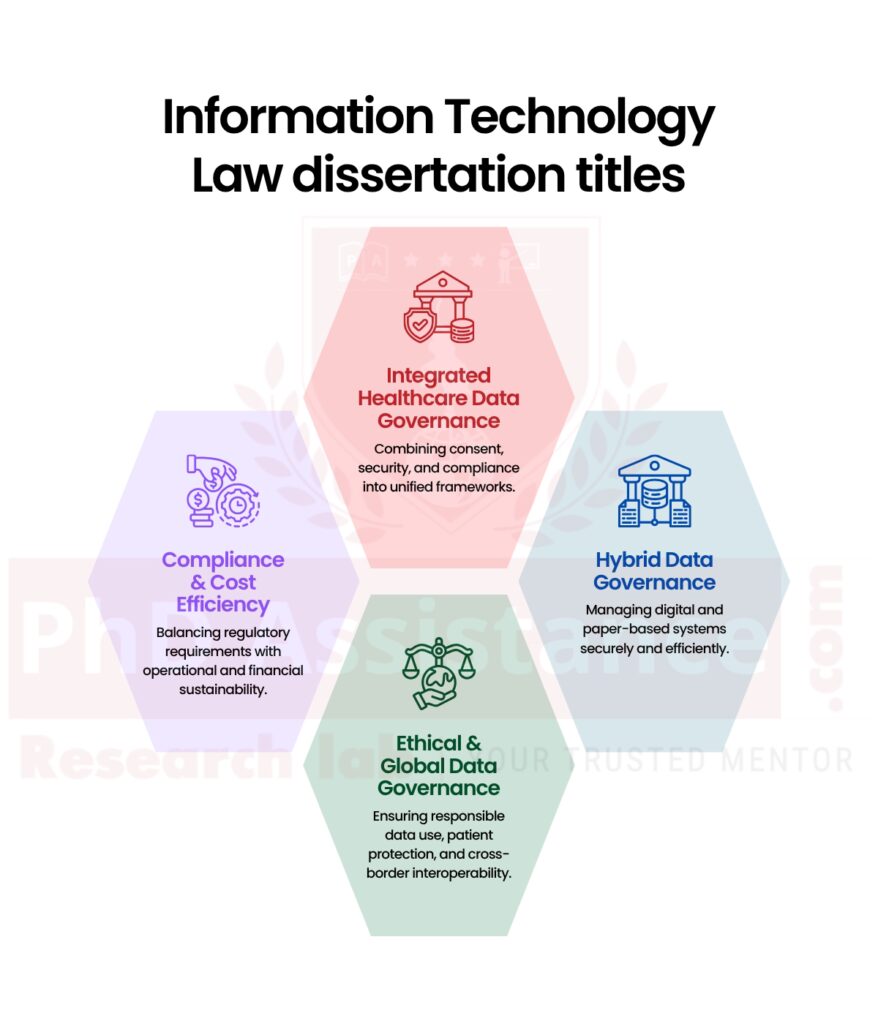
Proposed PhD Title 2. Assessing the Legal and Economic Impact of Data Protection Regulations in Healthcare: An Information Technology Law Perspective on DPDP Act Implementation
Data protection regulations, which include the DPDP Act, lead to major structural and financial transformations that affect healthcare systems. Chail et al. (2026) identify that compliance requirements—including infrastructure upgrades, staff training, data audits, and consent management systems—result in increased capital and operational expenditures for healthcare institutions. Healthcare organisations need to spend money on security measures that protect data and build patient trust, but these expenses create financial difficulties that healthcare organisations pass on to their patients through higher costs. Smaller healthcare providers, which have restricted funding, face greater difficulties when attempting to meet these regulatory requirements. The Cybersecurity Law Research Topics face increasing challenges, which include studying the expenses that arise from compliance requirements and data protection mandates in healthcare systems.
Problem Statement:
Healthcare facilities must use their financial resources for IT systems, compliance systems, and employee training programs according to the requirements of the DPDP Act, which mandates extensive financial and operational obligations. The operational efficiency of small healthcare providers suffers because their expenditures result in both diminished output and increased medical expenses. Health care organisations and their patients experience difficulties because organisations lack documented methods to achieve regulatory compliance while keeping their operational expenses at a minimum.
Research gap:
Current research provides limited insight into the economic and operational impact of data protection regulations in healthcare. The existing research studies fail to examine how cost efficiency trade-offs affect public access to healthcare services. This gap requires research that assesses compliance expenses while developing methods for sustainable operational execution.
Research Question:
What are the economic and operational impacts of DPDP Act compliance on healthcare institutions, and how can these impacts be optimised?
Outcome:
The research study will evaluate all expenses that result from compliance requirements related to data protection and present methods that organisations can use to operate their business while staying within legal requirements and keeping control of their expenses.
Reference:
Chail, A., Kumar, S., & Lahel, R. S. (2026). The Digital Personal Data Protection Act and rules: Implications for health care and strengths, weaknesses, opportunities, and challenges analysis. Journal of Marine Medical Society. https://doi.org/10.4103/jmms.jmms_176_25
Proposed PhD Title 3. Designing a Legal Framework for Hybrid Healthcare Data Governance: Integrating Digital and Paper-Based Systems under Information Technology Law
Many healthcare systems worldwide use both digital systems and paper records, which creates complicated problems for managing data and safeguarding information. The DPDP Act primarily focuses on digital personal data, which results in major deficiencies because it fails to regulate and protect paper-based and hybrid data systems. Chail et al. (2026) highlight that this limitation creates vulnerabilities in healthcare institutions, particularly in smaller hospitals and clinics that rely heavily on non-digital records. The healthcare system faces operational challenges because healthcare providers cannot share information between their digital and physical data systems. Researchers currently studying healthcare data governance investigate only digital systems, which do not represent actual data operations in organisations using hybrid data systems.
Problem Statement:
The healthcare systems of today use hybrid environments, which combine digital systems with paper-based record keeping. The DPDP Act governs digital information, but its regulations do not cover paper-based records. The system creates three problems, which result in security risks because of limited data protection and hybrid system incompatibility.
Research Gap:
Researchers study only complete digital systems, while they neglect to examine systems that use both digital and paper records. There is a lack of frameworks that integrate digital and paper-based data while ensuring compliance and security. The existing system needs new solutions that will enable organisations to handle their hybrid data systems between digital and physical data.
Research Question:
How can healthcare systems design secure and scalable frameworks to integrate digital and paper-based data while ensuring compliance with data protection regulations?
Outcome:
The research will develop a hybrid data governance framework that protects data and enables system compatibility while providing healthcare organisations with tools to implement their digital transformation projects.
Reference:
Chail, A., Kumar, S., & Lahel, R. S. (2026). The Digital Personal Data Protection Act and rules: Implications for health care and strengths, weaknesses, opportunities, and challenges analysis. Journal of Marine Medical Society. https://doi.org/10.4103/jmms.jmms_176_25
Proposed PhD Title 4. Strengthening Ethical and Legal Dimensions of Healthcare Data Usage: An Information Technology Law Approach to Consent, Vulnerable Populations, and Research Governance
The DPDP Act establishes a data governance framework that requires user consent because it values both user control and data security and system integrity. Chail et al. (2026) established multiple ethical and legal uncertainties that affect their research about vulnerable groups and the process of obtaining consent from past events, and the utilisation of medical data in studies. The Act remains ambiguous about various matters, which include determining consent capacity for people who have cognitive disabilities, securing private medical information and handling old medical records in scientific studies. These gaps raise concerns about ethical compliance, patient rights, and the ability of healthcare systems to support data-driven research and innovation. The IT Policy Analysis Research investigates these problems through its study of how digital health systems work with policy frameworks and ethical values and their real-world applications. Existing literature has not sufficiently addressed the intersection of ethical governance, legal frameworks, and practical healthcare data usage.
Problem Statement:
The DPDP Act establishes a consent-based framework for healthcare data management, but it fails to explain essential ethical principles that govern research involving vulnerable individuals and retrospective consent and research data access. The existing uncertainties create obstacles that prevent patients from exercising their rights and researchers from accessing healthcare data needed for their work.
Research gap:
Existing research examines Digital Privacy Law Research, but it fails to provide a complete understanding of the ethical, legal, and practical aspects that govern healthcare data management. There is limited focus on consent frameworks for vulnerable groups and research data usage. The existing gap demonstrates that organisations require an all-encompassing ethical governance framework.
Research Question:
How can ethical and legal frameworks be enhanced to ensure responsible healthcare data usage while supporting research and innovation?
Outcome:
The research project will establish an ethical governance framework that protects patient rights and improves consent processes while enabling researchers to access healthcare data.
Reference:
Chail, A., Kumar, S., & Lahel, R. S. (2026). The Digital Personal Data Protection Act and rules: Implications for health care and strengths, weaknesses, opportunities, and challenges analysis. Journal of Marine Medical Society. https://doi.org/10.4103/jmms.jmms_176_25
Proposed PhD Title 5. Enhancing Interoperability and Cross-Border Data Governance in Healthcare: An Information Technology Law Analysis of DPDP Act and Global Data Protection Frameworks
Healthcare systems need to share patient data because they need to treat patients who come from different countries at multiple medical facilities across the world. The DPDP Act aims to improve data protection and interoperability within India’s healthcare system, while aligning with global standards such as the General Data Protection Regulation (GDPR). Chail et al. (2026) report three primary issues, which include problems with system interoperability, challenges associated with meeting regulatory standards and difficulties in coordinating between healthcare providers and insurance systems and international partners. The implementation of strict data protection regulations prevents organisations from sharing data, which leads to detrimental effects on healthcare research, telemedicine advancement and international scientific research collaborations. The main research problems of the study focus on two specific aspects of Legal Issues in Information Technology Research, which examine how legal systems affect international data transfers and the progress of digital health technologies.
Problem Statement:
Healthcare systems need interoperable capacity, which enables hospitals to exchange information and medical facilities to work together across borders. The DPDP Act implementation process faces obstacles because the existing regulations remain unclear, while the technical systems have limitations, and data sharing restrictions exist. The existing problems prevent the creation of new solutions, while they stop international partnerships and hinder effective health service distribution.
Research gap:
Researchers have dedicated their efforts to studying technical interoperability components, but they need to consider regulatory requirements. Researchers still need to study how national legislation, such as the DPDP Act, relates to international frameworks like the GDPR. The existing gap requires researchers to investigate ways to create healthcare data systems that achieve both interoperability and compliance with regulations.
Research Question:
How can healthcare data systems achieve interoperability and global alignment while ensuring compliance with the DPDP Act and international data protection frameworks?
Outcome:
The research project will develop an interoperability framework that enables secure data exchange through its current functions while developing international partnerships and progressing digital health system development.
Reference:
Chail, A., Kumar, S., & Lahel, R. S. (2026). The Digital Personal Data Protection Act and rules: Implications for health care and strengths, weaknesses, opportunities, and challenges analysis. Journal of Marine Medical Society. https://doi.org/10.4103/jmms.jmms_176_25
Need assistance finalising your dissertation topic? Selecting a strong, researchable topic can be challenging — but you don’t have to do it alone.
Our research consultants can help refine your ideas, identify literature gaps, and guide you toward a topic that aligns with current academic trends and your programme requirements.
Contact us to begin one-on-one topic development and refinement with PhdAssistance.com Research Lab.
Share this:
Cite this work
PhDAssistance. (n.d.). Virtual Influencers Dissertation Titles Retrieved 30th January 2026, from https://www.phdassistance.com/title/virtual-influencers/
“Virtual Influencers Dissertation Titles, https://www.phdassistance.com/title/virtual-influencers/
“Virtual Influencers Dissertation Titles” PhDAssistance, PhDAssistance, Tuesday, January 30th,2026.
PhDAssistance, n.d. Virtual Influencers Dissertation Titles[Online]. Available at: https://www.phdassistance.com/title/virtual-influencers/ [Accessed January 30th, 2026].
PhDAssistance. Virtual Influencers Dissertation Titles[Internet]. PhDAssistance; [cited 2026 January 30th]. Available from: https://www.phdassistance.com/title/virtual-influencers/
PhDAssistance (n.d.).
Virtual Influencers Dissertation Titles. Retrieved January 30th, 2026, from https://www.phdassistance.com/title/virtual-influencers/
PhDAssistance, Virtual Influencers Dissertation Titles(PhDAssistance, n.d. January 30th accessed 2026.
Study Resources
Free resources to assist you with your university studies!