
Related Services
Our academic writing and marking services can help you
Introduction
Scientists have developed CRISPR-based gene editing methods which enable them to make precise modifications to human microbiome systems that regulate metabolic processes, immune system functions and disease progression. Scientists can use the method to conduct precise alterations of microbial populations, which enables the development of new treatment techniques that fight antibiotic resistance and cancer through engineered probiotics and antimicrobial peptide production. Microbiome instability and horizontal gene transfer, together with undefined ethical and regulatory standards, make it difficult to implement these technologies, which leads to restricted clinical use. Scientists must create integrated methods that combine ecological assessment with systems biology and governance systems to develop safe and effective CRISPR gene editing microbiome therapeutic applications.
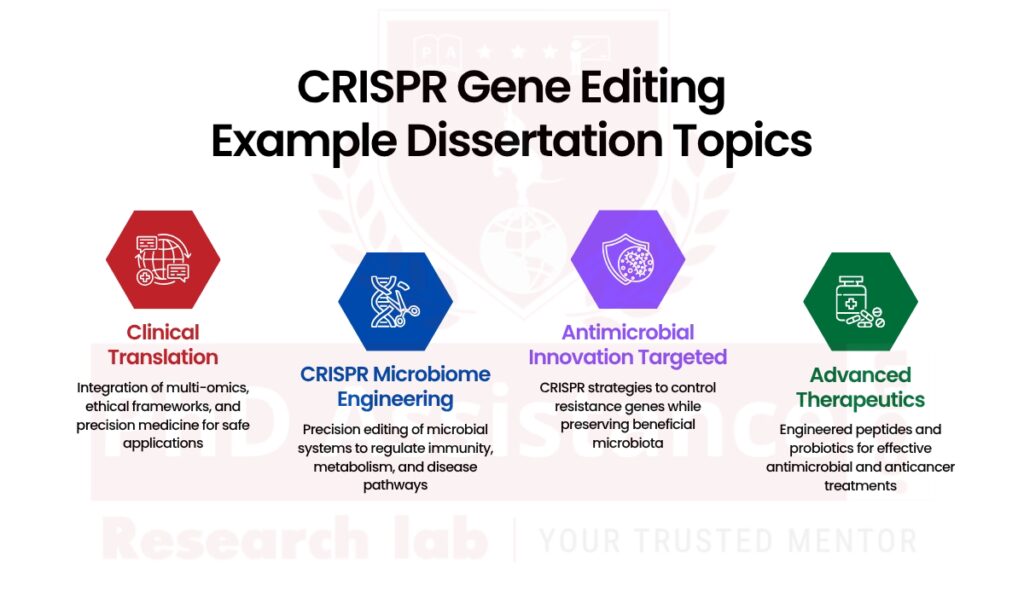
CRISPR Gene Editing Dissertation Topics I phdassistance.com
Proposed PhD Topic 1: Precision Phage- and Nanoparticle-Based CRISPR Delivery Systems for Selective Editing of Antimicrobial Resistance Genes in Complex Microbiome Environments
Background Context:
The current antimicrobial resistance crisis needs the development of targeted CRISPR for disease treatment. The review by Amen et al. (2025) published in Probiotics and Antimicrobial Proteins shows that CRISPR-based gene editing can accurately target resistance genes, although its use in medicine is restricted because of ineffective delivery methods. The current delivery methods treat all microorganisms the same way, which leads to harmful pathogens receiving equivalent treatment as helpful microbiota.
PhD-Level Verification:
No existing doctoral research has developed an integrated regulatory model that explains the process through which environmental hypoxia gets detected and its resulting rRNA modification patterns.
Research Questions:
PhD-Level Contributions:
Suggested Readings:
Amen, R. A., Hassan, Y. M., Essmat, R. A., Ahmed, R. H., Azab, M. M., Shehata, N. R., Elgazzar, M. M., & El-Sayed, W. M. (2025). Harnessing the microbiome: CRISPR-based gene editing and antimicrobial peptides in combating antibiotic resistance and cancer. Probiotics and Antimicrobial Proteins, 17, 1938–1968. https://doi.org/10.1007/s12602-025-10573-8
Proposed PhD Topic 2: CRISPR-Guided Engineering of Microbial Hosts for Enhanced Antimicrobial Peptides with Improved Stability, Bioavailability, and Broad-Spectrum Activity
Background Context:
According to Amen et al. (2025) in Probiotics and Antimicrobial Proteins, antimicrobial peptides (AMPs) demonstrate a strong ability to fight infections and cancer, which makes them potential replacements for traditional antibiotic treatments. The clinical use of these substances is restricted because they face multiple challenges, which include their poor structural stability, their low bioavailability in human body conditions and their diminished effectiveness against resistant bacteria. The existing obstacles prevent the successful development of these products for medical applications. The use of CRISPR-based Gene editing technology provides scientists with an efficient method to develop microbial systems that produce antimicrobial peptides at higher levels and achieve superior structural and functional characteristics for medical use.
PhD-Level Verification:
Currently available academic research does not exist that combines CRISPR-based microbial engineering with advanced AMP optimisation techniques to achieve stable delivery systems that enhance therapeutic performance.
Research Questions:
How can CRISPR be used for improving microbial production of antimicrobial peptides?
Which CRISPR in genetic disease treatment lead to better antimicrobial peptide stability and protection against enzymatic breakdown?
Can engineered antimicrobial peptides enhance treatment effectiveness against multidrug-resistant pathogens?
PhD-Level Contributions:
Suggested Readings:
Amen, R. A., Hassan, Y. M., Essmat, R. A., Ahmed, R. H., Azab, M. M., Shehata, N. R., Elgazzar, M. M., & El-Sayed, W. M. (2025). Harnessing the microbiome: CRISPR-based gene editing and antimicrobial peptides in combating antibiotic resistance and cancer. Probiotics and Antimicrobial Proteins, 17, 1938–1968. https://doi.org/10.1007/s12602-025-10573-8
Proposed Dissertation topic 3: CRISPR-Engineered Probiotic Platforms for Targeted Delivery of Anticancer Peptides within Tumour Microenvironments
Background Context:
The study by Amen et al. (2025) in Probiotics and Antimicrobial Proteins shows that engineered probiotics now serve as advanced delivery systems which can effectively transport therapeutic molecules. The systems provide targeted delivery which decreases their harmful effects on the entire body. The system requires three main components to function properly which include controlled gene expression and tumor-specific activation and safe effective host immune system interactions. The microbiome-based cancer therapies need these challenges to be solved before they can make progress.
PhD Level Verification:
No existing doctoral-level framework comprehensively integrates CRISPR-based probiotic engineering with tumour-targeted delivery mechanisms and immune system modulation strategies.
Research Questions:
PhD-Level Contributions:
Suggested Readings:
Amen, R. A., Hassan, Y. M., Essmat, R. A., Ahmed, R. H., Azab, M. M., Shehata, N. R., Elgazzar, M. M., & El-Sayed, W. M. (2025). Harnessing the microbiome: CRISPR-based gene editing and antimicrobial peptides in combating antibiotic resistance and cancer. Probiotics and Antimicrobial Proteins, 17, 1938–1968. https://doi.org/10.1007/s12602-025-10573-8
Proposed Dissertation Topic 4: Integrative Multi-Omics and CRISPR Functional Genomics Framework for Understanding Microbiome-Driven Mechanisms in Disease Progression
Background Context:
The authors of Amen et al. (2025) demonstrated advanced sequencing technologies together with metagenomics, metatranscriptomics and metabolomics to provide complete details about microbiome composition and activity in their study published in Probiotics and Antimicrobial Proteins. The methods fail to demonstrate how microbial functions lead to particular disease results. The CRISPR gene system functions as a highly effective instrument for testing the purposes of bacterial genes and their associated genetic pathways. The scientific field lacks sufficient research on how to combine multi-omics datasets with CRISPR experimental work for functional analysis research.
PhD-Level Verification:
No doctoral research has fully developed an integrated framework that combines multi-omics approaches with CRISPR-based validation to investigate microbiome-driven mechanisms in disease progression.
Research Questions:
Contributions at the PhD-Level:
Suggested Readings:
Amen, R. A., Hassan, Y. M., Essmat, R. A., Ahmed, R. H., Azab, M. M., Shehata, N. R., Elgazzar, M. M., & El-Sayed, W. M. (2025). Harnessing the microbiome: CRISPR-based gene editing and antimicrobial peptides in combating antibiotic resistance and cancer. Probiotics and Antimicrobial Proteins, 17, 1938–1968. https://doi.org/10.1007/s12602-025-10573-8
Proposed Dissertation Topic 5: Ethical, Regulatory, and Ecological Frameworks for the Clinical Translation of CRISPR-Based Microbiome Engineering and Therapeutics
Background Context:
The review by Amen et al. (2025) in Probiotics and Antimicrobial Proteins shows that CRISPR-based microbiome therapies face major ethical, regulatory and ecological challenges because of the fast technological progress. The problems include two main areas that concern scientists about microbiome stability over time and ecological impacts, and which lack complete regulatory systems needed to manage these advanced technologies. The safe and responsible use of microbiome-based treatments in clinical settings depends on resolving these matters.
PhD-Level Verification:
Amen et al. (2025) discovered essential deficiencies that stop scientists from transferring microbiome treatments to actual Applications of CRISPR in medicine. The existing research systems for doctoral students have not established a comprehensive system to study ethical matters together with regulatory requirements and ecological impacts.
Research Questions:
PhD-Level Contributions:
Suggested Readings:
Amen, R. A., Hassan, Y. M., Essmat, R. A., Ahmed, R. H., Azab, M. M., Shehata, N. R., Elgazzar, M. M., & El-Sayed, W. M. (2025). Harnessing the microbiome: CRISPR-based gene editing and antimicrobial peptides in combating antibiotic resistance and cancer. Probiotics and Antimicrobial Proteins, 17, 1938–1968. https://doi.org/10.1007/s12602-025-10573-8
Need assistance finalising your dissertation topic? Selecting a strong, researchable topic can be challenging — but you don’t have to do it alone.
Our research consultants can help refine your ideas, identify literature gaps, and guide you toward a topic that aligns with current academic trends and your programme requirements.
Contact us to begin one-on-one topic development and refinement with PhdAssistance.com Research Lab.
Share this:
Cite this work
PhDAssistance. (n.d.). Cybersecurity in business Dissertation Topics Retrieved January 28th, from https://www.phdassistance.com/topic/cybersecurity-business/
Jalolova, M., and Musawwir, M. “Cybersecurity in business Dissertation Topics for PhD Scholars.” PhDAssistance, https://www.phdassistance.com/topic/cybersecurity-business/ Accessed 28th January 2026.
Jalolova, M., and Musawwir, M., n.d. Cybersecurity in business Dissertation Topics for PhD scholars. [online] Available at: https://www.phdassistance.com/topic/cybersecurity-business/ [Accessed 28th January 2026].
Jalolova M., Musawwir M. Cybersecurity in business Dissertation Topics for PhD scholars [Internet]. PhDAssistance; [cited 2026 28th January]. Available from: https://www.phdassistance.com/topic/cybersecurity-business/
Jalolova, M., and Musawwir, M. (n.d.). Cybersecurity in business Dissertation Topics for PhD scholars. Retrieved 28th January 2026, from https://www.phdassistance.com/topic/cybersecurity-business/
Jalolova, M., and Musawwir, M., Cybersecurity in business Dissertation Topics (n.d.) https://www.phdassistance.com/topic/cybersecurity-business/ accessed 28th January 2026.
Study Resources
Free resources to assist you with your university studies!