
- / Title
Digital Platform Governance Titles | phdassistance.com
Info: 1557 words(1 pages) Digital Platform Governance Titles
Published: 25th march 2026 in Digital Platform Governance Titles
Share this:
Related Services
Introduction
Digital platforms have experienced rapid growth, which has created new economic systems and technological systems that develop complex environments that include users, platform providers and regulators. Digital platform governance has emerged as a critical research area because it studies how platforms control their user interactions, their data management and their responsibility to others, as stated by Pan et al. 2025 in the Journal of Global Information Management. The increasing adoption of artificial intelligence and data-driven technologies and algorithmic systems has resulted in new obstacles that impact transparency, privacy and compliance with regulations. Existing studies about digital platform governance research, regulation and user behaviour and ecosystem dynamics as separate topics, which creates a requirement for governance systems that establish trust, operational efficiency and sustainable platform operations.
Proposed PhD Title 1: Developing an Integrated Framework for Digital Platform Governance: Linking Regulation, User Behaviour, and Ecosystem Dynamics
The quick development of digital platforms has created new ways for people and businesses worldwide to interact, which has resulted in the development of complicated systems that include users, regulators and service providers. Frost et al. (2023) in Economic Policy state that digital platforms today face increasing control from regulatory systems and technological progress, which determines how users engage with the platforms and how markets function. Gawer (2021) in the Journal of Organisation Design shows that platform ecosystems function through various governance systems that control their operations while maintaining their ability to share resources. The existing research on digital platform governance has reached a point of development because the studies now available investigate regulation and user behaviour, and ecosystem dynamics as three separate elements, which prevent researchers from developing comprehensive governance models.
Problem Statement:
Digital platforms experience mounting difficulties as they attempt to establish connections between their regulatory obligations, the needs of their users and the performance of their operational systems. Digital platforms lack effective governance systems, which leads to disjointed governance practices, decreasing trust levels and poor operational efficiency on their platforms. Organisations need structured methods, which governance framework consulting services provide to develop governance systems that can maintain their operations over time and grow with their needs.
Research Gap:
The existing research needs a comprehensive framework that connects regulatory mechanisms with user behaviour and ecosystem dynamics across digital platforms.
Research Question:
How can an integrated governance framework be developed to align regulatory structures, user behaviour, and ecosystem dynamics in digital platforms?
Outcome:
The study will develop a comprehensive governance framework that enhances platform performance while establishing user trust, complying with regulatory standards, and supporting academic research on platform governance and theoretical development.
Reference:
Pan, Q., Luo, W., Liu, Z., & Zhang, J. Z. (2025).Digital platform governance: Literature review and research outlook. Journal of Global Information Management, 33(3), 407–431. https://doi.org/10.1080/10919392.2025.2502325
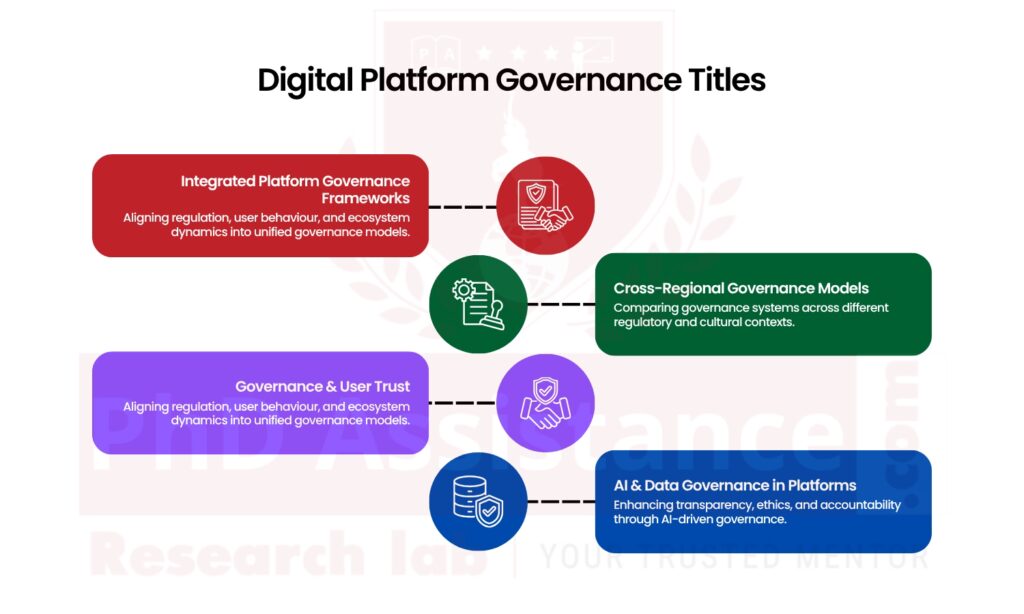
Proposed PhD Title 2. An Empirical Analysis of Digital Platform Governance and Its Impact on User Trust and Platform Performance
Digital platforms depend on governance systems to build user trust and keeptheir operations running smoothly. Bolton et al. (2022) in the Financial Analysts Journal demonstrate how governance practices influence financial performance and risk exposure, particularly in evolving digital environments. The research by Cusumano, Gawer, and Yoffie (2019) in MIT Sloan Management Review shows that platform success requires organisations to establish governance frameworks that regulate all user and stakeholder interactions. The existing research on digital platform governance lacks empirical data because it fails to show how governance methods impact user trust and performance metrics.
Problem Statement:
The current body of academic research fails to provide enough empirical evidence that would show how governance systems impact user confidence and platform efficiency. Digital platform governance consulting services become essential because organisations need data-driven insights to develop successful governance frameworks.
Research gap:
Existing research lacks empirical and quantitative analysis evaluating the impact of governance mechanisms on user trust and operational performance.
Research Question:
What is the impact of digital platform governance mechanisms on user trust and platform performance?
Outcome:
The research will deliver empirical models together with findings that will improve governance methods while increasing user trust and enhancing platform operational capabilities.
Reference:
Pan, Q., Luo, W., Liu, Z., & Zhang, J. Z. (2025).Digital platform governance: Literature review and research outlook. Journal of Global Information Management, 33(3), 407–431. https://doi.org/10.1080/10919392.2025.2502325
Proposed PhD Title 3. Comparative Study of Digital Platform Governance Models Across Regions: A Cross-Contextual Analysis
Digital platforms operate across various cultural and regulatory frameworks, which complicates their governance because each situation requires different governance methods. Kenney and Zysman (2016) in the Journal of Industry, Competition and Trade highlight how platform economies vary significantly across regions due to institutional differences. The researchers de Reuver, Sørensen, and Basole (2018) in their article for the Journal of Information Technology, show how contextual factors determine the development of platform governance strategies. The existing digital platform governance models face limitations because researchers have not studied how different regions implement governance practices within various environments.
Problem Statement:
Digital platforms now operate worldwide at an accelerated rate, which causes different regions to develop unique governance systems because of their specific regulatory frameworks and cultural practices, and technological capabilities. The absence of comparative studies restricts our comprehension of how different governance frameworks can be successfully implemented in various contexts. The international platforms face difficulties in three areas, which include achieving regulatory compliance, building user trust and delivering stable operations throughout different geographic regions.
Research Gap:
Existing studies on digital platform governance are often limited to single contexts and do not provide comprehensive cross-regional comparisons. Research needs to investigate how different governance models operate in various regions and industries and regulatory systems because currently, no studies exist on this topic.
Research Question:
How do digital platform governance models differ across regional and regulatory contexts, and what factors influence their effectiveness?
Outcome:
The study will create a governance framework that compares regional governance differences for developing digital platforms into adaptable governance solutions that protect international operations.
Reference:
Pan, Q., Luo, W., Liu, Z., & Zhang, J. Z. (2025).Digital platform governance: Literature review and research outlook. Journal of Global Information Management, 33(3), 407–431. https://doi.org/10.1080/10919392.2025.2502325
Proposed PhD Title 4. The Role of AI and Data Governance in Shaping Digital Platform Ecosystems: A Multidisciplinary Approach
Researchers who study digital platform ecosystems need to adopt data governance as their primary research focus because artificial intelligence and big data have created a fundamental change in these ecosystems. The authors of the study, Krafft et al. (2021), demonstrate that AI-driven platforms need to implement strong governance systems, which will provide both transparency and accountability according to their publication in Electronic Markets. Gillespie (2018) in Social Media + Society demonstrates that content moderation, together with algorithmic governance, plays a crucial role in preserving the integrity of platforms. The existing research fails to connect AI governance with the more extensive governance frameworks that govern platforms.
Problem Statement:
Digital platforms face increasing challenges because they need to protect data privacy and provide transparent algorithms, and execute their AI systems in an ethical manner across their complex digital environments. The increasing use of AI-powered technologies has created greater worries about bias problems, data protection violations and the absence of responsibility. The absence of a structured governance framework approach creates greater dangers because it reduces an organisation’s ability to comply with regulations and operate its oversight functions, which results in loss of customer confidence and organisational transparency.
Research gap:
The research investigates different aspects of AI governance and data governance in digital platforms, but fails to create a comprehensive framework for digital platform ecosystems. The existing research lacks comprehensive frameworks that demonstrate how governance mechanisms work together to establish transparency and accountability and guide ethical decision-making processes.
Research Question:
How can AI and data governance frameworks be effectively integrated to enhance transparency, accountability, and ethical practices in digital platforms?
Outcome:
The study will create a multidisciplinary governance framework that combines AI and data governance to enhance ethical standards, transparency and operational efficiency while helping digital platforms meet regulatory requirements.
Reference:
Pan, Q., Luo, W., Liu, Z., & Zhang, J. Z. (2025).Digital platform governance: Literature review and research outlook. Journal of Global Information Management, 33(3), 407–431. https://doi.org/10.1080/10919392.2025.2502325
Proposed PhD Title 5. Evaluating the Effectiveness of Governance Mechanisms in Digital Platforms: Evidence from Emerging Technologies and Regulatory Systems
Digital platforms have brought about changes to blockchain technology development and artificial intelligence research, and cloud computing solutions, which now create new governance challenges. Giglio et al. (2021) in Review of Financial Studies demonstrate how technological risks influence financial systems and require advanced governance mechanisms. The author of Platform Ecosystems: Aligning Architecture, Governance, and Strategy, Tiwana (2014), explains that organizations which experience environmental changes need to evaluate their governance structures. Studies about digital platform governance research assistance have expanded since their inception, yet researchers still need to conduct further evaluations about the actual governance systems used in technology-based environments.
Problem Statement:
Researchers still need to investigate how governance mechanisms work in fast-changing technological fields, which include AI, blockchain and cloud-based systems. This situation makes it difficult for organisations to develop successful governance methods while they try to meet their changing regulatory requirements. The growing complexity of digital platforms makes it harder for organisations to establish effective governance methods, which results in increased compliance risks and operational challenges and decreased trust from stakeholders.
Research gap:
The existing academic research has not studied the actual performance of governance systems in technology-based environments. Existing research has not produced complete assessments that measure how governance systems handle risk management, compliance enforcement, and innovation support in new technological spaces.
Research Question:
How effective are existing governance mechanisms in managing risks and ensuring compliance in digital platforms using emerging technologies?
Outcome:
The research will create assessment frameworks that deliver strategic guidance to improve governance systems and enable organisations to drive innovation while meeting regulatory requirements in their digital platform systems.
Reference:
Pan, Q., Luo, W., Liu, Z., & Zhang, J. Z. (2025).Digital platform governance: Literature review and research outlook. Journal of Global Information Management, 33(3), 407–431. https://doi.org/10.1080/10919392.2025.2502325
Need assistance finalising your dissertation topic? Selecting a strong, researchable topic can be challenging — but you don’t have to do it alone.
Our research consultants can help refine your ideas, identify literature gaps, and guide you toward a topic that aligns with current academic trends and your programme requirements.
Contact us to begin one-on-one topic development and refinement with PhdAssistance.com Research Lab.
Share this:
Cite this work
PhDAssistance. (n.d.). Virtual Influencers Dissertation Titles Retrieved 30th January 2026, from https://www.phdassistance.com/title/virtual-influencers/
“Virtual Influencers Dissertation Titles, https://www.phdassistance.com/title/virtual-influencers/
“Virtual Influencers Dissertation Titles” PhDAssistance, PhDAssistance, Tuesday, January 30th,2026.
PhDAssistance, n.d. Virtual Influencers Dissertation Titles[Online]. Available at: https://www.phdassistance.com/title/virtual-influencers/ [Accessed January 30th, 2026].
PhDAssistance. Virtual Influencers Dissertation Titles[Internet]. PhDAssistance; [cited 2026 January 30th]. Available from: https://www.phdassistance.com/title/virtual-influencers/
PhDAssistance (n.d.).
Virtual Influencers Dissertation Titles. Retrieved January 30th, 2026, from https://www.phdassistance.com/title/virtual-influencers/
PhDAssistance, Virtual Influencers Dissertation Titles(PhDAssistance, n.d. January 30th accessed 2026.
Study Resources
Free resources to assist you with your university studies!