Critical review of Unveiling the hidden key: “can help-seeking behaviors bridge the gap between doctoral supervision relationship and research self-efficacy of PhD candidates?”
Introduction
Doctoral education serves as a fundamental pathway that leads to advanced research skill development and academic and professional career training for scholars. The PhD Supervision Relationship between supervisors and PhD candidates control the entire process because it determines both the PhD candidate’s research development and their overall doctoral experience. A strong Supervisor–Student Relationship gives doctoral candidates three types of support, which include intellectual guidance, emotional support and academic mentorship for their complex research activities.
The doctoral development process needs Research Self-Efficacy because this assessment tests doctoral students’ ability to perform independent research. The research findings demonstrate that Student Self-Efficacy enables students to overcome research obstacles while achieving high academic standards and completing their doctoral studies.
The article Unveiling the hidden key: can help-seeking behaviours bridge the gap between doctoral supervision relationship and research self-efficacy of PhD candidates? investigates the role of help-seeking behaviour in doctoral education. Help-Seeking Behaviour describes how students actively seek help from others whenever they face research challenges. The study investigates whether these behaviours act as intermediaries for the relationship between Supervision Relationship and PhD Self-Efficacy.
Summary of the article
The article examines how the Supervision Relationship influences PhD Self-Efficacy, while also investigating the mediating role of Help-Seeking Behaviour among doctoral candidates. The research operates on the premise that effective doctoral supervision requires supervisors to guide while students need to take responsibility for their own support-seeking activities.
The study collected data through an online questionnaire completed by 178 PhD candidates across a variety of scientific disciplines. The questionnaire measured different dimensions of the Supervisor–Student Relationship, including the level of guidance, feedback, and academic interaction between supervisors and doctoral students. The assessment measured help-seeking behaviour through two types of study methods, which included adaptive help-seeking strategies that support learning and maladaptive behaviours that prevent academic success.
Critique
Significance and contribution of the field
A significant contribution was made in the study by connecting the doctoral supervision, PhD research self-efficacy, and help-seeking behaviour of PhD researchers. Some studies have addressed this issue separately, but none have highlighted the interaction of doctoral supervision with PhD self-efficacy, whereas this study provides an integrative perspective of the impacts of these elements on the learning in PhD research.
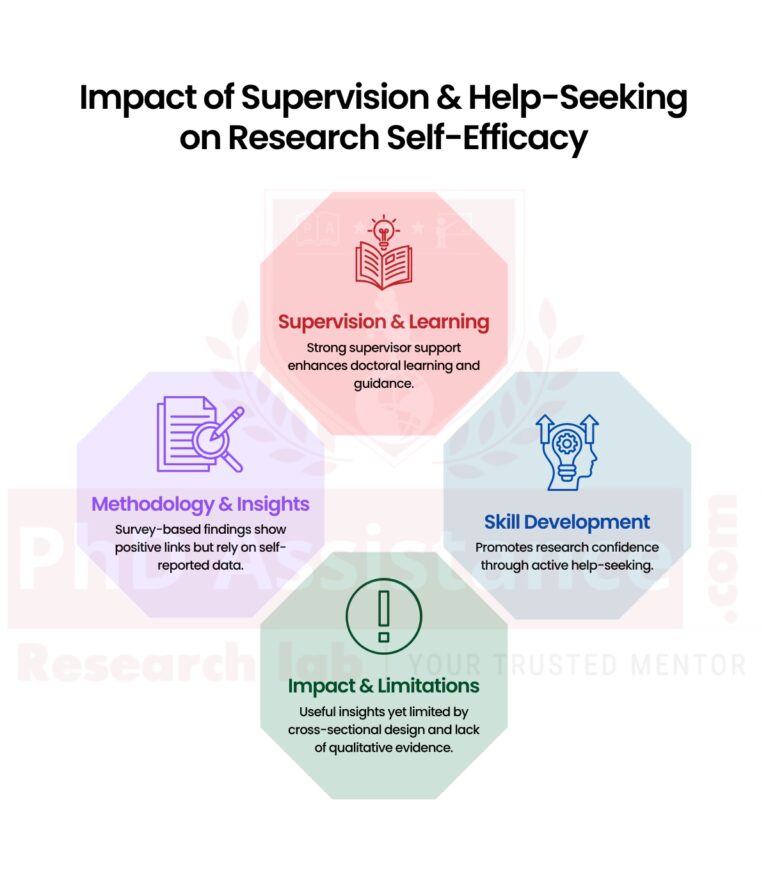
The perspective of academic help-seeking behaviour is crucial as it elicits the efforts taken by the doctoral candidates regarding their research with the supervisor’s support. This study establishes that the successful completion of the doctoral research also depends on the initiatives taken by the candidates upon the efficiency of the supervisors.
The comparison of supervision relationships across different universities and institutions could have added more value to the study. Because the relationship between the supervisor and PhD candidates can vary among nations and institutions, which could impact the PhD self-efficacy among different doctoral students.
Methodology and research design
The study applies a quantitative research design through an online questionnaire, which was given to 178 doctoral candidates. The researcher used this method to test statistical connections between Supervision Relationship and Help-Seeking Behaviour, and PhD Self-Efficacy.
The study uses mediation analysis as its main research method which enables researchers to find out how supervision affects Student Self-Efficacy through indirect paths. The study demonstrates that supervisory support leads to increased doctoral confidence through its evidence, which shows how supervision affects Help-Seeking Behavior and research self-efficacy.
The study demonstrates various strengths, yet it contains several limitations. The research mainly depends on self-reported data from doctoral candidates, which creates bias in assessing both Supervisor–Student interaction quality and Academic help-seeking behaviour frequency. The researchers cannot study PhD Self-Efficacy development over time because the study uses a cross-sectional design.
Argumentation and Use of Evidence
The article presents a well-structured argument that connects the Supervision Relationship to PhD Self-Efficacy while showing how Help-Seeking Behaviour functions as a mediating factor. The author supports these claims with empirical data and references to previous research on doctoral supervision, student learning strategies, and academic self-efficacy.
The evidence demonstrates that supportive supervisory environments encourage doctoral candidates to engage in Academic help-seeking behavior which, in turn, enhances their research confidence and academic competence. The argument supports existing theories that explain self-efficacy and collaborative learning in higher education.
The research requires qualitative data, which can be obtained through interviews with doctoral candidates and their supervisors. The Supervisor-Student Relationship research requires this data because it helps understand how students develop Help-Seeking Behaviour and their progress in Student Self-Efficacy.
Ethical considerations and omissions
The study does not raise significant ethical concerns, as it relies on voluntary participation through anonymous questionnaires completed by doctoral candidates. The participants shared their views on three topics because they could maintain their anonymity.
The research needs to study additional elements that affect academic help-seeking behaviours. Doctoral candidates’ willingness to seek help from supervisors and peers depends on three factors: cultural differences, power dynamics in the Supervisor-Student Relationship, and institutional expectations.
The development of Doctoral Student Self-Efficacy requires a comprehensive understanding through analysis of multiple academic environments.
Writing Style and Structure
The article presents its arguments in a clear and systematic manner, beginning with a theoretical overview of doctoral supervision and student self-efficacy. The research questions, methodology, and findings are well organised, which allows readers to easily follow the study’s analytical framework.
The discussion successfully establishes links between research results and international discussions regarding doctoral education, which include the Supervision Relationship as a key factor that influences PhD students’ academic progress. The author also highlights the practical implications of the study for improving supervisory practices and encouraging help-seeking behaviour among doctoral candidates.
The article needs to develop its theoretical framework through additional research that describes existing connections between Help-Seeking Behaviour, supervisory interaction and PhD Self-Efficacy.
Conclusion
The article shows how the PhD Supervision Relationship affects PhD Self-Efficacy of doctoral students. The research demonstrates that doctoral success depends on both supportive supervisory environments and the proactive engagement of students in seeking guidance through Help-Seeking Behaviour, which serves as a mediating factor.
The research results demonstrate that a positive relationship between supervisors and students leads doctoral students to seek academic assistance, which boosts their self-efficacy as doctoral students and their ability to conduct research independently. These insights are particularly relevant for universities seeking to improve doctoral training and supervision practices.
Although the study provides strong empirical evidence, future research should expand its analysis by studying longitudinal changes in PhD Self-Efficacy and investigating cross-cultural differences in the PhD Supervision Relationship and adding qualitative insights into Help-Seeking Behaviour.
Reference
Boisselier, J. (2025). Unveiling the hidden key: Can help-seeking behaviors bridge the gap between doctoral supervision relationships and research self-efficacy of PhD candidates? Higher Education Research & Development, 33–48. https://doi.org/10.1080/07294360.2025.2526