
Call for Papers: Environmental Determinants of Children’s Health
Introduction
Environmental changes, pollution, and climate variability now pose increasing health risks that harm the development of children and adolescents. Researchers, together with healthcare professionals, need to study environmental factors that affect children’s health, as it has become their main research focus.
Children face dangerous environmental threats because of three main factors, which include air pollution, water contamination, and toxic substances. Research continues to show the impact of pollution on children’s health, which includes respiratory diseases, developmental disorders and other long-term health issues.
The existing environmental climate change problems, together with their negative effects on children’s health, require researchers from different fields to study the relationship between environmental factors and paediatric health outcomes.
This Special Issue on Environmental determinants of children’s health invites high-quality environmental health research for children that examines environmental exposures and their effects on children and adolescents while supporting evidence-based environmental policy and child health initiatives.
Scope
This Special Issue accepts research articles and reviews that study environmental factors that affect children’s health and their effects on paediatric health outcomes.
Know More About This Issue
Children face increased danger from environmental threats because their body systems require complete development during their early growth stage and because they face greater environmental contact per unit of body weight. Environmental influences during early childhood can therefore affect long-term physical, neurological and psychological development.
Recent progress in environmental health research for children has improved understanding of how environmental exposures interact with biological processes to influence disease development. Studies examining air pollution, climate variability, chemical exposure and urban environmental conditions have established strong connections between environmental changes and health outcomes for children.
The Special Issue enables scientists, engineers and policy experts to present their research findings, which help achieve large-scale decarbonization and sustainable energy infrastructure development. The document aims to develop better research integration between decarbonization studies and engineering applications, economic assessments, and regulatory frameworks.
The Special Issue serves as a platform that researchers can use to present their groundbreaking research about environmental factors that affect children’s health and the health effects of pollution on children. The Special Issue particularly invites submissions that focus on global issues because these studies will provide scientific evidence for prevention methods and enhance environmental protection policies and systems for child health protection.
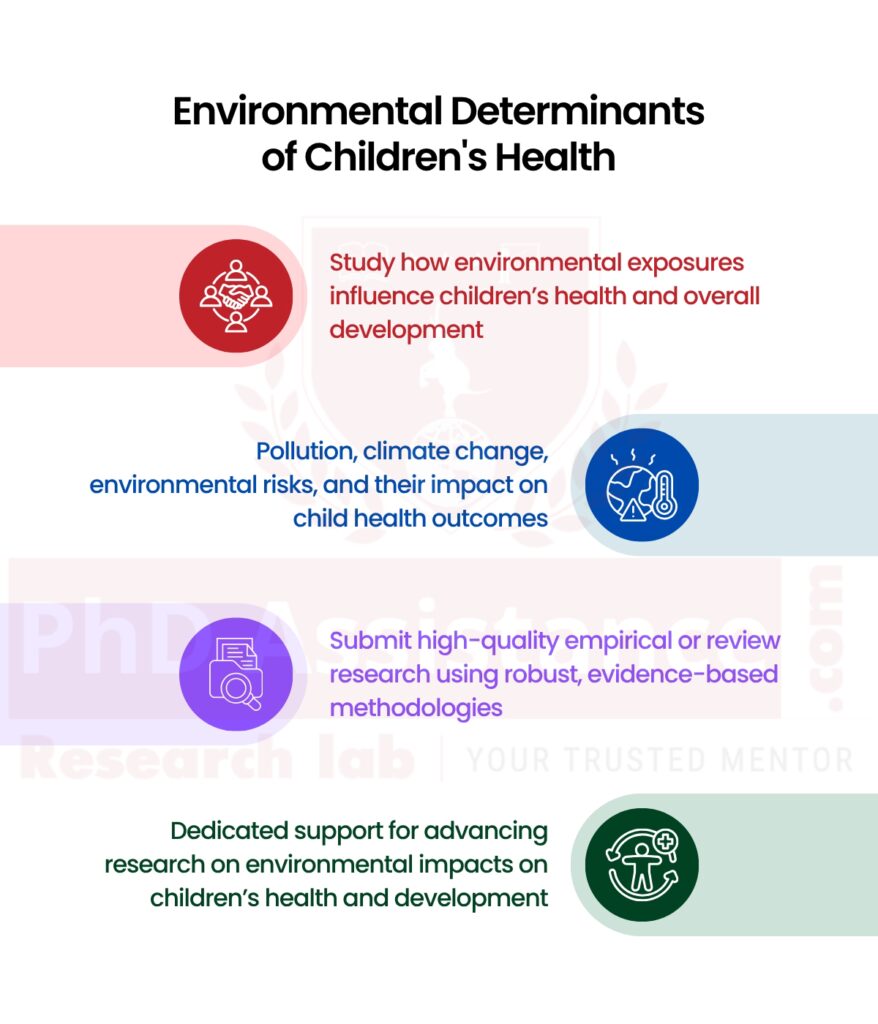
Key Themes
How We Support Your Submission
Publishing requires international journals to have researchers create strong research designs and present their findings clearly while following specific journal requirements. The research support team helps authors develop high-quality manuscripts which lead to successful submission to the Special Issue.
Journal Guidelines:
Important Dates
Submission Deadline: 31 October 2026
To ensure successful and timely submission to the special issue “Environmental Determinants of Children’s Health,” researchers are encouraged to seek expert publication support from conceptualisation to final submission.
Free Guide: How to Write the Journal Manuscript
Book a free consultation to get guidance from the PhD assistance research lab for writing a credible research manuscript and submitting it in the high-quality journal.
Reference
Elsevier. (2026, March 5). Call for papers: Environmental determinants of children’s health. Global Pediatrics. https://www.sciencedirect.com/journal/global-pediatrics/call-for-papers/environmental-determinants-of-childrens-health