
Critical Review of Stress Among Research Scholars: Causes, Coping Strategies and Implications for Policy Reform
Introduction
Research scholars in modern higher education institutions work to generate new knowledge while they advance scientific research. The combination of rising academic requirements, financial instability and institutional obligations has created an environment that intensifies stress for research scholars, which results in severe mental health issues and decreased research output for doctoral students. Scholars experience stress, which affects their personal health and their ability to succeed academically and develop their careers in the future.
The article Stress Among Research Scholars: Causes, Coping Strategies and Implications for Policy Reform studies three main stress factors that affect research scholars. The authors show that research scholars need both institutional solutions and policy changes to establish better learning environments for their academic work.
The evaluation of the research methods and their results, and their overall impact on understanding the difficulties that PhD students face with stress management and mental health issues during their doctoral studies.
Summary of the article
Examination of how stress affects research scholars while explaining which factors cause stress to increase among doctoral and postgraduate researchers. The study uses a literature-based approach, reviewing previously published research from academic databases such as Google Scholar and PubMed.
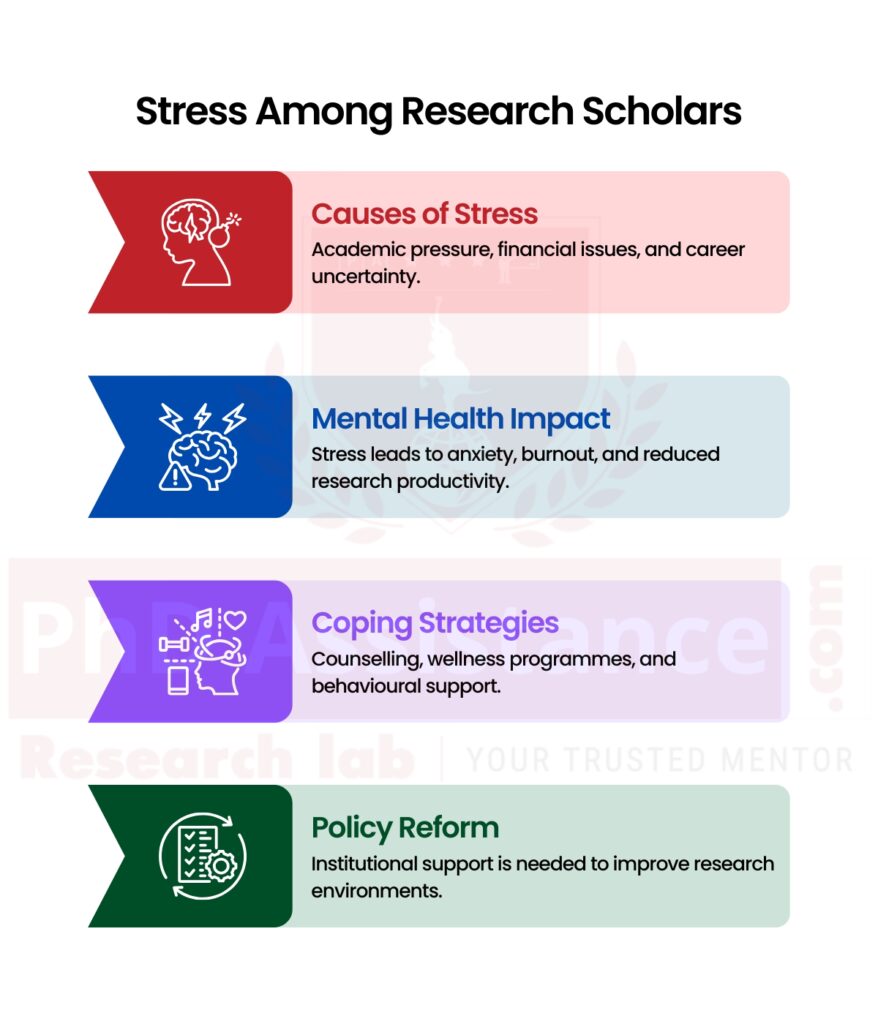
The findings show that multiple academic and personal factors create stress for scholars. The main reasons for research scholar stress originate from academic pressure, limited research resources, financial instability, guide-student relationship problems, future career uncertainty and work-life imbalance.
This demonstrates how continued stress leads to severe negative effects on human health. The doctoral student population experiences major mental health challenges which arise from their ongoing stress problems that lead to anxiety and depression and burnout. Academic work becomes difficult to complete because stress affects students’ ability to study and their research work suffers from lower quality results.
Critique
Significance and contribution of the field
A valuable contribution to research on causes of stress among research scholars by providing a comprehensive overview of the psychological and academic pressures experienced by doctoral students was done in the study. The research study today shows that mental health problems among doctoral students have become a leading issue that higher education institutions need to address.
It reveals important information about how structural and institutional elements affect PhD scholars’ mental health through their research, which identifies stress factors that affect research scholars. The research discussion establishes institutional support systems and policy changes as essential factors that help research scholars achieve their work goals while reducing their mental health issues.
The research depends mainly on secondary sources instead of primary data, which should have been collected from research scholars. The research would have benefited from including first-hand accounts of doctoral students because this would have offered a deeper understanding of the difficulties that PhD scholars encounter.
Methodology and research design
A literature review methodology was employed that synthesises findings from existing research studies. The authors use this approach to examine three elements, which include common stressors and coping mechanisms, and policy implications across various academic fields of study.
The method shows its benefit through its ability to deliver complete information about research scholar stress levels through the examination of various studies. The review shows specific patterns that research scholars use to cope, which include counselling support, behavioural interventions and wellness programmes.
A major drawback because researchers failed to collect primary data found in the study. The lack of empirical data makes it impossible to evaluate which stress factors are most important and to assess how well particular coping strategies work. Future research could employ surveys, interviews or longitudinal studies to better understand the challenges faced by PhD scholars and their psychological outcomes.
Argumentation and Use of Evidence
A clear logical structure through its arguments, which rely on citations from earlier scholarly research presented in the study. The authors establish connections between research scholar stress origins and the institutional and policy challenges that impact higher education systems.
A stronger arguments achieved through the inclusion of comparative research between various nations and educational fields. The research results would determine which stress factors exist in all situations and which exist only in particular cases. The coping strategies for research scholars needed more comprehensive assessment of their effectiveness over extended periods.
Ethical considerations and omissions
It does not raise significant ethical concerns because it relies primarily on previously published research rather than direct human participant data. The research contains two significant areas that require further examination.
This fails to investigate how different demographic factors that restrict its investigation, study the research scholars’ stress levels through gender identity, international student status and socioeconomic background. All of these factors should receive research attention because they have significant effects on doctoral student mental health.
The article studies academic stress as its main focus, while it overlooks the essential structural problems, which include job insecurity and labour conditions that PhD scholars encounter in multiple countries.
Writing Style and Structure
A clear and accessible language is used to explain complex psychological and academic topics to readers. The paper presents its content in a logical sequence that begins with identifying research scholar stress sources and ends with an exploration of coping methods and policy consequences.
The section about coping methods for research scholars provides essential information because it shows educational institutions which measures they can adopt to support their doctoral students. The article needs additional theoretical development through existing research on doctoral education and academic work to attain better content quality.
Conclusion
The article provides an important overview of the psychological and institutional challenges affecting doctoral researchers. The study shows that research scholars experience rising stress levels because of multiple factors, which include academic pressure, financial instability and work–life balance problems.
It establishes multiple coping methods and policy reforms for research scholars, while it shows that institutional solutions and research scholar policy changes create academic spaces that promote better health for scholars.
For researchers seeking expert support in developing research publications, the PhD Assistance Research Lab offers specialised academic guidance tailored to doctoral scholars and early-career researchers.
Reference
Kumar, S., Singh, G., Kumar, A., & Giri, S. K. (2026). Stress Among Research Scholars: Causes, Coping Strategies and Implications for Policy Reform. Annals of Neurosciences, 33(1), 123–130. https://doi.org/10.1177/09727531251315236