
Critical Review of Exploring PhD Students’ Utilisation of Generative AI in Academic Writing for Publication Purposes: Insights for EAP
Introduction
The swift surge of Generative AI into academic writing has transformed doctoral students’ methods for conducting research communication. The rising global publishing standards have led PhD students to adopt Generative AI in academic writing, which has become more common for L2 scholars who face difficulties in understanding academic writing rules. The article reviewed by Wu et al. (2026) studies doctoral students’ views about whether academic writing for publication should allow AI technology, and it examines how these views affect their writing behaviour in English-speaking university environments.
The research analyses for Academic Purposes writing because it demonstrates how EAP programs must now teach their students to use artificial intelligence technologies in an ethical manner and for practical purposes. The article fills an urgent research gap that exists in doctoral education studies because artificial intelligence tools have become common in research writing, and ethical AI usage in research remains a controversial topic.
The review assesses the article by examining its theoretical foundation, research methods, and its results, its argument and its wider impact on doctoral education and academic integrity systems.
Summary of the Article
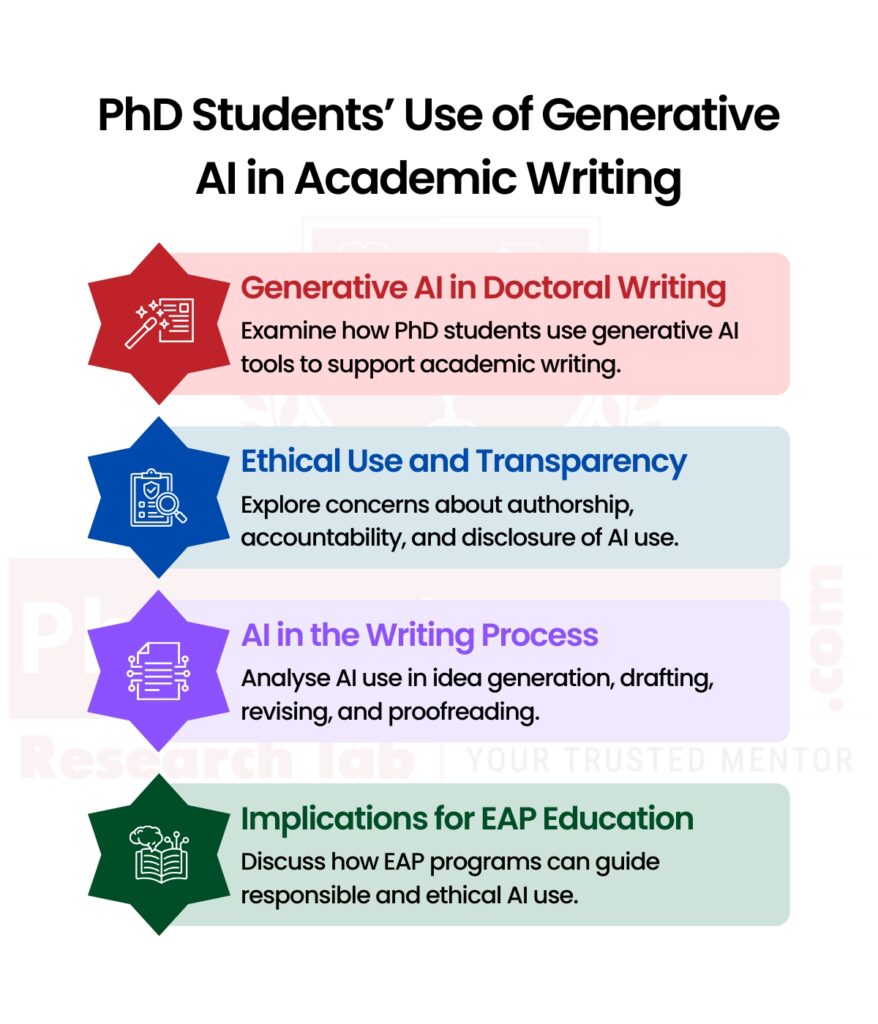
The research uses a two-stage study method that combines a survey with 63 L2 PhD students and 22 follow-up semi-structured interviews, which researchers conducted at a university in Hong Kong. The study included doctoral candidates from the arts and humanities and social sciences who needed to complete publishing requirements before they could graduate. The research investigates how doctoral students perceive Generative AI usage for academic writing throughout five writing process stages, which include conceptualising and drafting, revising and editing, maintaining transparency and honesty and disclosing their AI usage. Different research writing stages show that people hold different opinions about whether AI tools should be used.
Students at the conceptualisation stage showed divided opinions about using GenAI for idea generation and outlining. Students regarded the technology for brainstorming with supervisors, but they thought it would reduce their ability to create original work. Participants accepted AI-assisted paraphrasing and language refinement during drafting, but they completely rejected the practice of using AI-generated text without any changes.
The researchers found that most participants supported using AI for proofreading grammar and lexical accuracy improvements through their revision and editing work. The researchers found three main problems, which included authorship issues, accountability problems, and security breaches. Most people recognised that transparency matters and they supported Ethical use of AI in research, yet about sixty per cent of the participants said they would not reveal their AI usage when publishing their work.
The study discovered its most important result through the way people understood ethical standards, yet behaved in different ways. The article presents six teaching guidelines that educators should use to improve English for Academic Purposes writing instruction so doctoral students can learn to use AI responsibly in their work.
Critique
Significance and Contribution to the Field
The researchers found that most participants supported using AI for proofreading grammar and lexical accuracy improvements through their revision and editing work. The researchers found three main problems, which included authorship issues, accountability problems and security breaches.
Most people recognised that transparency matters and they supported ethical AI research practices, yet about sixty per cent of the participants said they would not reveal their AI usage when publishing their work.
The study discovered its most important result through the way people understood ethical standards, yet behaved in different ways. The article presents six teaching guidelines that educators should use to improve English for Academic writing instruction so doctoral students can learn to use AI responsibly in their work.
Methodology and Research Design
The article uses a culturally aware Move-Step linguistic analysis method to examine job advertisements through its dual research method, which includes both quantitative and qualitative research methods.
Thematic organisation of findings according to writing stages enables researchers to examine AI tools for research writing throughout the entire publication process.
The research becomes more valid because it employs a mixed-methods research design to conduct its study. The survey provides quantitative data about AI usage patterns, while interviews deliver detailed information about students’ reasons and worries. The reliability statistics that researchers report to the public make their research methods understandable to all observers.
Argumentation and Use of Evidence
The authors present a coherent argument that connects empirical findings to the wider academic discourse about English for Academic writing and digital literacy. Their focus on transparent practices matches current academic integrity standards.
The article demonstrates its main point by establishing a direct connection between its empirical findings and cultural capital theory, which exists in higher education. The comparison between healthcare and IT provides persuasive evidence that PhD employability in academia requires contextual awareness rather than abstract skill acquisition.
The article would improve through the inclusion of first-hand accounts, which PhD graduates provide to support the textual analysis of job advertisements. Including lived experiences could provide deeper insight into how doctoral scholars interpret and adapt their industry-relevant skills in real professional settings.
Ethical Considerations and Omissions
The study properly investigates three main aspects, which include transparency, together with declaration requirements and the reliability of artificial intelligence detection methods. The participants showed doubt about AI detection equipment, which demonstrated a larger problem from unknown elements involved in monitoring Generative AI usage in Academic writing for publication.
The discussion needs to expand its content about how long-term AI dependency will affect research skill development among doctoral students. The relationship between cognitive dependency and loss of independent academic identity needs further exploration through theoretical research.
Writing Style and Structure
The article presents its academic content through a logical structure that maintains academic clarity throughout. The categorisation of writing stages improves reading comprehension because the survey tables that have been included in the text help readers understand the analysis better.
The theoretical density of the material presents difficulties for practitioners who want to learn about teaching methods. The six recommendations that follow offer EAP reformers clear implementation directions.
Conclusion
The article presents a current study that investigates Generative AI through empirical research, in which PhD students use of generative AI software to create academic documents. The study investigates how doctoral students write their academic papers to show that their need to fulfil two different academic requirements creates stress, which hinders their research work.
The research findings offer important insights that advance academic writing research and English for Academic Purposes writing and research ethical standards for AI usage. The results show that academic journals need to create more specific rules while they must develop discipline-specific educational programs together with methods to teach responsible AI usage.
Researchers should expand their studies to multiple educational institutions, and they need to include cross-cultural comparison methods, which will enhance their understanding of AI research writing tools that transform doctoral education systems across different countries.
Reference:
Wu, C., Moorhouse, B. L., Wan, Y., & Wu, M. (2026). Exploring PhD students’ utilization of generative AI in academic writing for publication purposes: Insights for EAP. Journal of English for Academic Purposes, 79, 101612.