
Critical Review of The PhD Premium: Diverging Occupational Returns to the PhD Credential in 20 European Countries
Introduction
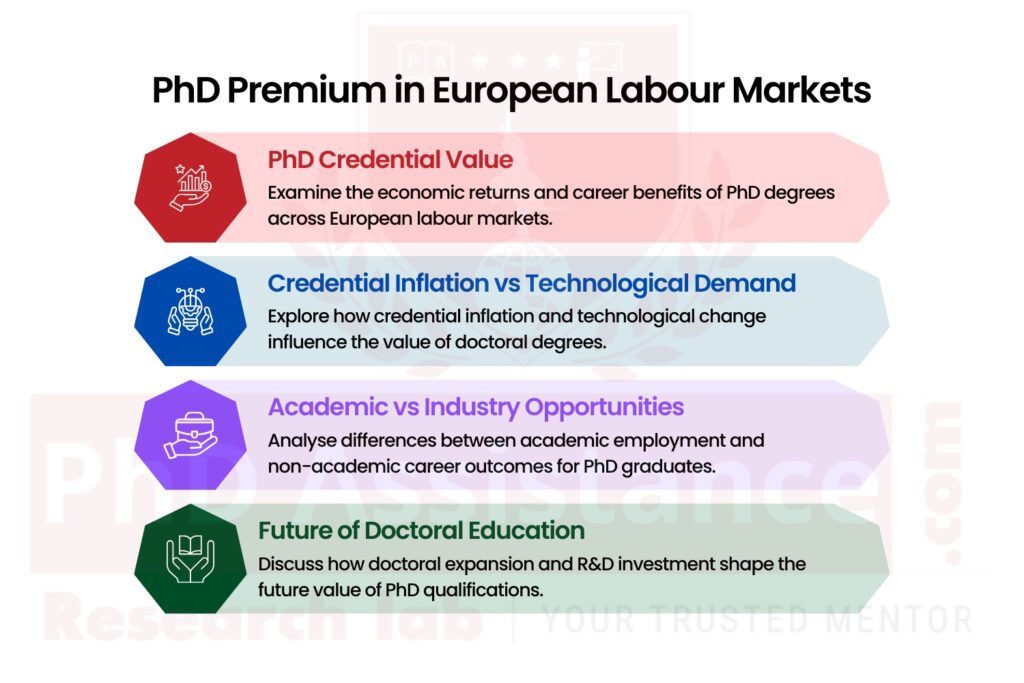
The IEC perspective maintains that when more people obtain doctoral degrees the value of the degree as a credential decreases, which results in reduced employment benefits. The SBTC theory maintains that technological progress raises the need for expert workers, which makes doctoral degrees more valuable. The article analyses two different situations to help researchers understand how doctoral education provides economic benefits in contemporary knowledge-based economies.
The article The PhD Premium: Diverging Occupational Returns to the PhD Credential in 20 European Countries examines the occupational returns to PhD premium across European labour markets. The increase in doctoral programs throughout Europe has generated two main concerns, which relate to credential inflation, reduced academic employment opportunities and the value of PhD degrees. The study situates this debate within two competing theoretical perspectives: the Inflation of Educational Credentials (IEC) theory and the Skill-Biased Technological Change (SBTC) framework.
The review examines the study’s theoretical framework, research methods and study results and total impact on European labour market research for PhD holders.
Summary of the Article
The authors use a two-step modelling method to assess the returns on doctoral education. The first step requires country-period regression models to determine the benefits that PhD holders receive. The second step connects these estimates with macro-level variables, which include the percentage of PhD holders in the population and the government budget for Research and Development (R&D). The framework allows assessment of doctoral program growth and technological spending on their effects on European labour market results..
The research results demonstrate that a PhD degree provides a financial advantage that exists in most countries. Doctoral graduates generally access academic jobs more easily, and they earn higher salaries than non-PhD graduates. The increasing number of doctoral students demonstrates a negative impact on professorship availability because it creates more academic competition among researchers. Increased research and development funding results in more non-academic personnel working in prestigious roles because knowledge-driven industries show greater demand for workers. The link between doctoral program growth and income levels remains mostly unchanged despite growing doctoral programs.
The authors of the study demonstrate that both credential inflation and technological demand mechanisms shape the economic value of credentials, depending on the occupational sector.
Critique
Significance and Contribution to the Field
The article makes a valuable contribution by providing large-scale comparative evidence across 20 countries. Existing research about doctoral education returns analyses individual countries, which creates problems for generalising findings. The research provides new insights into the field through its systematic cross-country PhD comparison, which reveals essential information about employment trends in various countries.
The study demonstrates its major advantage through its ability to evaluate PhD earnings across different work fields. The authors investigate two types of employment results, which include both academic work and non-academic work. The approach measures PhD economic value through two factors, which include salary and professional advancement in different job sectors.
The research should evaluate how different higher education systems in various countries operate their funding systems, their tenure systems and their systems for training doctoral students. The structural elements of a country’s research base show how different European nations create different labour market results for their doctoral degree economic value holders.
Methodology and Research Design
European Labour Force Survey data provides statistical reliability which enables researchers to make accurate comparisons between different studies. The two-step modelling method combines individual results with macro-level context to produce accurate estimates of doctoral education outcomes because of its combination with extensive sample data.
The SBTC argument receives support from R&D expenditure which serves as a proxy for technological demand. The research provides empirical evidence which demonstrates the factors that drive non-academic returns. The study relies mainly on cross-sectional data which restricts its ability to determine how PhD premium occupational returns have changed throughout history.
The income measurement system uses deciles instead of continuous earnings which leads to less accurate wage difference estimation. The research fails to investigate all aspects of different disciplines. The economic value of PhD credentials shows major differences between STEM and non-STEM fields because research needs to analyze each academic discipline.
The research method shows transparent implementation through its execution despite existing limitations.
Argumentation and Use of Evidence
The article presents a coherent and theoretically grounded argument. The credential inflation hypothesis, which states that academic advantages decrease when more degrees become available, has been proven by the negative relationship that exists between doctoral program expansion and access to professorship positions. The positive relationship between R&D spending and non-academic benefits demonstrates the SBTC framework because technological progress creates a need for higher qualifications.
Researchers have found that different systems assess the value of a PhD degree for industrial sectors in various ways. The academic labour market functions through supply-based competition, while non-academic employment markets respond more strongly to demand-driven economic changes. The distinction between these two elements provides better insights into how doctoral graduates access European labor market outcomes.
The research shows strong statistical relationships between variables, but it needs further evidence to prove direct causal links. The research needs longitudinal or quasi-experimental research designs to establish better evidence about how doctoral education returns have changed over time.
Ethical Considerations and Omissions
The research study uses anonymised secondary data, which lacks any ethical issues. The research study needs to explore three main areas, which include gender differences, migration history, and insecure work environments. The economic worth of PhD degrees requires assessment through these factors, which should be examined in upcoming studies.
Writing Style and Structure
The article shows both theoretical clarity and organised structure. The scholarly work achieves its highest level of value because the authors establish a connection between theoretical frameworks and their research findings. The statistical model presents difficulties to non-expert users, but the complete work maintains its scientific standards and displays its research methods.
The policy discussion about doctoral programme reform needs to become more practical because it will help policymakers who want to enhance doctoral education economic outcomes.
Conclusion
The research article demonstrates the PhD premium value for European labour markets through its comparative evidence. Doctoral education produces professional benefits that differ according to different work sectors and various international settings.
The academic value of degrees decreases because more students obtain doctoral degrees, according to credential inflation theory. The skill-biased technological change framework shows that countries with greater R&D spending produce better non-academic returns. The income premiums maintain their stability while showing reduced responsiveness to doctoral program expansion.
The research demonstrates that PhD degrees have economic value because two elements produce their value. Future research should use longitudinal data combined with institutional distinctions and different disciplines to study doctoral education economic returns and their effects on European labour markets.
Reference:
Ballarino, G., & Cantalini, S. (2026). The PhD premium: Diverging occupational returns to the PhD credential in 20 European countries. Research in Higher Education, 67(2). https://doi.org/10.1007/s11162-025-09874-2
Methodology and Research Design