
Future Research Directions in Identifying Dissertation Topics
- Home
- Academy
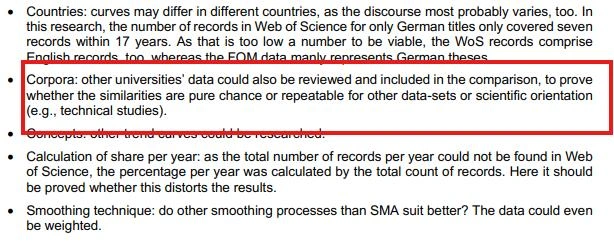
- Study Guide
Future Research Directions in Identifying Dissertation Topics: Insights from Management Trends
Published 01st March 2025

Introduction
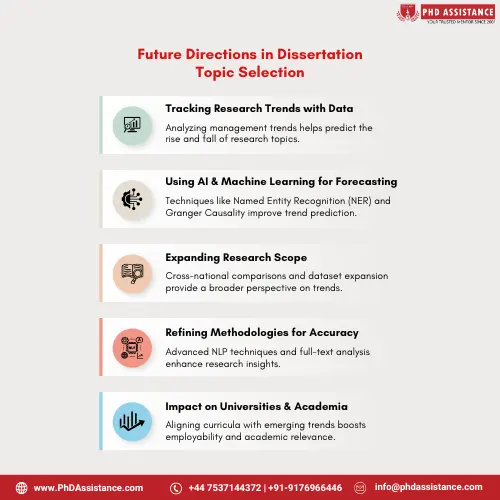
Evolution of management trends may serve as a helpful factor in choosing dissertation topics [1]. Research has shown that large datasets can be analyzed to trace the life cycle of management concepts: their rise, peak, and eventual decline.
This article discusses how to track such trends and explores future avenues for research to improve the accuracy and applicability of findings.
It is also possible through computational techniques like Pointwise Mutual Information (PMI) and machine learning to provide better methods for identifying dissertation-worthy topics that are more in keeping with academic and industry trends.
Tracking Management Trends Through Data Analysis
The study of management trends via data analysis has revealed that the pattern of trends typically runs through a predictable lifecycle stage [1].
- Emergence – A concept gains initial attention.
- Growth – The trend experiences increasing adoption.
- Peak – Popularity reaches its highest point.
- Decline – The trend either evolves or loses relevance.
Researchers are able to visualize these patterns by doing corpus analyses of larger databases, like Web of Science records and titles of university dissertations. The study of buzzwords such as ‘Balanced Scorecard’ and ‘Sustainability’ shows that those trend curves exhibit similar behavior across datasets, which implies an interrelationship between academic research and management discourse.
Methodology: Using PMI for Trend Analysis
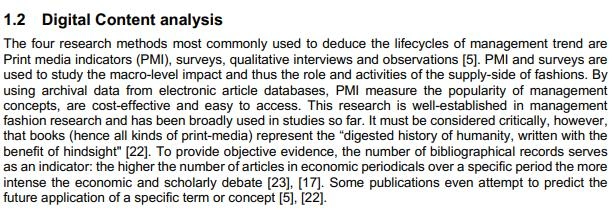
PMI proved to be an effective method for extracting trend curves from massive corpora of data. The trend curves show:
- Rate of adoption of specific notions
- Peaks that indicate extensive identification
- Sudden dips indicating a shift in interest
Large significant correlations (p <.001) between dissertation titles and a larger research database suggest that dissertations can either follow or even predict where industry and academia are moving ahead. More tests are needed to statistically validate the observations set forth [1].
Research Directions for the Future: Improving Dissertation Topic Identification
Key areas require further investigation to further develop this approach:
Duration Extension of Analysis
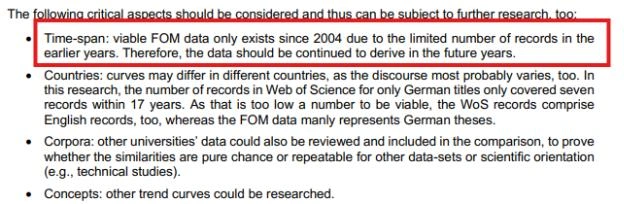
Only data from 2004 onward are records of the dataset from FOM University of Applied Sciences [1]. Future studies need to extend the datasets over a longer timeframe to examine more prolonged changes.
Analysis of shifts in management orientation over several decades would better capture long-term shifts in a given area of research focus.
Cross-National Comparison of Management Trends
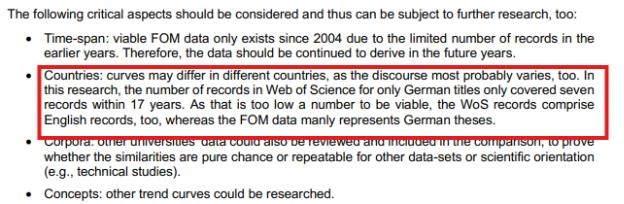
This new dataset is mainly about English-language publications, while almost all dissertations at FOM University are completed in German. This difference may bias any trend analysis.
Further research should compare trends across a number of countries and languages to know whether management trends have global synchronization or a regional differential [1].
Expand Dataset: Include Several Universities
Research into Additional Management Themes
Other than the Balanced Scorecard and Sustainability, some other management buzzwords need to be tested to determine whether they follow similar trends.
Concepts such as Agile Management, Digital Transformation, and Behavioral Economics can also undergo testing in respect of their lifecycle attributes.
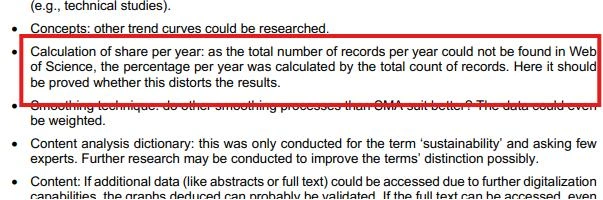
Refine Calculating Annual Trend Shares
Investigating Different Smoothing Techniques
Refining Content Analysis with Advanced NLP Techniques
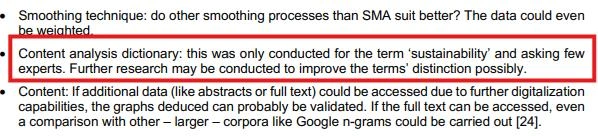
Manual expert input was used to define the terms associated with “Sustainability” in this study. This could also benefit from more extensive operation through Natural Language Processing (NLP).
Automated dictionary build-up using Named Entity Recognition (NER) will help in classifying even more newer management trends.
Source:
Refining Content Analysis with Advanced NLP Techniques
Manual expert input was used to define the terms associated with “Sustainability” in this study. This could also benefit from more extensive operation through Natural Language Processing (NLP).
Automated dictionary build-up using Named Entity Recognition (NER) will help in classifying even more newer management trends.
Full Text-Based Analysis for Greater Insight
Although analysis has been restricted so far to dissertation and journal article titles, abstracts and full texts could provide much richer insights into how trends evolve over time.
Future research should consider looking into Google N-grams and other such large-scale corpora to further augment trend prediction capabilities.
Potential Bias and Methodological Considerations
Academic Publisher Classification Bias
Academic Publisher Classification Bias: Accuracy of trend detection depends on the classification systems of academic publishers.
Future research should analyze the influence of bias in category on trend assessment.
Institutional Specialization and Trend Adoption
Universities especially distinguished in a competitive field may determine the choice of dissertation topic.
It would be interesting to look at comparison of trend differences between general universities versus specialized institutions in terms of how institutional focus affects research trends.
Proposed Hypotheses for Future Studies
The findings gave rise to the two main hypotheses:
H1: Dissertation Titles Are Reliable Predictors of Management Trends
If dissertation topics mirror broader research trends, they can serve as an early indicator of emerging management concepts. Further studies should explore causal relationships between research discourse and academic trend diffusion.
H2: Students at Private Universities Shape Management Trend Adoption
Students may not only reflect management trends but also actively influence their diffusion.
A comparative analysis of public vs. private university research could determine whether students serve as drivers or passive adopters of trends.
Applying Machine Learning for Trend Forecasting
The integration of machine learning techniques could bring forth a new dawn in trend detection and forecasting for dissertation research.
Using Named Entity Recognition (NER) for Automated Trend Detection
NER models can detect developing keywords in enormous academic datasets. Such method helps universities predict the imminence of certain topics and make curricula adjustments.
Applying Granger Causality Tests for Predictive Modeling
The evidence of Granger causality test may depict whether dissertation trends are predicting research trends or vice versa.
Where dissertation trends lag behind the currents of academia, universities could pre-emptively integrate current topics into coursework.
Implications for Universities: Reform in Curriculum Design
Developing Dynamic Academic Programs
Trend analysis can help universities determine the need to update courses in response to new management thinking.
Improving Student Employability
Students should aspire to create topics through research that fits some kind of industrial trend, especially those industries that would otherwise employ students.
Strengthening Knowledge Transfer
A better incorporation of trend insight into pedagogy will enable students to actively contribute to closing the gap between academia and industry needs.
Conclusion: The Future of Dissertation Topic Selection
The ability to track, analyze, and predict management trends using large corpora opens new possibilities for academic research. Further refining of methodologies and enlargement of datasets would develop a strong absorption framework for identifying topics that qualify for a dissertation.
Universities could also keep evolving their curricula upon these signals. Trend forecasting can be mechanized through machine learning techniques. Students could benefit from more relevant and impactful dissertation topics.
As digitalization advances, the intersection of data science and academic research will continue to evolve that will offer new frontier in dissertation topic identification.