

Immersive XR Technologies and Digital Storytelling in Cultural Heritage Preservation
June 27, 2026
Generative AI and Data-Driven Innovation Strategies in Sustainable Business Ecosystems
June 29, 2026Why UAE PhD Scholars Struggle to Find Research Gaps and How to Fix It
- June 27, 2026
- PhD Literature Review
Introduction
The UAE is one of the leading countries in the world. This country also places high importance on providing excellence in higher education, research, and innovation facilities. Both the UAE Vision 2031 and the National Strategy for Higher Education 2030 are national development strategies for higher education with specific directions and goals, which would improve sectors such as healthcare, business, artificial intelligence, finance, engineering, social science, and sustainability.
Even with such possibilities, however, one of the main issues to encounter in PhD research with a scholarship, UAE students find it challenging to spot what has been left undiscovered and, in consequence, how they might add anything of value. This would commonly lead to revised drafts in case it hadn’t been successfully done with a research gap, and journal reviewers would not find anything new to evaluate.
Our professionals from the PhD Assistance Research Lab provide the key reasons for PhD scholars in the UAE failing to find gaps and effective solutions to address these issues, PhD Literature Review Services in UAE, and utilising evidence-based approaches of the academic field.
What you will learn from this blog?
- Why identifying research gaps is critical for PhD success
- How literature reviews help uncover research opportunities
- Common challenges faced by UAE doctoral scholars
- Practical strategies to identify meaningful research gaps
Understanding PhD Literature Review Help in UAE
More than an annotation of work published by earlier scholars, the literature review is a thorough method of interpreting, juxtaposing and integrating available research sources to appraise the body of the literature in a gin each. Above all, it should build on these efforts to outline knowledge that needs to be addressed in a new and original research project leading to a doctoral thesis.
Universities within the UAE require PhD candidates to prove in-depth mastery of their research area to suggest future studies. Many scholars need to work through hundreds of papers on a certain field using sources like Scopus, Web of Science, IEEE Xplore, ScienceDirect or PubMed (depending on the field). Working through articles is only part of the challenge because students need to scrutinise methods used, theoretical approaches, contrasting research results, and barriers of prior studies.
A key problem of this research is the large number of publications. Daily, thousands of papers across science disciplines continue to be published, and this makes the need to update, stay on top, and be knowledgeable become ever so pressing and ultimately it is quite hard for PhD students to organise the great pile of references into themes to see what work can be carried out. So, a professional PhD Literature Review Help in UAE can significantly help scholars study the available literature and find gaps.
Major Quantitative Statistics Challenges in Economics PhD Research
1. Conducting an Inadequate Literature Review
Not carrying out a thorough review is the main reason that PhD students struggle to find research gaps, since they are doing an incomplete review. Many PhD students tend to base their review on a few, irrelevant and very old research articles, as well as an incomplete database check for articles.
Some scholars make it even harder by limiting their review to research papers only those that are in support of their research hypothesis in terms of their hypothesis, and never really searching the complete, widespread mass of research literature that surrounds their chosen field of interest.
Supervisors at UAE universities now expect scholars to cover sufficient breadth and depth in their international literature survey to meet approval before they accept a research proposal. Supervisors review high-impact journals, conference papers, and examine review articles and new empirical work. Such analysis should help the candidate make a credible claim for novelty.
Example: Booth et al. (2021) stated that a comprehensive literature review can contribute to ensuring the research has an acceptable quality and robustness by exposing contradictory findings, methodological deficiencies, or even missing knowledge gaps. In their words, the omission of an incomplete review not only has an adverse effect in terms of duplicated previous findings.
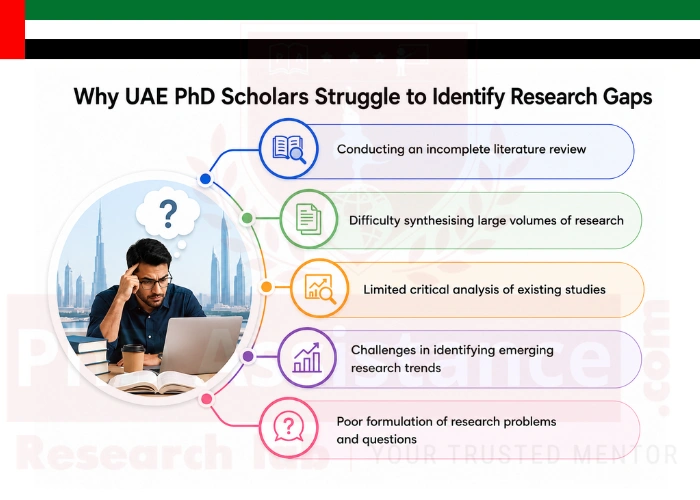
2. Addressing the challenge: Synthesising Large Volumes of Literature with Dissertation Literature Review Help in UAE
With current technology, there’s more information available at academics’ fingertips than ever before. This may sound wonderful for accessing all information needed, but it raises a whole raft of problems when you must string hundreds of journal articles into a flowing story.
A common error PhD candidates make when they have hundreds of articles that must somehow fit together is to go through describing each article separately. However, this method won’t help you pick out the links, conflicts, weak methodological approaches or new lines of inquiry that tell you what the “gaps” in the literature are. Students often consider a structured Dissertation Literature Review Help in UAE to choose a correct method for their review.
A synthesis of the literature isn’t a listing of what appears in each piece but rather is a critical investigation of the relations between studies. This means assessing when studies are telling the same story and when they conflict, where evidence gaps have been created and what issues with methods appear in many studies that have come before.
Example: The idea of conceptual synthesis (or non-chronological review of literature) was strongly advocated by Webster and Watson (2002), who proposed an organisational framework that organises literature around conceptual clusters that highlight relationships between different empirical studies and opportunities for further research.
3. Lack of Critical Analysis Rather Than Critical Reading
One of the most debated misconceptions among PhD scholars is that reading several papers ensures that you will locate a research gap. On the other hand, this success has less to do with reading many and more with critical reading than the former in PhD research work.
Most of the PhD Scholars in the UAE produce literature reviews that simply reflect previous work done without a critical review of strengths, weaknesses and methodological flaws. This thus leaves scholars with great difficulty in demonstrating the need for their research to be carried out.
Critical analysis involves asking questions such as:
- What assumptions did prior studies overlook?
- What research findings were inconsistent and contradicted each other?
- Were the findings cross-culturally or across industries applicable?
- Are prior study conclusions undermined by technology or policy changes?
Example: Paul and Criado (2020) suggest that review articles should not be an uncritical compilation of past work. Instead, they identify ‘the search for discrepancies and theoretical discrepancies as central to identifying research gaps.’
4. Difficulty Identifying Emerging Research Trends
Many PhD students in the UAE can’t spot gaps in the literature because they concentrate only on existing literature, whereas a whole universe of contemporary issues should be their source of research inspiration. Because of technological advancements, policies, government regulations and industry trends and challenges, there are brand-new streams of research issues opening every year.
By only looking at the literature in the database of the university’s library, the student may find themselves attempting to solve questions that may have already been solved.
This issue has strong significance in the UAE, with a national agenda in AI, renewable energy, smart cities, digital transformation, fintech, and sustainable solutions, which are changing research priorities at an expedited pace.
Example: A systematic literature review can summarise current knowledge, as well as point to new research areas, through the discovery of underexplored topics and new themes. As Snyder (2019) notes, researchers need to be in an active stance to observe shifting patterns of research, rather than just looking at past literature alone.
Get the pricing details for the PhD literature review service at PhD Assistance Research Lab, designed to assist researchers in finding research gaps.
5. Poor Formulation of Research Problems and Research Questions
Many PhD researchers are unable to translate these findings into clearly formed research problems and focused research questions. They can sometimes spot areas of the existing research that could be improved or expanded, but cannot clearly define why that gap matters and how it will enhance the body of knowledge.
Research gaps only hold academic interest; however, if they can be translated into a workable research problem, based on attainable objectives, supported by clear and achievable research questions.
Most proposals fail due to not correctly explaining;
- Why the gap is important.
- How addressing it advances theory.
- Who benefits from the findings?
- What methodological approach is required?
Example: Booth et al. (2021) argue literature reviews do more than point out what’s missing from the research: They explain the significance of plugging the knowledge gaps for theory, policy or practice. The evidence for this framework shows well formulated research questions can become more ‘real’ when rooted in robust evidence.
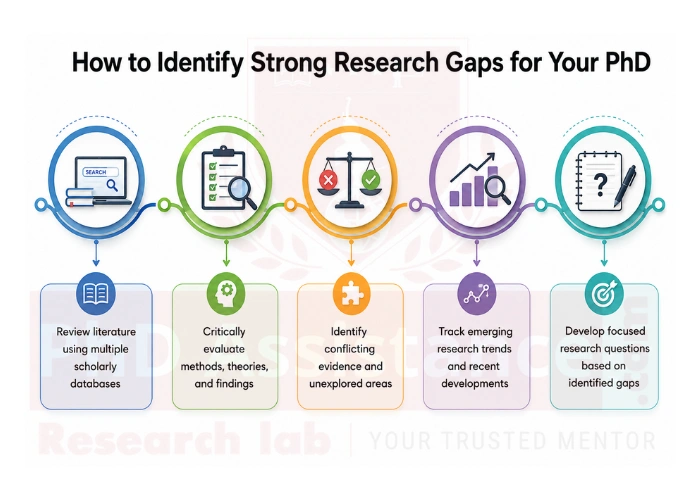
Strategies to Identify Strong Research Gaps
- Search in several scholarly databases broadly.
- Choose up-to-date articles published on highly rated peer-reviewed journals.
- Detailly examine authors, theoretical approaches and methods.
- Address those conflicting findings or unresolved debates.
- Research into limitations found by other researchers.
- Monitor emerging trends through bibliometric studies and systematic reviews.
- Develop conceptual maps to visualise relationships between studies.
Conclusion
The literature review process- locating and identifying significant research gaps is often the most challenging, yet crucial, phase of the research project. Doctoral studies demand an increase in the volume of research articles, cross-disciplinary studies and the expectation of research novelty and impact.
Instead of summarising all prior studies, research teams must employ a critical, thematic and rigorous exploration of prior literature to identify key unanswered questions, limitations in methodological and theoretical aspects of previous works and new avenues for exploration. Enhancing the use of advanced analytical methods and approaches of Systematic literature reviews, as well as a sustained attention to ongoing research outputs, are some important steps that can enhance the uniqueness of a doctoral study.
PhD Assistance Research Lab provides a customised Healthcare Literature Review Help in UAE for Researchers that ensures systematic literature search, thematic analysis, and evidence-based research.
Book a Free Expert Consultation to conduct a critical literature review and identify a research gap for your doctoral studies.
References
- Booth, A., Sutton, A., Clowes, M., & Martyn-St James, M. (2021). Systematic approaches to a successful literature review (3rd ed.). Sage. https://www.scirp.org/reference/referencespapers?referenceid=3184401
- Kunisch, S., Denyer, D., Bartunek, J. M., Menz, M., & Cardinal, L. B. (2023). Review research as scientific inquiry. Organizational Research Methods, 26(1), 3–45. https://doi.org/10.1177/10944281221127292 .
- Paul, J., & Rialp-Criado, A. (2020). The art of writing literature review: What do we know and what do we need to know? International Business Review, 29(4), 101717. https://doi.org/10.1016/j.ibusrev.2020.101717
- Snyder, H. (2019). Literature review as a research methodology: An overview and guidelines. Journal of Business Research, 104, 333–339. https://doi.org/10.1016/j.jbusres.2019.07.039
- Webster, J., & Watson, R. T. (2002). Analyzing the past to prepare for the future: Writing a literature review. MIS Quarterly, 26(2), xiii–xxiii. https://www.jstor.org/stable/4132319
- Xiao, Y., & Watson, M. (2019). Guidance on conducting a systematic literature review. Journal of Planning Education and Research, 39(1), 93–112. https://doi.org/10.1177/0739456X17723971
