
Call for Papers: ChemBioStruct26: From Structure to Function: Integrating Structural Biology and Chemical Biology for Therapeutic Innovation
Introduction
New developments have been made in structural biology, where knowledge of biological processes has been greatly impacted at the molecular level. This is due to advances in cryo-electron microscopy, X-ray crystallography, NMR spectroscopy, integrative structural biology, and artificial intelligence.
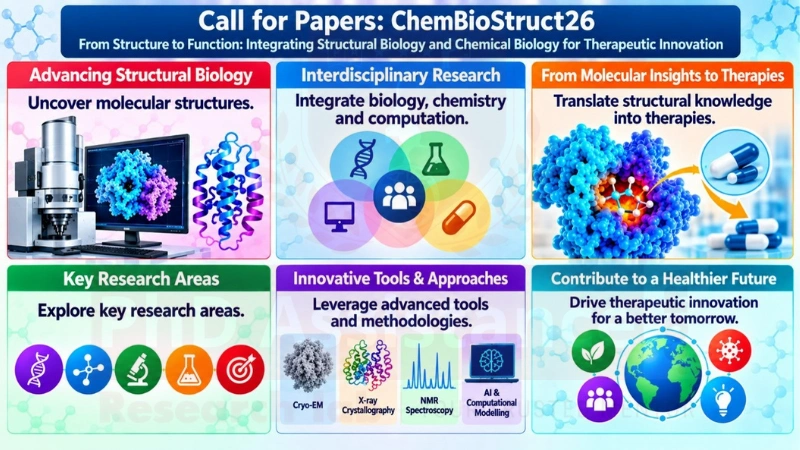
The ChemBioStruct26 Call for Papers invites researchers to contribute their work related to the structure and chemistry involved in biological function, with particular emphasis on molecular recognition, biomolecular mechanisms and structure-based drug discovery based on structure. This Special Issue will cover a variety of scientific fields such as structural biology, chemical biology, biophysics, computer science, and medicinal chemistry.
Why publish in this issue?
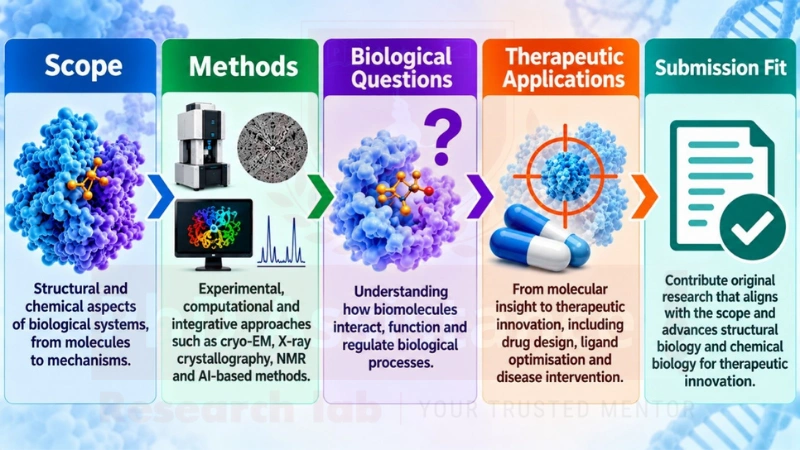
This Special Issue provides an opportunity to present research at the interface of structural biology and chemical biology, with applications in molecular recognition, biomolecular mechanisms, structure–function relationships and therapeutic innovation. Contributions may integrate experimental, computational and AI-based approaches to advance understanding of biological systems and support structure-based drug discovery.
Key advantages:
Scope
Research Articles on structural and chemical aspects of biological systems are encouraged for submission to the Special Issue. Studies that integrate the disciplines of structural biology, chemical biology, biophysics, computational biology, and medicinal chemistry will be especially relevant to this structural biology call for papers.
Topics of interest include, but are not limited to:
Know More About This Issue
New developments in cryo-EM, X-ray crystallography, NMR spectroscopy, and integrative structural biology approaches have enabled researchers to study complex macromolecular assemblies in structural contexts (Garman, 2014; Göbl et al., 2014; Banari et al., 2025). At the same time, advancements in machine learning techniques, such as AlphaFold, have increased the prospects for Protein structure prediction, as well as structure-activity relationships and molecular mechanisms (Jumper et al., 2021).
But structure prediction by computation does not negate the need for experimental structure biology. Experiments are still required to validate structures, study the dynamics of proteins, characterise their heterogeneity, and understand molecular interactions that include proteins, nucleic acids, lipids, metabolites, and small molecules.
The Special Issue, resulting from the conference of the Biological Macromolecules Section of the Italian Crystallographic Society and of the Division of Biological Systems Chemistry of the Italian Chemical Society, is meant to gather people from chemistry, biology, structural science, and drug discovery.
Key factors
How We Support Your Submission
PhD Assistance Research Lab supports researchers with manuscript development, scientific editing, structuring and submission preparation while preserving researcher authorship and responsibility.
Our services include:
1. Scientific Manuscript Development and Editing
Problem: Structural and chemical biology research often combines complex molecular, computational and experimental concepts.
Solution: Technical manuscript development, academic editing and content polishing focused on clear scientific communication.
Value: A coherent manuscript that presents the research methodology, findings and scientific significance clearly.
2. Research Design & Methodology
Problem: Interdisciplinary structural biology studies may require careful integration of experimental, computational or analytical approaches.
Solution: Support with research design, methodology, data considerations and appropriate analytical approaches.
Value: A systematic research framework that clearly connects methods with research objectives.
3. Journal Formatting & Manuscript Structuring
Problem: Special Issue submissions must follow the relevant journal’s author instructions and submission requirements.
Solution: Manuscript organisation, formatting and structural editing based on the applicable journal guidelines.
Value: Better submission preparedness and consistency with journal requirements.
4. Academic Language Editing & Proofreading
Problem: Complex scientific concepts can become difficult to communicate when language, structure or terminology is inconsistent.
Solution: Academic language editing, proofreading and scientific communication refinement.
Value: Clearer, more consistent and professionally presented research paper.
5. Pre-Submission Review & Submission Support
Problem: Manuscripts may contain structural, formatting or presentation issues before submission.
Solution: Final manuscript review and support with submission document preparation.
Value: A more organised manuscript submission process.
Journal Indexing and Submission Information
Journal indexing, journal suitability, article types, submission guidelines, and other publication-related details should be verified on the journal’s official website of the journal and other indexing database sites. Journal indexing and submission guidelines can change over time, so authors should verify the updated guidelines.
Journal Guidelines:
Verify all information against the latest official Elsevier CFP before publication.
If your research addresses Integrating Structural Biology and Chemical Biology for Therapeutic Innovation, consider submitting your manuscript to this Special Issue. Researchers interested in the chemical biology call for papers can review the submission requirements and prepare their paper before the deadline.
Is My Paper a Fit?
Your manuscript may be a good fit if it:
Check Your Manuscript’s Fit for This Special Issue
Get guidance on manuscript scope, structure, formatting and pre-submission preparation, including how to prepare for and respond to peer-review requirements.
FAQs:
1. What is the focus of the ChemBioStruct26 Special Issue?
This Special Issue focuses on interdisciplinary research at the interface of structural biology and chemical biology, including molecular recognition, biomolecular mechanisms, structure–function relationships, and therapeutic innovation.
2. What article types are accepted for ChemBioStruct26?
The ChemBioStruct26 Call for Papers welcomes original research, reviews, and methodological contributions covering structural biology, chemical biology, biophysics, computational approaches, and medicinal chemistry.
3. How does structural biology contribute to drug discovery?
Structural biology provides insights into protein structures, molecular interactions, ligand binding, and conformational changes, supporting structure-based drug design, fragment-based discovery, and the optimisation of therapeutic candidates.
4. What are current research areas in structural and chemical biology?
Research opportunities include protein dynamics, molecular recognition, chemical probes, therapeutic modulators, protein engineering, disease mechanisms, and emerging experimental and computational methodologies.
5. Which methods are relevant to this Special Issue?
Relevant approaches include cryo-EM, X-ray crystallography, NMR spectroscopy, integrative structural biology, molecular simulations, AI-based structural prediction, and other emerging methodologies.
Reference
- (2026, August 10). ChemBioStruct26: From Structure to Function: Integrating Structural Biology and Chemical Biology for Therapeutic Innovation. Submission deadline: 14 April 2027.
- Biophysical Chemistry | ScienceDirect.com by Elsevier – Biophysical Chemistry | ScienceDirect.com by Elsevier
- Garman E. F. (2014). Developments in X-ray crystallographic structure determination of biological macromolecules. Science (New York, N.Y.), 343(6175), 1102–1108. https://doi.org/10.1126/science.1247829
- Göbl, C., Madl, T., Simon, B., & Sattler, M. (2014). NMR approaches for structural analysis of multidomain proteins and complexes in solution. Progress in nuclear magnetic resonance spectroscopy, 80, 26–63. https://doi.org/10.1016/j.pnmrs.2014.05.003
- Banari, A., Samanta, A.K., Munke, A. et al. Advancing time-resolved structural biology: latest strategies in cryo-EM and X-ray crystallography. Nat Methods 22, 1420–1435 (2025). https://doi.org/10.1038/s41592-025-02659-6
- Jumper, J., Evans, R., Pritzel, A. et al. Highly accurate protein structure prediction with AlphaFold. Nature 596, 583–589 (2021). https://doi.org/10.1038/s41586-021-03819-2