

Chapter by chapter: how AI tools are helping UK economics PhD students tackle part-dissertations faster and smarter
June 3, 2026
How to Develop a PhD Research Proposal in UAE Management: Applying Smart Cities, AI Strategy and Innovation Models
June 4, 2026Why UAE nursing PhD manuscripts get rejected by journals - the five structural mistakes no one tells you about
- June 04, 2026
- PhD Manuscript
Introduction
The UAE has emerged as an essential hub for education in healthcare, research in nursing, and practice guided by evidence. Various universities in the UAE have started urging Nursing PhD candidates to help in advancing the body of knowledge in healthcare through research and academic writing. Research has gained momentum in fields such as patient safety, nursing leadership, healthcare technology, management of chronic diseases, and quality improvement.
Many nursing PhD students manage to meet all the requirements concerning coursework and conducting dissertations; however, there is a problem with publishing their research findings in academic periodicals. Numerous manuscripts fail to be published even though they contain results of highly valuable and conducted studies effectively. The reason for this rejection is often not the research itself but flaws present in its structure.
The increased focus on scientific medicine and scholarly publications means that nursing PhD students are required to format their papers in a manner that meets certain journal guidelines. However, most authors are oblivious of these errors and the issues that arise because of poor structure.
In this blog, you will be reading about five common structure errors that often result in rejections and some advice on how to improve your chances of acceptance. The PhD Assistance Research Lab understands the struggles of nursing students in manuscript writing and provides customised PhD Manuscript Writing Help in UAE.
What you will learn from this blog?
- The most common reasons Nursing PhD manuscripts get rejected
- Structural mistakes frequently identified by journal reviewers
- Examples from nursing and healthcare research publications
- Strategies for improving manuscript quality
- How expert manuscript support can enhance publication success
Professional Nursing PhD Manuscript Writing Services in UAE
For a research paper to be published in a respected nursing journal, much more is required beyond just completing a quality study. Researchers must submit their study in the form of an articulate manuscript that is easy to understand and comprehend.
PhD research in nursing often face the problem of failing to submit their dissertations chapter directly to the journal due to necessary alterations that should be made before the submission process begins. In addition to following the writing format, the author is required to represent his/her results in a certain way.
Preparing the manuscript for submission requires having good knowledge of such aspects as standards of reporting, formatting, as well as ethical requirements. With expert nursing PhD manuscript writing service in UAE, researchers can enhance manuscript organisation and academic writing proficiency for successful publications.
Why UAE Nursing PhD Manuscripts Get Rejected
1. Weak Problem Statement and Research Significance
The inability to clarify the research problem and its significance is one of the main causes of manuscripts being rejected. Many manuscripts provide lots of background information but fail to give sufficient reasons as to why the study is significant and needed.
From the beginning of the review, journal reviewers would like to get an insight into the significance of the research. The reviewer wants to know whether there is a gap in the existing literature that is solved by the study conducted by the author.
Clearly defined research goals may significantly reduce the amount of time needed in future phases when conducting the dissertation. The use of artificial intelligence in assessing the viability of the chosen topic contributes to effective dissertation development.
The formulation of the problem forms the basis upon which the research is built, helping the reviewers get to know why the research needs publication.
Example: Polit and Beck (2021) say that good research papers in nursing show the significance of the research problem and its relevance to nursing practice.2. Poor Literature Review Integration
2. Poor Literature Review Integration
The other important structural flaw is related to the literature review section. Quite often, Nursing PhD scholars present a summary of earlier research without evaluating or analysing the results.
The literature review needs to accomplish far more than simply summarising earlier research. It is necessary for authors to uncover gaps, contradictions, flaws, and other issues in the earlier research. The literature review must also show the relationship between the present work and the earlier scholarship.
Literature in isolation without a coherent review may be questioned for lack of originality and theoretical contribution by potential reviewers. The failure to integrate literature will undermine the concept underpinning the manuscript. Current nursing journals value manuscripts which can critically examine existing literature and show how new knowledge advances the field.
Example: Webster and Watson (2002) stressed the need for literature to synthesise knowledge and develop conceptual understandings of the work.
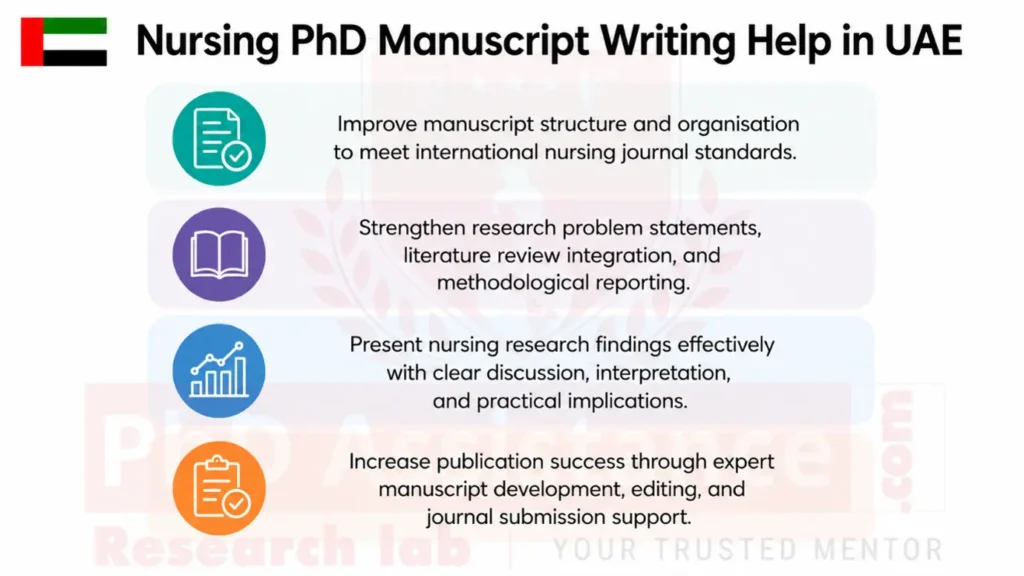
3. Addressing Poor Literature Review Integration with Journal Manuscript Writing Help in UAE
Problems with methodologies remain one of the commonest grounds for rejection of manuscripts submitted to healthcare and nursing journals. The ability of the reviewer to critically evaluate the scientific methodology of the research is of great importance. In some situations, the manuscript contains inadequate information about its methodology. If the reviewer finds it difficult to understand the process involved, he or she may question the conclusions of the research.
Such issues may include inadequate explanation of participant selection, sampling procedure, eligibility criteria, data collection process, ethical clearance, reliability test, validity test, and data analysis process among other methodological aspects. In certain instances, there may be no clear explanation as to why the researcher used a certain approach, hence raising the question of whether the approach is appropriate.
Seeking a Journal Manuscript Writing Help in UAE will enable researchers to provide an accurate description of the methodology used in the study. Researchers usually consider that information presented in the dissertations they have written is unnecessary for inclusion in an article they submit for publication in a journal. But it must be noted that the reviewers need enough information on the methodology used to judge the validity of the research work.
Example: These reporting models include CONSORT and COREQ, which have been adopted by many healthcare-related publications for assessing their methodological quality and reporting adequacy. Those who adhere to such guidelines are likely to increase the acceptability of their papers.
4. Weak Presentation of Results and Discussion
Most Nursing PhD papers have valid research findings but lack explanations of how the presented data are significant. In many cases, the authors will regurgitate the same results that have been presented earlier in the discussion section.
The reviewers of the journal expect the researchers to move beyond mere presentation of their results and would wish to know how the results relate to the practice of nursing, administration of health services, nursing education, or even policymaking. The discussion needs to be able to synthesise results with previous literature, reconcile any contradictions, discuss any surprises, and give the implications of the results.
Another frequent problem is the absence of any correlation between the results obtained and the research goals, hypotheses, and theories discussed. It reduces the scientific value of the paper altogether and might cause doubts as to the importance of this research on behalf of the reviewer. The authors must show the place of their study within the current body of knowledge.
Example: According to Warriner (2008), the value of research findings increases whenever authors succeed in linking their research to healthcare practice, policymaking, and clinical decision-making.
Get the pricing details for the PhD Part dissertation writing service at PhD Assistance Research Lab, designed to assist researchers in developing ethical AI-assisted dissertation chapters.
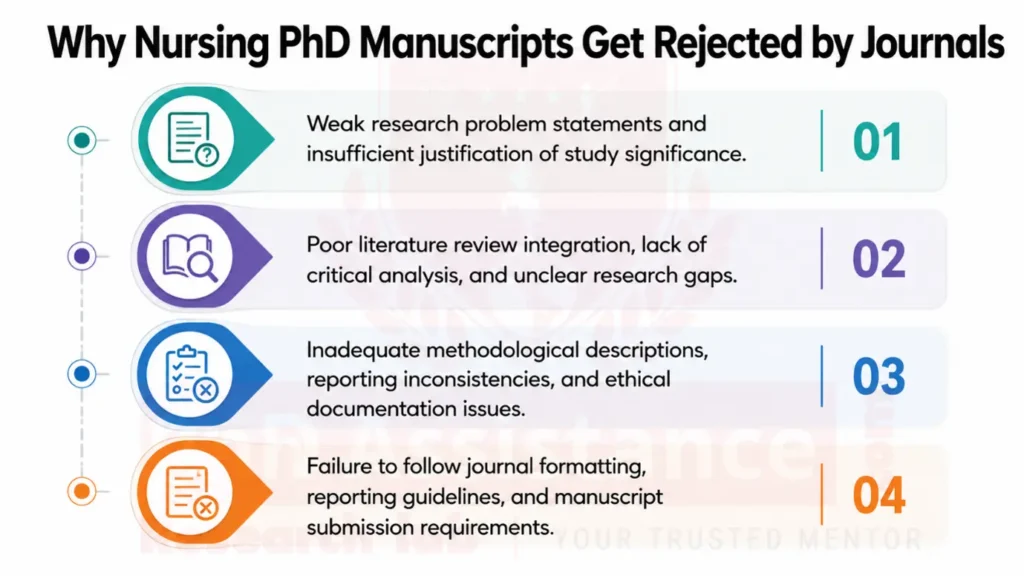
5. Failure to Follow Journal Guidelines
However, many papers written by nurses end up being rejected even before the process of peer review due to non-conformity with the submission guidelines of journals. This is even though such studies may have been conducted to very high standards, with significant potential for impact.
How the use of artificial intelligence would be useful in the above case includes helping students organise their findings, enhance writing skills and provide links to previous studies. Artificial intelligence would be able to help interpret the discussions and organise them properly while offering great insight into how to logically link the information.
There are journals which get hundreds of papers monthly for submission and have stringent methods of screening papers to establish those that do not fit technical criteria. The rejection of papers by editors usually implies that such papers have been developed without much thought in them or with inadequate reading of journal specifications.
Example: According to research by Björk and Solomon (2013) on the trends of publishing scholarly works, many submissions are rejected at the initial phase since most of them do not comply with various standards set by the journals. Technical non-conformity is among the most common reasons for instant rejection in many healthcare journals.
Strategies to Improve Nursing Manuscript Acceptance
- State the research problem clearly and justify its importance.
- Perform a critical analysis of relevant literature instead of describing it.
- Adhere to reporting standards based on the design of the study.
- Report results that have implications for nursing practice.
- Methodological clarity should be maintained throughout the manuscript.
- Adhere strictly to journal guidelines for submission.
- Ensure editing and proofreading are carried out professionally before submission.
- Expert nursing Manuscript and publication service in UAE is recommended for improved submission.
- Revising manuscripts according to reviewers’ and supervisor’s comments is necessary.
Conclusion
Publishing research papers in prestigious journals goes well beyond having conducted a great study; many factors must be considered, such as structure, methodology description, and scholarly language, among others, for the success of the submission.
Several doctoral students in nursing from the UAE have faced rejection of their papers, not because of any limitation in the results of the research itself, but because of some technical issues that are easy to avoid.
A successful publication is something that must be seen as the continuation of the research carried out as part of the dissertation for a PhD in Nursing. Through the dedication of effort in manuscript creation, reporting excellence, and scholarly writing, the work of nursing scholars can have more visibility.
Journal Nursing Manuscript Help in UAE at PhD Assistance Research Lab may assist students in turning their research into manuscripts that will be accepted for publication in international journals, contributing to their future success.
Book a Free Expert Consultation to increase the chances of getting your research published in a highly reputed journal.
References
- Polit, D. F., & Beck, C. T. (2021). Nursing Research: Generating and Assessing Evidence for Nursing Practice.
- Warriner D. (2008). How to Read a Paper: The Basics of Evidence-Based Medicine. BMJ : British Medical Journal, 336(7657), 1381. https://doi.org/10.1136/bmj.a186.
- Webster, J., & Watson, R. T. (2002). Analyzing the Past to Prepare for the Future: Writing a Literature Review. MIS Quarterly, 26(2), xiii–xxiii.
- Tong, A., Sainsbury, P., & Craig, J. (2007). Consolidated Criteria for Reporting Qualitative Research (COREQ). International Journal for Quality in Health Care, 19(6), 349–357.
- Schulz, K. F., Altman, D. G., & Moher, D. (2010). CONSORT 2010 Statement: Updated Guidelines for Reporting Parallel Group Randomised Trials. BMJ, 340, c332.
- Björk, B. C., & Solomon, D. (2013). The publishing delay in scholarly peer-reviewed journals. Journal of Informetrics, 7(4), 914–923.
