
Space Tourism Commercialisation and the Future Economics of Private Space Dissertation Topics I phdassistance.com
Info: Space Tourism Commercialisation and the Future Economics of Private Space Dissertation Topics I phdassistance.com
Published: 14th may in Space Tourism Commercialisation and the Future Economics of Private Space Dissertation Topics I phdassistance.com
Share this:
Related Services
Our academic writing and marking services can help you
Introduction
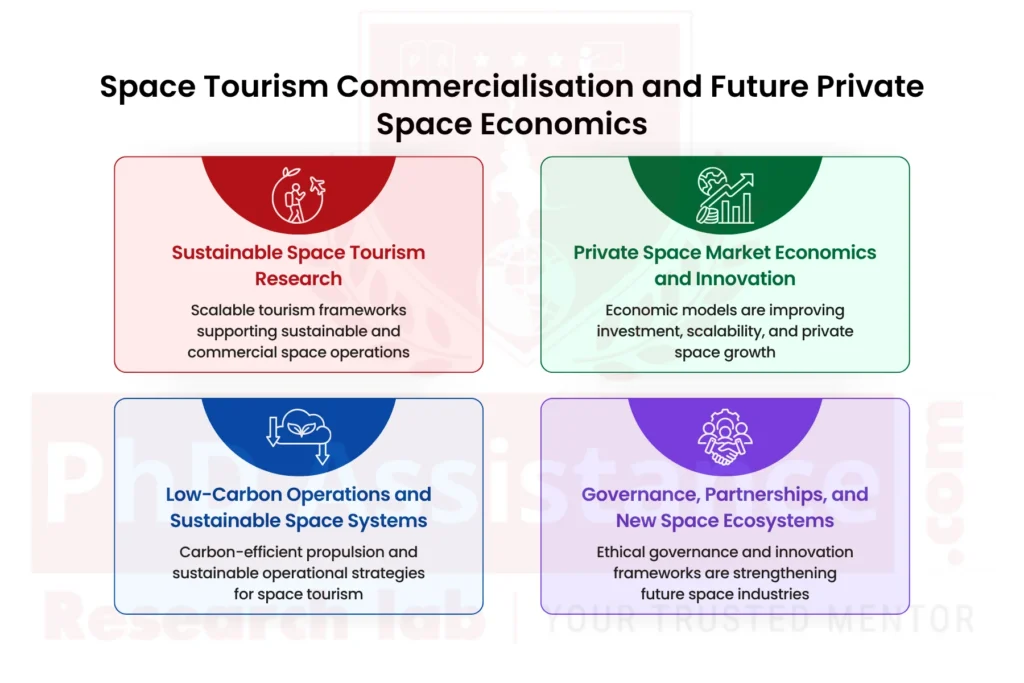
The researchers in Space Tourism find challenges in choosing PhD research topics that would meet academic and industrial requirements equally. The chosen area for pursuing research at the PhD level should reflect the latest advancements in private space endeavours, sustainable space tourism practices, regulations, environmental sustainability considerations, and new space technology innovations. PhD Assistance helps in choosing innovative and research-focused topics that reflect not only academic rigour but also the needs of the space tourism Commercialization. Research assistance is provided in areas like sustainable space tourism, economics of the private space market, and low-carbon operations. Each topic chosen by PhD Assistance meets the requirements of current research, university policies, and future needs of the industry.
Proposed PhD Topic 1: Developing Sustainable Consumer Behaviour Frameworks for Space Tourism Commercialisation
Background Context:
Commercialisation of space tourism is rapidly growing via the development of reusable launch systems, the operations of private aerospace companies, and luxurious tourism packages. The business of space tourism is increasingly addressing the needs of tourists regarding innovation and exciting trips. As per Khan et al. (2025) the risk perception, sustainability issues, and motivational behaviour have played a significant role in determining the decision-making process in space tourism activities. On the contrary, there is less research focus on the correlation between motivational behaviours and sustainability.
PhD-Level Verification:
In today’s research, the focus is on individual dimensions of novel experience, sensation, and adventure drives, but there is a lack of knowledge on the relationship between environmental consciousness, risk perception, behavioural economics, and consumer trust within scalable space tourism businesses. Also, there is no comprehensive comparative study on psychological motivations toward sustainable customer engagement.
Research Questions:
PhD-Level Contributions:
Suggested Readings:
Khan, G. A., Bashir, I., Alshiha, A. A., Alnasser, E. M., Alkhozaim, S. M., & Alshiha, F. A. (2025). Balancing thrill, risk and sustainability: An optimal arousal perspective on space tourism intentions. Journal of Tourism Futures.
Proposed PhD Topic 2: Designing Low-Carbon Operational Frameworks for Sustainable Space Tourism Commercialisation
Background Context:
The unprecedented growth of the space tourism sector has triggered serious issues of sustainability, carbon footprints, and ecological consequences. The current levels of CO2 produced by suborbital travel are substantially higher per passenger than the amounts produced by commercial airlines. According to a study published in PLOS One, the authors, Huang and Xu (2025), have shown that the suborbital tourism industry will emit more CO2 annually than some countries if its commercial success continues to grow. The economics of space tourism are becoming more reliant on innovation and environmental considerations as the world’s climate policies tighten.
PhD-Level Verification:
Researchers study explainable artificial intelligence applications in finance through credit scoring systems and fraud detection systems, while they ignore live trading systems. Financial markets need high-speed conditions because their existing research shows there is no operational explainability method that meets their performance requirements. The existing studies fail to establish a proper balance between making things understandable and achieving effective predictions, which creates a major research gap.
Research Questions:
PhD-Level Contributions:
Suggested Readings:
Huang, A. M., & Xu, Y. (2025). Estimating CO₂ emissions due to present and future suborbital space tourism industry. PLOS One, 20(8), e0328456.
Proposed Dissertation topic 3: Advancing Interdisciplinary Governance Models for Ethical AI in Trading and Cross-Border Financial Regulation
Background Context:
The future of private space ventures is largely characterised by factors such as commercial innovation, private financing, launch systems, and demand for space services. This is due to the change in the space business from the government’s exploratory approach to commercialising space ventures. According to Yolusever (2025) in İzmir Sosyal Bilimler Dergisi, reduced costs of launch, commercial investment, and innovations have altered the economics of the global private space market. Nevertheless, there remain some challenges associated with sustainable development in space tourism, due to issues such as governance constraints and infrastructure costs.
PhD Level Verification:
Contemporary research tends to examine the evolution of the space economy as well as aerospace commercialisation; however, there is a lack of literature on the subject of integrated approaches to policy, strategy, and economy of the commercial space industry as a whole. No model would compare policy, strategy, and economics of the private space market.
Research Questions:
PhD-Level Contributions:
Suggested Readings:
Yolusever, A. (2025). The space economy: A new frontier for economic growth and innovation. İzmir Sosyal Bilimler Dergisi, 7(1), 15–31.
Proposed Dissertation Topic 4: Building Public–Private Partnership Models for Sustainable Space Tourism Commercialisation
Background Context:
The impact of public and private partnerships on the private sector in space industry can be seen from the present collaborations, ecosystems, and infrastructural development processes. This can be evidenced from programs such as the Artemis program and International Lunar Research Station, which show increased participation by commercial ventures in the realm of space exploration and tourism. As noted by Peeters & Ehrenfreund (2025), “Future space exploration will rely increasingly on responsible governance, collaboration among multiple stakeholders, and a sustainable public-private partnership approach”. Yet, there remain some concerns in the commercial space industry about funding, sustainability, governance, and cooperation.
PhD-Level Verification:
The present body of literature analyses either government-sponsored exploration initiatives or commercial innovations in isolation. It does not offer any analysis on public-private partnership models that incorporate ethics and sustainability in space exploration activities, along with the scalability of business in the future. There is also scope for research in designing coordination mechanisms among multiple stakeholders.
Research Questions:
Contributions at the PhD-Level:
Suggested Readings:
Peeters, W., & Ehrenfreund, P. (2025). Charting the future of space: A collaborative vision for innovative commercial partnerships and sustainable space exploration. New Space, 13(1).
Proposed Dissertation Topic 5: Designing Domain-Specific and Regulatory-Compliant Explainable AI Models for Transparent Financial Systems
Background Context:
Space ecosystem evolution has played an important role in making commercial space activities more democratic via the deployment of reusable rockets, CubeSats, satellite constellations, and financing mechanisms. The commercial space tourism sector is enjoying increased access to affordable rocket launches, accessible technology, and growing commercial infrastructure. According to Peeters (2025), writing in the journal Businesses, entrepreneurial innovations, small satellite technologies, and lower costs are allowing new space nations to be active players in the world space economy. Despite these advances, traditional space tourism business models still struggle with scalability issues in infrastructure, personnel, policies, and economics.
PhD-Level Verification:
The current literature on the expansion of the New Space ecosystem and innovation in the aerospace sector has been considered separately. However, little research is available on a comprehensive business ecosystem framework that can contribute to the scalability and accessibility of sustainable tourism across the globe. There is a lack of strategic model literature for the private space market economy.
Research Questions:
PhD-Level Contributions:
Suggested Readings:
Peeters, W. (2025). New Space business: An opportunity for emerging space nations. Businesses, 5(4), 50.
Need assistance finalising your dissertation topic? Selecting a strong, researchable topic can be challenging — but you don’t have to do it alone.
Our research consultants can help refine your ideas, identify literature gaps, and guide you toward a topic that aligns with current academic trends and your programme requirements.
Contact us to begin one-on-one topic development and refinement with PhdAssistance.com Research Lab.
Share this:
Cite this work
PhDAssistance. (n.d.). Cybersecurity in business Dissertation Topics Retrieved January 28th, from https://phdassistance.com/topic/cybersecurity-business/
Jalolova, M., and Musawwir, M. “Cybersecurity in business Dissertation Topics for PhD Scholars.” PhDAssistance, https://phdassistance.com/topic/cybersecurity-business/ Accessed 28th January 2026.
Jalolova, M., and Musawwir, M., n.d. Cybersecurity in business Dissertation Topics for PhD scholars. [online] Available at: https://phdassistance.com/topic/cybersecurity-business/ [Accessed 28th January 2026].
Jalolova M., Musawwir M. Cybersecurity in business Dissertation Topics for PhD scholars [Internet]. PhDAssistance; [cited 2026 28th January]. Available from: https://phdassistance.com/topic/cybersecurity-business/
Jalolova, M., and Musawwir, M. (n.d.). Cybersecurity in business Dissertation Topics for PhD scholars. Retrieved 28th January 2026, from https://phdassistance.com/topic/cybersecurity-business/
Jalolova, M., and Musawwir, M., Cybersecurity in business Dissertation Topics (n.d.) https://phdassistance.com/topic/cybersecurity-business/ accessed 28th January 2026.
Study Resources
Free resources to assist you with your university studies!