
Metabolic Engineering of Microbial Strains for Sustainable Bioplastic Production
Info: Metabolic Engineering of Microbial Strains for Sustainable Bioplastic Production Topics I phdassistance.com
Published: 7th September in Metabolic Engineering of Microbial Strains for Sustainable Bioplastic Production Topics I phdassistance.com
Share this:
Related Services
Our academic writing and marking services can help you
Introduction
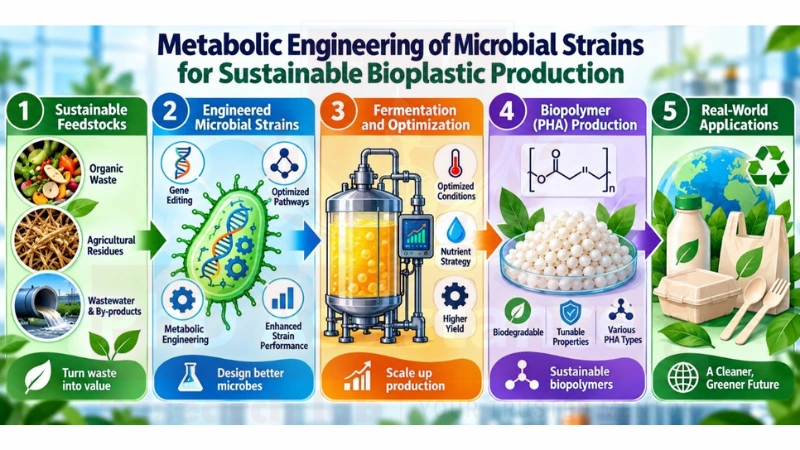
The increasing need for a viable substitute for plastics made up of petroleum products has resulted in the utilisation of microbes in the production of bioplastics. By engineering microbes to produce biodegradable polymers made from sustainable sources and wastes, such as polyhydroxyalkanoates (PHA), one can develop more efficient production of bioplastic materials. However, PHA production involves several technical challenges. There have been studies examining various approaches to metabolic engineering for improving microbial synthesis of PHA. This offers opportunities for exploring ways of integrating metabolic engineering for bioplastic production.
Proposed PhD Topic 1: Cell-Free-Guided Metabolic Engineering for Enhanced Microbial PHA Bioplastic Production
Background Context:
The cell-free TX-TL system represents an effective technique for prototyping PHA biosynthesis pathways before introducing selected pathways into engineered E. coli. The cell-free system can assist in in vivo metabolic engineering by evaluating various configurations and the genetic design of a metabolic pathway in vitro. Kelwick et al. (2018) showed how a cell-free system could be used to prototype a PHA biosynthesis operon in their study and further tested it in engineered E. coli bacteria. The results of this study suggest that cell-free prototyping could help to select promising pathway designs before conducting in-depth tests. Nonetheless, the study focused on a selected PHA construct instead of developing a systematic protocol linking cell-free systems and Microbial Bioplastic Production outcomes in microorganisms. Thus, there is an opportunity for further research in combining cell-free screening with metabolic modelling and strain engineering to optimise the PHA biosynthesis pathway.
Why This Could Support PhD Level Research:
Based on the results from Kelwick et al. (2018), a PhD study could assess how pathway performance within cell-free systems can help provide insights for the engineering of microbes. This research would involve combining cell-free prototyping, metabolic modelling, and genetic engineering with validation within E. coli. The research would seek pathways/enzyme combinations whose performance is consistent across cell-free and living cell conditions.
Research Questions:
Contributions at the PhD-Level:
Suggested Readings:
Kelwick, R., Ricci, L., Chee, S. M., Bell, D., Webb, A. J., & Freemont, P. S. (2018). Cell-free prototyping strategies for enhancing the sustainable production of polyhydroxyalkanoates bioplastics. Synthetic Biology, 3(1), ysy016. https://doi.org/10.1093/synbio/ysy016
Proposed PhD Topic 2: Integrated Metabolic Engineering of Cupriavidus necator for High-Yield PHA Copolymer Production
Background Context:
Cupriavidus necator serves as a significant microbial chassis for PHA synthesis, as the metabolism of this organism is genetically modifiable to increase carbon flow towards biosynthesis of the polymer. Nevertheless, obtaining high PHA yields while simultaneously promoting the growth of cells and ensuring control of the polymer composition poses an important problem, especially when using renewable or waste substrates for cultivation of C. necator. Hectors et al. (2025) presented a review of metabolic engineering approaches in the case of carbon flux, cofactor balance, and pathway modification aimed at increasing PHA synthesis in C. necator. Hence, it can be considered that there are some possibilities for studying the effect of metabolic engineering approaches on PHA synthesis.
Why This Could Support PhD-Level Research:
Based on the information synthesised in Hectors et al. (2025), a PhD project can explore the effects of carbon flux engineering, cofactor balances, and pathway manipulation in C. necator. This project can investigate the effects that such modifications have on the production of PHA, its monomer profile, and cell growth on renewable or waste-based substrate feedstocks. This may help in developing more focused metabolic engineering strategies for PHA production.
Research Questions:
Contributions at the PhD-Level:
Suggested Readings:
Hectors, W., Delmulle, T., & Soetaert, W. K. (2025). Metabolic Engineering Strategies for Enhanced Polyhydroxyalkanoate (PHA) Production in Cupriavidus necator. Polymers, 17(15), 2104. https://doi.org/10.3390/polym17152104
Proposed Dissertation topic 3: Combinatorial Metabolic Network Rewiring for Substrate-Adaptive PHB Production in Corynebacterium glutamicum
Background Context:
C. glutamicum provides an alternative host for PHB biosynthesis because its central metabolism can be engineered through genetic and regulatory manipulation. A combinatorial approach could be applied to analyse various metabolic designs rather than single-gene manipulations. The FACS screening technique used by Yim et al. (2023) enabled researchers to screen a library of combinatorial metabolic configurations and identify designs that improved PHB production through rewiring of central carbon metabolism. Moreover, the study indicated that the application of different metabolic designs could result in enhanced PHB biosynthesis based on whether glucose or fructose would be the carbon substrate for microbial fermentation. Thus, this work revealed the significance of substrate-related responses of metabolism for the development of microbial strains with substrate-adaptive PHB production. One possible avenue for further research is to test other substrates and environmental conditions for a new combinatorial metabolic rewiring.
Why This Could Support PhD Level Research:
Based on the study by Yim et al. (2023), a PhD thesis may explore the ways in which the combinatorial metabolic rewiring technology can be applied in relation to the use of various carbon sources and production conditions. Metabolic modelling, as well as FACS screening and genetic confirmation of metabolic networks that result in enhanced PHB productivity, could be explored.
Research Questions:
Contributions at the PhD-Level:
Suggested Readings:
Yim, S. S., Choi, J. W., Lee, Y. J., & Jeong, K. J. (2023). Rapid combinatorial rewiring of metabolic networks for enhanced poly(3-hydroxybutyrate) production in Corynebacterium glutamicum. Microbial Cell Factories, 22, 29. https://doi.org/10.1186/s12934-023-02037-x
Proposed Dissertation Topic 4: Hybrid Microbiome Engineering for Robust Cyanobacterial Bioplastic Production
Background Context:
Genetically modified cyanobacteria represent a photosynthetic basis for PHB synthesis and offer an option to utilise light and CO2 as primary raw materials for PHB production. Stability of the process in the face of changes in the environment and scaling of the system are some of the factors that need to be considered. In the work carried out by Zini et al. (2026), the researchers created a photosynthetic microbiome by adding a genetically modified strain of Synechocystis to a naturally occurring microbial community. The hybrid system was characterised by increased stability under the influence of light and temperature variations, and PHB production was observed even when the system was run in larger-scale photobioreactors at concentrations of up to 32% PHB as a percentage of cell dry weight under photoautotrophic growth conditions. Other relevant factors include optimisation of productivity and reactor design for scalability. Therefore, further research could investigate the impact of such interactions on the stability and productivity of PHB synthesis.
Why This Could Support PhD-Level Research:
Based on Zini et al. (2026), a PhD topic could examine the effects of the composition of the microbial community, the environment and photobioreactor operating parameters on PHB productivity. The temporal analysis of the microbial community could be integrated with metabolism and process information to determine the interactions between the microbial community and the productivity of the process.
Research Questions:
Contributions at the PhD-Level:
Suggested Readings:
Zini, A., Müller, J., Fink, P., & Forchhammer, K. (2026). Cultivation in a Natural Microbial Community Enhances the Industrial Performance of a Genetically Engineered Cyanobacterium for Bioplastic Production. Microbial Biotechnology, 19(1), e70302. https://doi.org/10.1111/1751-7915.70302
Proposed Dissertation Topic 5: Functional Characterization and Metabolic Engineering of Novel Yeast PHA Biosynthesis Pathways
Background Context:
Yeasts have been considered an effective system for sustainable PHA production due to the ease of genetic manipulation, different substrate utilisation capabilities, and storage product accumulation capability. New genes coding for PHA biosynthesis pathways in yeast could provide additional information for future pathway construction and improve understanding of the pathway in poorly characterised microorganisms. In this context, the recent work by Abd-El-Haleem et al. (2024) has revealed a possible gene coding for sugar utilisation in the wild-type yeast strain DMG-2, identified as H. valbyensis, which also possesses some regulatory domains. The authors showed that this candidate gene was successfully cloned into E. coli, resulting in increased PHA accumulation, including PHB and PHV. This research provides grounds for studying the functional significance of novel genetic material regarding PHA biosynthesis. One may consider the identification of novel genetic elements and regulators as a promising research area.
Why This Could Support PhD-Level Research:
Based on Abd-El-Haleem et al. (2024), a PhD project could explore the physiological functions of candidate PHA genes and their regulators through genetic/metabolic engineering techniques. The work would involve studying gene expression, pathway activities and PHA biosynthesis in engineered hosts, such as E. coli, among others. In addition, it could assess whether the identified genes can be incorporated into E. coli metabolic engineering strategies to enhance PHA biosynthesis.
Research Questions:
Contributions at the PhD-Level:
Suggested Readings:
Abd-El-Haleem, D. A. M., Elkatory, M. R., & Abu-Elreesh, G. M. (2024). Uncovering novel polyhydroxyalkanoate biosynthesis genes and unique pathway in yeast Hanseniaspora valbyensis for sustainable bioplastic production. Scientific Reports, 14, 27162. https://doi.org/10.1038/s41598-024-77382-x .
Need assistance finalising your metabolic engineering for bioplastic production PhD topic? Developing a strong, researchable topic around microbial strain engineering, PHA production, metabolic pathway optimisation, or sustainable bioplastic production can be challenging — but you don’t have to do it alone.
Our research consultants can help refine your ideas, identify gaps in the literature, and guide you toward a topic that aligns with current academic trends and your programme requirements.
Contact us to begin one-on-one topic development and refinement with PhD Assistance Research Lab.
FAQs:
- How are microbial strains engineered to produce sustainable bioplastics?
Microbial strains are engineered by modifying metabolic pathways to direct cellular resources toward PHA production. Common strategies include controlling gene expression, redirecting carbon flux, strengthening precursor supply, and reducing competing metabolic pathways. - What are the current challenges in scaling up microbial bioplastic production?
Key challenges include production cost, maintaining high productivity at larger scales, efficient utilisation of renewable or waste-based substrates, controlling polymer composition, and balancing microbial growth with PHA accumulation. - What is metabolic engineering for sustainable bioplastic production?
Metabolic engineering is the targeted modification of microbial metabolic pathways to alter cellular metabolism for a desired product. In sustainable bioplastic production, it is used to improve the conversion of carbon sources into PHA and optimise production-related traits. - How does metabolic engineering improve PHA production?
Metabolic engineering can improve PHA production by increasing precursor availability, redirecting metabolic flux toward PHA biosynthesis, optimising cofactor balance, and reducing competing pathways. These changes can improve PHA yield, productivity, or polymer composition. - Which microbes are commonly engineered for bioplastic production?
Commonly investigated hosts include Escherichia coli, Cupriavidus necator, Corynebacterium glutamicum, cyanobacteria such as Synechocystis, and selected yeast species. Each offers different advantages for pathway engineering, substrate utilisation, and PHA production.
Share this:
Cite this work
PhD Assistance. (n.d.). Metabolic engineering for bioplastic production. Retrieved September 1, 2026, from PhD Assistance.
PhD Assistance. “Metabolic Engineering for Bioplastic Production.” PhD Assistance, n.d. Web. 1 Sept. 2026.
PhD Assistance. “Metabolic Engineering for Bioplastic Production.” PhD Assistance. Web. 1 Sept. 2026.
PhD Assistance (n.d.) Metabolic Engineering for Bioplastic Production. Available at: https://www.phdassistance.com/topic/metabolic-engineering-for-bioplastic-production (Accessed: 1 September 2026).
PhD Assistance. Metabolic Engineering for Bioplastic Production [Internet]. [cited 2026 Sep 1]. Available from: PhD Assistance – Metabolic Engineering for Bioplastic Production
PhD Assistance. “Metabolic Engineering for Bioplastic Production.” PhD Assistance. Retrieved September 1, 2026, from PhD Assistance – Metabolic Engineering for Bioplastic Production
PhD Assistance, ‘Metabolic Engineering for Bioplastic Production’ (PhD Assistance, n.d.) https://www.phdassistance.com/topic/metabolic-engineering-for-bioplastic-production accessed 1 September 2026.
Study Resources
Free resources to assist you with your university studies!