
Circular Fashion Systems and Sustainable Consumer Culture Transformation Dissertation Topics I phdassistance.com
Info: Circular Fashion Systems and Sustainable Consumer Culture Transformation Dissertation Topics I phdassistance.com
Published: 25th may in Circular Fashion Systems and Sustainable Consumer Culture Transformation Dissertation Topics I phdassistance.com
Share this:
Related Services
Our academic writing and marking services can help you
Introduction
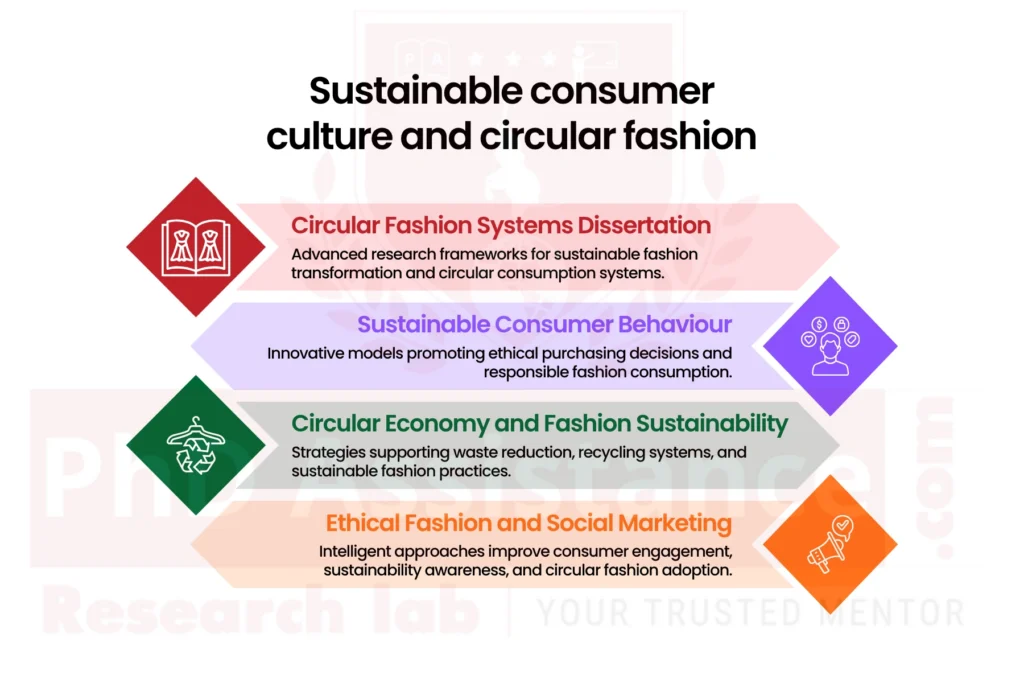
The fashion industry today is facing issues such as sustainability and ethical consumption. Problems related to environmental hazards, wastage, and over-consumption have emerged as concerns and are a threat to the environment. There are many research projects going on to find out new frameworks that help in rational consumption, sustainable production systems, and environmental responsibility. The Circular Fashion Systems Dissertation topics have attracted much attention because of their contribution to fostering circular consumption models, sustainable consumer behaviour, and the ethical fashion revolution. Apart from these, there are a few other techniques, such as social marketing, culture transformation, and sustainable policies, which are making a difference by engaging industries with consumers under the circular economy.
Proposed PhD Topic 1: Artificial Intelligence-Driven Sustainable Fashion Retail Systems for Enhancing Consumer Experience and Circular Fashion Innovation
Background Context:
The integration of AI technology into the fashion retail industry involves personalising products, providing virtual dressing room options, creating an intelligent logistics chain, and analysing data to engage customers. The fashion retail sector faces several problems using traditional approaches, which include overproduction, stock problems, unsustainable consumption patterns, and a lack of personalisation in consumer engagement. To overcome these limitations, it is becoming evident that more scholars are developing an interest in AI-enabled retail innovation strategies for sustainable consumer culture. AI applications are further promoting the Circular Economy by facilitating intelligent inventory planning, waste minimisation, and responsible retailing. According to Burnstine (2025), AI-based fashion systems bring about high levels of efficiency, sustainability, and consumer engagement.
PhD-Level Verification:
Whereas the literature highlights existing research efforts in areas such as retail personalisation and optimisation in the supply chain using AI, few studies have considered the use of AI for sustainable analysis in ethics-based retailing and a consumer-centred circular fashion paradigm. The other issue is the lack of focus on behavioural transformation towards sustainability.
Research Questions:
PhD-Level Contributions:
Suggested Readings:
Burnstine, A. (2025). The Role of Artificial Intelligence in Transforming Physical and Online Fashion Retail. https://ccsenet.org/journal/index.php/
Proposed PhD Topic 2: Circular Economy-Based Fashion Design Education Frameworks for Sustainable Research and Environmental Awareness
Background Context:
The Circular Economy approach is increasingly gaining ground within fashion design education through its influence on sustainable product design, resource efficiency, and environmentally friendly design processes. The typical fashion education system often focuses on aesthetics and commercial fashion design without sufficient attention to sustainability ideas. Several studies have been conducted in Sustainable Fashion Research to incorporate the principles of the circular economy into the educational system of fashion design. Moreover, the aspect of education on sustainability plays an important part in guaranteeing that future fashion designers understand the impact of their fashion practices on the environment. According to Moreira et al. (2025), integration of the circular economy in fashion education promotes environmental consciousness.
PhD-Level Verification:
While much of the literature revolves around sustainable design principles and environmental education, there is very little research done regarding sustainable fashion curriculum design involving circular economy principles, sustainability literacy, and pedagogically innovative approaches. There is also a lack of research in terms of creating industry-specific sustainability training modules for fashion professionals.
Research Questions:
PhD-Level Contributions:
Suggested Readings:
Moreira, S., et al. (2025). Circular Economy Practices in Fashion Design Education: The First Phase of a Case Study. https://www.mdpi.com/2071-1050/17/3/951
Proposed Dissertation topic 3: Sustainable Circular Fashion Supply Chain Models for Ethical Fashion and Regenerative Fashion Systems
Background Context:
In the fashion industry, the environmental and societal issues include pollution, carbon dioxide emissions, manufacturing processes, and consumption processes. Strategies regarding sustainable circular supply chain management that seek to create ethically made goods are being investigated. With more companies adopting Ethical Fashion processes, fashion firms are adopting various strategies such as recycling programs and sustainable sourcing methods. Circular Economy in Fashion is another concept that has become popular and is proving to be beneficial in solving the problems of waste generation. According to Burnstine and Ghattas (2025), circular fashion systems can help in waste generation and sustainable business performance in the fashion industry.
PhD Level Verification:
While previous literature has emphasised circular supply chain management and sustainable production systems, little attention has been paid to sustainable fashion governance approaches. Moreover, little attention has been paid to system transformation methods that consider consumer culture, sustainable development policies, and circular production ecosystems.
Research Questions:
PhD-Level Contributions:
Suggested Readings:
Burnstine, A.P., & Ghattas, R. (2025). Assessing the Sustainable Circular Fashion Supply Chain as a Model for Achieving Economic Growth in the Global Market. https://www.mdpi.com/2071-1050/17/19/8558
Proposed Dissertation Topic 4: Socio-Cultural Transformation Frameworks for Sustainable Culture and Fashion Ecosystem Sustainability
Background Context:
There is a growing understanding in the fashion industry of the significance of socio-cultural sustainability and responsible consumption practices for sustainable economic and environmental development. Fast fashion systems, which have traditionally dominated the industry, result in wasteful behaviour and consumption patterns. Scholars have shifted their attention to cultural transformation approaches that support Sustainable Culture, rational consumption patterns, and sustainable behavioural change. Also, socio-cultural sustainability approaches help develop sustainable production systems and fashion ecosystems. As Hardabkhadze (2025) argues, culture plays an important part in controlling the sustainability transformation process within the fashion industry ecosystem.
PhD-Level Verification:
Prior research has focused primarily on sustainability from an economic and environmental perspective, with limited focus on the effect of socio-cultural transformations on consumers and culture within the context of sustainable fashion systems. Moreover, there is inadequate emphasis on the integration of cultural sustainability approaches into fashion system transformation initiatives.
Research Questions:
Contributions at the PhD-Level:
Suggested Readings:
Hardabkhadze, I. (2025). Role of Culture in Transformation Processes of the Fashion Industry Ecosystem. http://culture-art-knukim.pp.ua/article/view/340331 .
Proposed Dissertation Topic 5: Consumer Behaviour and Social Marketing Frameworks for Fashion Sustainability Dissertation and Circular Fashion Adoption
Background Context:
Consumer behaviour and social marketing are currently making crucial contributions towards encouraging sustainable fashion acceptance and creating circular consumption systems. Fashion industries have been facing some problems, including over-consumption, waste creation, consumer reluctance towards sustainability, and a lack of understanding of circular fashion systems among consumers. The new focus of researchers is to find out models of cultural transformation, which can create a sustainable culture through rational consumption and sustainable behaviour. Furthermore, the concept of socio-cultural sustainability is being used to foster an ethical production process along with a sustainable fashion environment. Hardabkhadze (2025) asserts that culture is very significant in managing sustainability transformations.
PhD-Level Verification:
Current studies have focused only on sustainable consumer behaviour and circular fashion adoption. Very few studies have examined multi-level social marketing interventions, sustainability policy frameworks, and behavioural transformation systems towards sustainable fashion. Furthermore, very little attention has been given to consumer engagement approaches for circular economy transitions.
Research Questions:
PhD-Level Contributions:
Suggested Readings:
Faludi, J. (2025). Sustainable Fashion, Circularity and Consumer Behaviour – Systematic Review and a Social Marketing Research and Policy Agenda. https://journals.sagepub.com/doi/10.1177
Need assistance finalising your dissertation topic? Selecting a strong, researchable topic can be challenging — but you don’t have to do it alone.
Our research consultants can help refine your ideas, identify literature gaps, and guide you toward a topic that aligns with current academic trends and your programme requirements.
Contact us to begin one-on-one topic development and refinement with PhdAssistance.com Research Lab.
Share this:
Cite this work
PhDAssistance. (n.d.). Cybersecurity in business Dissertation Topics Retrieved January 28th, from https://phdassistance.com/topic/cybersecurity-business/
Jalolova, M., and Musawwir, M. “Cybersecurity in business Dissertation Topics for PhD Scholars.” PhDAssistance, https://phdassistance.com/topic/cybersecurity-business/ Accessed 28th January 2026.
Jalolova, M., and Musawwir, M., n.d. Cybersecurity in business Dissertation Topics for PhD scholars. [online] Available at: https://phdassistance.com/topic/cybersecurity-business/ [Accessed 28th January 2026].
Jalolova M., Musawwir M. Cybersecurity in business Dissertation Topics for PhD scholars [Internet]. PhDAssistance; [cited 2026 28th January]. Available from: https://phdassistance.com/topic/cybersecurity-business/
Jalolova, M., and Musawwir, M. (n.d.). Cybersecurity in business Dissertation Topics for PhD scholars. Retrieved 28th January 2026, from https://phdassistance.com/topic/cybersecurity-business/
Jalolova, M., and Musawwir, M., Cybersecurity in business Dissertation Topics (n.d.) https://phdassistance.com/topic/cybersecurity-business/ accessed 28th January 2026.
Study Resources
Free resources to assist you with your university studies!