
- / Title
Graph Neural Networks and Explainable AI for Complex Multimodal Data Analytics DissertationTitles | phdassistance.com
Info: Graph Neural Networks and Explainable AI for Complex Multimodal Data Analytics DissertationTitles | phdassistance.com
Published: 26th June 2026 in Graph Neural Networks and Explainable AI for Complex Multimodal Data Analytics DissertationTitles | phdassistance.com
Share this:
Related Services
Introduction
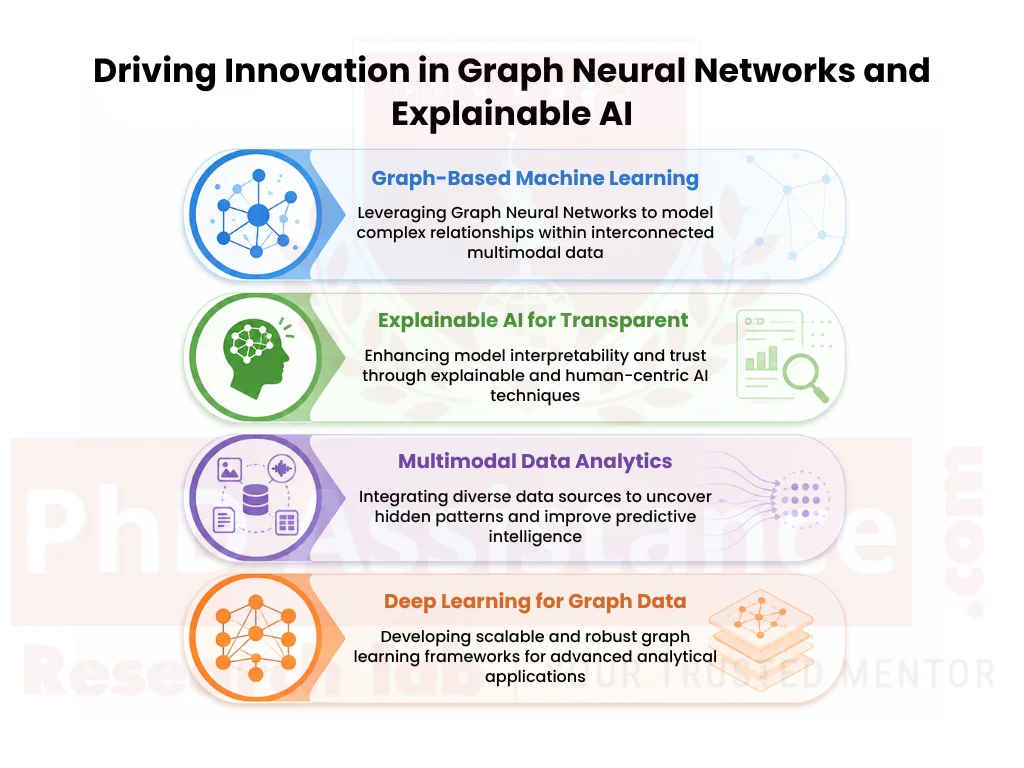
Over the past couple of years have seen some tremendous growth in AI (Artificial Intelligence), ML (Machine Learning), and data mining algorithms, which have transformed temporal data mining and analysis for different domains of applications, including healthcare, cybersecurity and intelligent systems. Recently, causality inference research has shifted the focus away from correlation analysis, making progress towards causality and prediction of temporal data patterns. In parallel, computational capabilities have improved significantly, and the amount of data available enables advanced analysis with topological methods for identifying patterns from data with high dimensionality. The development of Graph Neural Networks further improved graph mining approaches, with proven power to model network-like and dynamically changing data. Nevertheless, there are some inherent challenges remaining in scalability, interpretability, security and trustworthiness. Therefore, developing a secure, interpretable and computationally efficient framework, such as causal-topological learning, is crucial for recognising complex temporal patterns.
Proposed PhD Title 1: Explainable AI-Driven Graph Neural Network Frameworks for Multimodal Data Analytics in Neurodegenerative Disease Biomarker Discovery
With advancements in brain neuroimaging, gene sequencing, gene transcript data, and Electronic Medical Records (EMRs), Multimodal Analytics are increasingly deployed in biomedical research in healthcare. It provides a robust and invaluable resource to explore progression patterns and potential markers for neurological diseases. Recent developments in Machine Learning have also been utilised to analyse inherent relationships in a biological graph, which standard ML may fail to observe. For instance, Tripathy et al. (2025) have demonstrated the potential of Graph Networks in modelling interwoven relationships in biomedicine to enhance accuracy. Meanwhile, the growing need for reliable and trustworthy artificial intelligence in healthcare also pushes for Explainable AI and Artificial Intelligence to increase acceptance and trust among healthcare professionals. Recently, while much focus has been put into training accurate predictive models with Deep Learning on Graph data, a holistic model is required that integrates accuracy, interpretability, and decision support for clinical care.
Problem Statement:
Existing clinical and biomedical analytic tools usually treat neuroimaging, genomic, and clinical data in silos, thereby failing to exploit associations and correlations among different factors that contribute to a disease. While Neural Networks ield promising predictive performance, most current models are “black box” approaches lacking transparency. The explainability gap would cause distrust and limit the practical use of these tools by clinicians.
Research Gap:
GNNs have delivered encouraging outcomes for multimodal biomedical analytics, though current work has mainly concentrated on predictive power. Scarcely any papers merge XAI, disease progression prediction and clinical determination under one framework and offer adequate model opacity to apply in the clinical context.
Research Question:
Can XAI-assisted Neural Networks assist in identifying multimodal biomarkers for neurodegenerative disease prediction with better accuracy?
Outcome:
This research aims to create a multimodal XAI-based Graph Neural Network framework to analyse neurodegenerative disease through the identification of improved biomarkers, increased diagnostic certainty and an understandable explanation of the clinical interpretation, which can contribute to enabling clinically meaningful decisions to be made with trust.
Reference:
Tripathy, R. K., Frohock, Z., Wang, H., Cary, G. A., Keegan, S., Carter, G. W., & Li, Y. (2025). Effective integration of multi-omics with prior knowledge to identify biomarkers via explainable graph neural networks.
Proposed PhD Title 2. Dynamic Graph Neural Networks with Explainable AI for Real-Time Multimodal Data Analytics in Healthcare Systems
Numerous continuously evolving healthcare datasets are produced by healthcare systems such as EMRs, X-ray data, and other sources like wearable smart devices and remote patient monitoring tools. Continuous and ever-changing data provide huge opportunities for state-of-the-art Multimodal Analytics and smart prediction models in healthcare. Nevertheless, most common machine learning approaches assume static graphs that cannot handle patients’ ever-changing conditions and their relationships. In addition to static graphs, Sadeghi et al. (2026) acknowledged the fact that learning on dynamic graphs for healthcare time evolution is essential to reflect evolving and changing health networks. In Machine Learning, Deep Learning for Graph Data, and XAI should not only make models more accurate, but they can also make models better by providing explanations in terms of why a certain output is obtained. Despite the importance, no prior work has thoroughly exploited any artificial Intelligence framework that effectively incorporates dynamic temporal information and multimodal data in a single system.
Problem Statement:
The majority of existing healthcare analytics systems rely on stationary static graph structures, which cannot adequately capture the transient dynamics of patients and their interactions. Existing works leverage the rich temporal aspect of the heterogeneous clinical datasets. However, most Graph-Based Machine Learning models are not adapted for the modelling of transient interdependencies, and they often struggle to provide explicit and interpretable prediction explanations.
Research Gap:
Most recent research in dynamic graph learning focuses on temporal forecasting in dynamic networks, and there have few researches combine dynamic graph modelling with multimodal analytics and XAI.
Research question:
Can dynamic graph networks coupled with XAI optimise real-time multimodal prediction for the healthcare domain?
Outcome:
This study aims to generate an energetic graph-based health analytics system for real-time investigation of ever-changing multimodality patient’s data with increased predictive capacity and an understandable decision process from XAI to foster smart clinic management and a timely medical intervention system.
Reference:
Sadeghi, A., Hajati, F., Argha, A., Lovell, N. H., Yang, M., & Alinejad-Rokny, H. (2026). Interpretable graph-based models on multimodal biomedical data integration: A technical review and benchmarking.
Proposed PhD Title 3. Explainable Heterogeneous Graph Neural Networks for Multimodal Data Analytics with Missing and Imbalanced Data
Multimodal datasets are gaining prominence across various domains like smart systems, smart cities, social media and networks, financial markets and healthcare; thereby paving new frontiers in the age of data-driven intelligence. However, most real-world Multimodal Datasets suffer from missing data, disparate knowledge representation and the diverse nature of relations that make it difficult for classic methods to process. Rogovschi et al. (2025) had earlier shown how heterogeneous Networks can capture relationships in a Multimodal setup. This led to the exploration of Machine Learning in the domain of complex Multimodal Analytics. Furthermore, transparency and trustworthiness of AI systems are essential for organisations. While Deep Learning for graphs is excellent at providing accurate predictions, the application of XAI and interpretable artificial intelligence is minimal in the presence of heterogeneous and incomplete information in a multimodal setup.
Problem Statement:
In real applications, real-world multimodal data has been identified as having missing values, imbalanced information and heterogeneous relations, and these issues have led to degraded machine learning models. While GNN can be exploited to depict the various relationships, many current methods don’t offer uncertainties or credible explanation mechanisms for their results.
Research Gap:
We found that existing homogeneous and heterogeneous Graph Neural Network models have shown promising results in the modelling of complex heterogeneous correlations but fail to solve the problem of missing and imbalanced data. Meanwhile, the efforts in applying uncertainty reasoning and XAI were very limited. We found that existing works focus on performance, rather than clarity and trustworthiness.
Research Question:
Can Explainable Heterogeneous Neural Networks enhance robustness and transparency in multimodal data scenarios?
Outcome:
This research will develop an explainable and heterogeneous Graph Neural Network-based framework for reasoning over incomplete and imbalanced multimodal data to increase prediction accuracy, handle uncertainties efficiently, and provide explanations that foster trust in AI-driven decisions.
Reference:
Rogovschi, N., Bresson, X., & Laurent, T. (2025). Graph neural networks: Architectures, applications, and future directions.
Proposed PhD Title 4. Interpretable Graph-Based Machine Learning Frameworks for Multimodal Clinical Outcome Prediction Using Explainable AI
Driven by digital transformation in health, large-scale multimodal health datasets including medical images, electronic medical records, patient-generated data and lab test results are available. These can help advance predictions of diseases and evaluate clinical outcomes, leading to increased value to be mined by employing state-of-the-art analytics. Tai et al. (2025) emphasised that explainable predictive models can offer useful recommendations for guiding healthcare decisions and build confidence in clinicians. Existing methods commonly address explainability by relying on feature-level explanations; these are inadequate for understanding intricate relations between healthcare attributes connected with each other. Developments in graph machine learning and deep learning on graph data can help facilitate modelling these relationships. Consequently, a greater need exists for explanation or interpretation frameworks, the so-called XAI or artificial intelligence, to facilitate greater transparency and prediction capability in Multimodal Data Analysis and improve confidence.
Problem Statement:
Most existing healthcare prediction models are highly dependent on predictive performance with little explanation. The methods analyse each feature individually without capturing complex interactions among various healthcare data sources. This approach could easily lead to a lack of explainability or trust by physicians.
Research Gap:
Very few studies use a combination of Graph-Based ML and XAI on clinical data across modalities, and most existing explainable clinical prediction research performs feature-level interpretation rather than using relational learning techniques.
Research Question:
Are graph-based interpretable models more clinically relevant and accurate compared to alternative machine learning models?
Outcome:
This project will develop an XAI graph learning-based framework for multimodal clinical outcome prediction to enhance prediction accuracy, exploit complex healthcare relationships and provide clinically understandable insights to boost the physician’s trust and improve the patients’ medical treatment.
Reference:
Tai, Y., Zhang, H., Wang, J., Liu, Y., & Chen, X. (2025). Explainable artificial intelligence for healthcare prediction and decision support: Advances and challenges.
Proposed PhD Title 5. Scalable Explainable Graph Transformer Architectures for Complex Multimodal Data Analytics and Knowledge Integration
The explosion of huge and interconnected graphs raises the bar for the sophistication of learning methods used in social media, transportation, recommendation systems and the health sciences. The last several years have witnessed tremendous progress in graph transformer designs that can substantially empower GML models to represent intricate graph structures in the context of very large or highly connected graphs. Ponzi and Napoli (2025) suggest that learning on graphs with transformers would represent a fertile research topic. Meanwhile, the society’s requirement for responsible and trustworthy artificial intelligence systems is increasingly rising and combining Deep Learning and the XAI field over graphs is a direction that can provide improved transparency to machine models with no or minimal sacrifice in their performance, whilst research must be carried to build interpretable and scalable artificial intelligence methods, with reference to knowledge sharing and multimodality learning for complex datasets and systems.
Problem Statement:
Model Architecture: Graph transformers have proven effective at modelling complex and large-scale graph datasets. Unfortunately, most available graph transformers focus on predictive performance rather than their Interpretability and Explainability. As multimodal graph datasets get large and complicated, a lack of scalable XAI hampers model trust and deployment usability.
Research Gap:
The effectiveness of graph transformers in the modelling of sophisticated graph structures has been proven to be satisfactory, but explainability of the models has not yet reached the desired level. Previous works have made achievements, including the efficiency of scalability and robustness in predictive power, but hardly shed light on their interpretability.
Research Question:
Can interpretable graph transformer-based architectures enhance scalability, explainability and predictive performance in Multimodal Data Analytics?
Outcome:
This research aims to foster the development of a scalable and explainable graph transformer architecture for sophisticated multimodal data analysis and knowledge fusion, with potential implications for transparency, predictive power, scalability in graph learning, and the promotion of trustworthy AI decision-making for various application settings.
Reference:
Ponzi, L., & Napoli, C. (2025). Graph transformers for scalable representation learning and multimodal knowledge integration: Current advances and future opportunities.
Need assistance finalising your dissertation topic? Selecting a strong, researchable topic can be challenging — but you don’t have to do it alone.
Our research consultants can help refine your ideas, identify literature gaps, and guide you toward a topic that aligns with current academic trends and your programme requirements.
Contact us to begin one-on-one topic development and refinement with PhdAssistance.com Research Lab.
Share this:
Cite this work
PhDAssistance. (n.d.). Virtual Influencers Dissertation Titles Retrieved 30th January 2026, from https://phdassistance.com/title/virtual-influencers/
“Virtual Influencers Dissertation Titles, https://phdassistance.com/title/virtual-influencers/
“Virtual Influencers Dissertation Titles” PhDAssistance, PhDAssistance, Tuesday, January 30th,2026.
PhDAssistance, n.d. Virtual Influencers Dissertation Titles[Online]. Available at: https://phdassistance.com/title/virtual-influencers/ [Accessed January 30th, 2026].
PhDAssistance. Virtual Influencers Dissertation Titles[Internet]. PhDAssistance; [cited 2026 January 30th]. Available from: https://phdassistance.com/title/virtual-influencers/
PhDAssistance (n.d.).
Virtual Influencers Dissertation Titles. Retrieved January 30th, 2026, from https://phdassistance.com/title/virtual-influencers/
PhDAssistance, Virtual Influencers Dissertation Titles(PhDAssistance, n.d. January 30th accessed 2026.
Study Resources
Free resources to assist you with your university studies!