
- / Title
AI-Driven Precision Agriculture Systems DissertationTitles | phdassistance.com
Info: AI-Driven Precision Agriculture Systems DissertationTitles | phdassistance.com
Published: 28th May 2026 in AI-Driven Precision Agriculture Systems DissertationTitles | phdassistance.com
Share this:
Related Services
Introduction
The rapid development of technology has led to the emergence of an effective agricultural industry due to smart systems. The requirement to improve production, global warming, lack of water sources, and ineffectiveness in the agriculture industry have required the use of some systems to enhance agricultural production. All the above reasons have made it mandatory to adopt AI-Driven Precision Agriculture Systems. AI applications like artificial intelligence, machine learning, internet of things, computer vision, and predictive analysis will be able to play an important role in farming and crop irrigation. Intelligent solutions can be useful for better decision-making and minimising waste generation. Therefore, precision agriculture through AI is an important area of research.
Proposed PhD Title 1: Intelligent Crop Monitoring Frameworks Using Artificial Intelligence and Precision Agriculture Technologies
Monitoring crop development by intelligent systems has been gaining popularity among farmers to improve their productivity and efficiency. The research highlights the use of artificial intelligence in machine learning, computer vision, and the Internet of Things in crop monitoring and forecasting disease frequencies. Climate change, soil deterioration, and increased food needs have been putting tremendous pressure on existing farming methods. According to Mohammed et al. (2025), the adoption of AI tools contributes greatly to the process of precision agriculture by monitoring, prediction, and sustainable farming practices.
Problem Statement:
Current farming technologies employ manual inspections and monitoring techniques that are often unable to detect diseases and stress in plants. Current farming technologies do not have intelligent systems that can predict potential problems within plants. Hence, current technologies require improved AI crop monitoring solutions.
Research Gap:
Previous studies have mainly focused on individual agricultural technologies, such as detecting diseases, remote sensing, and machine learning applications. Few studies have attempted to integrate artificial intelligence, computer vision, IoT sensors, and precision agriculture into a single system for crop monitoring. The existing systems also have scalability and real-time adaptive monitoring as weaknesses.
Research Question:
In what ways will the intelligence of AI-based monitoring systems be able to improve the efficiency of agriculture?
Outcome:
The study aims to develop a crop monitoring system through the integration of AI technology along with other precision agriculture technologies.
Reference:
Mohammed, S. P., et al. (2025). A systematic literature review on artificial intelligence in transforming precision agriculture for sustainable farming: Status and future directions. Plant Science Today.
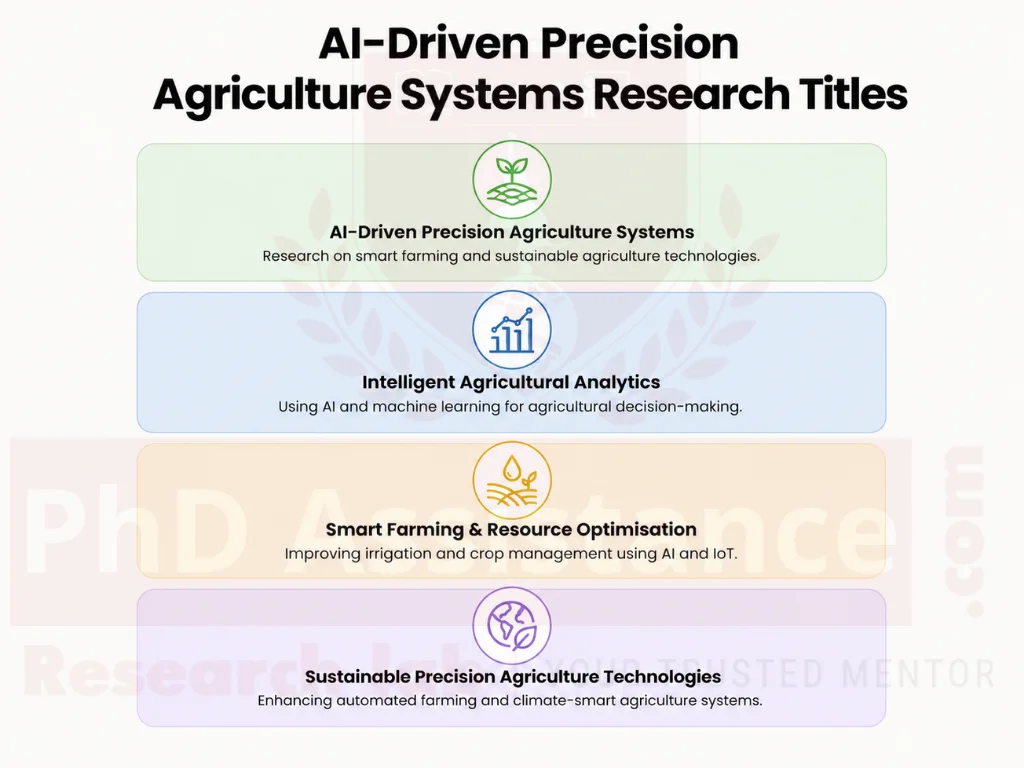
Proposed PhD Title 2. Smart Irrigation Optimisation Models for Sustainable Precision Agriculture Using AI and IoT
The complexity of agricultural systems has increased the demand for predictive technology that can provide high crop and food safety. The use of AI-powered irrigation management, machine learning techniques, predictive analytics, and deep learning models has been used in crop forecasting, soil assessment, and decision-making in agriculture. Conventional agricultural practices often encounter issues of inaccurate yield prediction, climate uncertainties, and a lack of effective practices. As stated by Ali et al. (2025), machine learning and deep learning have made crop prediction and selection much easier.
Problem Statement:
Irrigation management through the traditional process has been marked by the fact that there is manual monitoring, which results in the wastage of water. The shortage of water due to weather changes has added another challenge to the management of agricultural practices.
Research Gap:
In previous studies on smart irrigation systems, there has been an emphasis on soil moisture detection and irrigation scheduling. Very few attempts have been made to incorporate artificial intelligence predictive analysis.
Research question:
How can AI and IoT-based approaches to the optimisation of irrigation systems be leveraged for more efficient water resource utilisation?
Result:
The main goal of the study is to develop an intelligent irrigation optimisation model using the concept of AI and IoT.
Reference:
Bayar, J., et al. (2025). Artificial intelligence of things (AIoT) for precision agriculture: Applications in smart irrigation, nutrient and disease management. Smart Agricultural Technology.
Proposed PhD Title 3. Predictive Agricultural Analytics for Crop Yield Forecasting Through Machine Learning Techniques
The increasing complexity of agriculture has created a need for innovative predictive technologies capable of enhancing crop yield and food security. The role of machine learning in agriculture, prediction technology, and deep learning models on crop forecasting, soil analysis, and agricultural decision-making is being evaluated by researchers. Conventional agricultural methods tend to encounter problems related to inaccurate crop yield predictions, climate variability, and poor agricultural planning. According to Ali et al. (2025), machine learning and deep learning models help optimise agricultural decisions regarding crop selection and accurate yield predictions through data-based technologies.
Problem Statement:
The current agricultural processes are impacted due to issues such as predicting crop yield in different weather conditions. Conventional agricultural practices lack predictive analytics and timely decision-making as well. This necessitates an advanced system that uses machine learning for crop yield prediction.
Research Gap:
The existing research in AI for crop yield prediction has small sample sizes and univariate predictions. Very few attempts have been made to apply concepts from deep learning in addition to weather conditions and soil parameters in conjunction with agricultural analytics into a predictive farming system.
Research Question:
How is predictive agriculture analytics aid in forecasting crop yield and efficiency in farming through machine learning?
Outcome:
This research will help formulate a machine learning algorithm for use in agriculture analytics for the prediction of crop yield and improvement in farming processes.
Reference:
Kumari, K., et al. (2025). AI-Driven Future Farming: Achieving Climate-Smart and Sustainable Agriculture. AgriEngineering.
Proposed PhD Title 4. Autonomous Farming Technologies for Smart Agriculture Automation and Sustainable Resource Management
The emergence of smart farming technologies has revolutionised the agriculture field through automation, intelligent analysis, and data-driven resource management. Scientists have been investigating how automation in agriculture, artificial intelligence, the Internet of Things, and variable technologies can improve the performance of agriculture. The rapidly growing size of the population, climate change, and resource shortage have increased the need for intelligent systems that can be used to improve efficiency while reducing adverse effects on the environment. As explained by Kumari et al. (2025), automation, artificial intelligence, and the Internet of Things lead to precision agriculture.
Problem Statement:
In this case, traditional farming is still dependent on manual work and outdated agricultural processes that will lower the efficiency of agricultural activities and the sustainability of agriculture. Modern agricultural systems have also not incorporated intelligent automation and adaptation capabilities needed in precision farming. This means that there is a need for advanced technology in smart agriculture automation.
Research Gap:
The existing body of literature in relation to automated farming has mostly concentrated on each technology alone, like robotics, Internet of Things (IoT), and AI-based monitoring systems. Only a few researchers have attempted to examine the combination of intelligent automation, predictive decision-making systems, and precision agriculture technologies into an automated farming system.
Research Question:
In what way is resource management facilitated with automation technology in smart agriculture?
Outcome:
This research work will create a model for intelligent automation farming that promotes agricultural automation and precision farming.
Reference:
Kumari, K., et al. (2025). AI-Driven Future Farming: Achieving Climate-Smart and Sustainable Agriculture. AgriEngineering.
Proposed PhD Title 5. Precision Farming Decision Support Systems for Intelligent Resource Optimisation and Sustainable Agriculture
Utilisation of intelligent decision support systems is increasingly becoming necessary for optimising agricultural production, sustainability, and efficient usage of resources. Several studies have investigated the use of AI crop monitoring systems, IoT technology for sensors, cloud-based analytics, and other predictive farming models to enhance decision-making within the agricultural domain and ensure sustainable crop management. Inefficient irrigation systems, inadequate environmental monitoring systems, and a lack of sufficient prediction capability were some of the common problems faced by traditional agricultural practices. According to Kaushik & Singh (2025), there is increased efficiency in resource optimisation and precision farming through the application of smart irrigation systems based on artificial intelligence and intelligent analytics.
Problem Statement:
However, there are certain difficulties in the management and monitoring of irrigation, crops, and resources in the case of precision farming. The traditional methods use human monitoring of these factors but lack decision-making with respect to the allocation of resources. Therefore, the need of the hour is intelligent precision farming systems that incorporate AI systems for crop monitoring and resource prediction.
Research Gap:
The existing decision support systems within precision agriculture technology do not incorporate AI analytics, IoT, and resource optimisation sufficiently. Most of the works are devoted to cases of farm decision-making. There is a lack of publications concerning adaptive and data-driven decision support systems in agriculture.
Research Question:
What is the approach of precision farming decision support systems in maximising resources via intelligent farming and sustainable agriculture practices?
Outcome:
The proposed research intends to construct a framework of precision agriculture decision support systems for sustainable agriculture.
Reference:
Kaushik, S., & Singh, K. (2025). AI-Driven Smart Irrigation and Resource Optimisation for Sustainable Precision Agriculture. Journal of Scientific Innovation and Advanced Research.
Need assistance finalising your dissertation topic? Selecting a strong, researchable topic can be challenging — but you don’t have to do it alone.
Our research consultants can help refine your ideas, identify literature gaps, and guide you toward a topic that aligns with current academic trends and your programme requirements.
Contact us to begin one-on-one topic development and refinement with PhdAssistance.com Research Lab.
Share this:
Cite this work
PhDAssistance. (n.d.). Virtual Influencers Dissertation Titles Retrieved 30th January 2026, from https://phdassistance.com/title/virtual-influencers/
“Virtual Influencers Dissertation Titles, https://phdassistance.com/title/virtual-influencers/
“Virtual Influencers Dissertation Titles” PhDAssistance, PhDAssistance, Tuesday, January 30th,2026.
PhDAssistance, n.d. Virtual Influencers Dissertation Titles[Online]. Available at: https://phdassistance.com/title/virtual-influencers/ [Accessed January 30th, 2026].
PhDAssistance. Virtual Influencers Dissertation Titles[Internet]. PhDAssistance; [cited 2026 January 30th]. Available from: https://phdassistance.com/title/virtual-influencers/
PhDAssistance (n.d.).
Virtual Influencers Dissertation Titles. Retrieved January 30th, 2026, from https://phdassistance.com/title/virtual-influencers/
PhDAssistance, Virtual Influencers Dissertation Titles(PhDAssistance, n.d. January 30th accessed 2026.
Study Resources
Free resources to assist you with your university studies!