
Call for Papers: Temporal Dynamics Linking Adversity, Adaptation, and Neurodevelopment
Introduction
Research that is currently being developed shows that people who face difficulties will experience better brain development results. The development of cognitive skills and emotional abilities throughout life will be affected by neurodevelopmental patterns that result from chronic stress and socioeconomic disadvantage, trauma and neglect experiences. Children demonstrate exceptional ability to adapt because their development processes provide them with the capacity to recover from different circumstances.
Understanding the temporal dynamics in neurodevelopment is critical for advancing research on how the brain develops across early life stages. Neurodevelopment is not a static process; rather, it unfolds through complex, time-sensitive interactions between biological systems and environmental exposures.
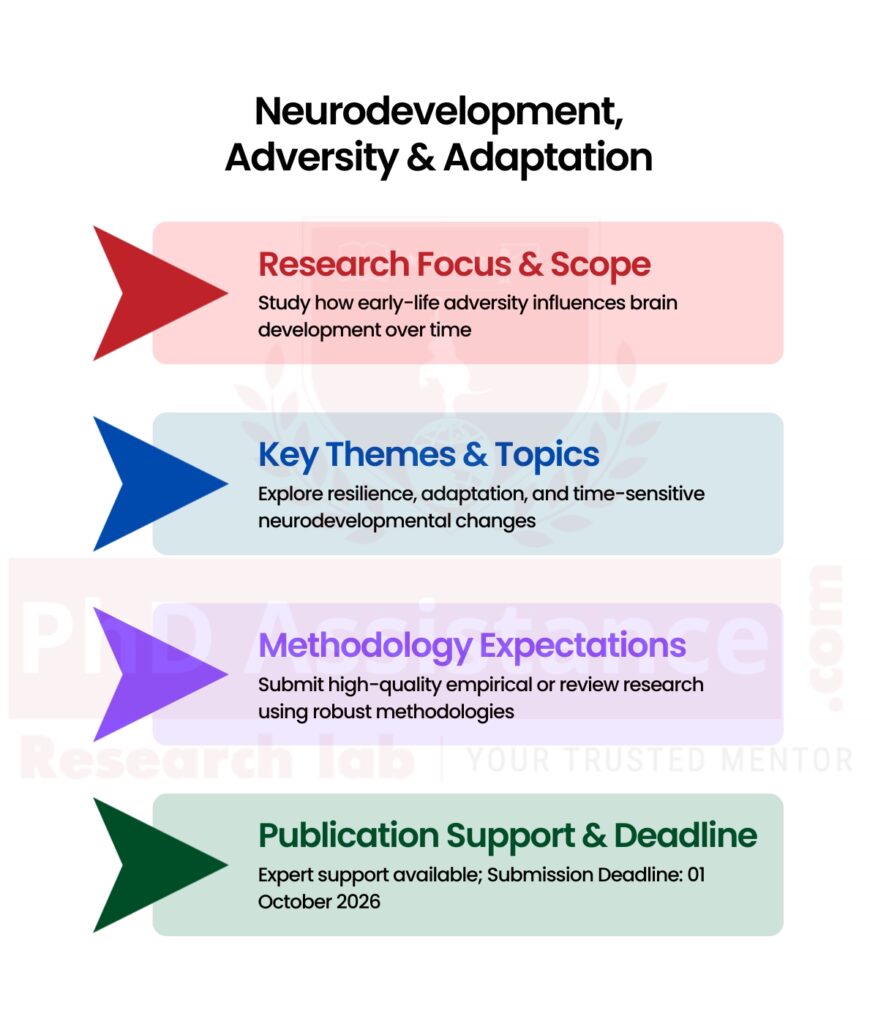
Increasing attention has been directed toward how early life adversity effects shape long-term brain structure and function.This Special Issue invites high-quality research exploring the role of brain development within dynamic developmental frameworks. The contributions should use longitudinal, mechanistic and interdisciplinary research methods to explain how different adversity factors affect neurobiological outcomes through their timing, intensity and duration.
Scope
This Special Issue seeks empirical and review manuscripts that examine the dynamics in neurodevelopment from infancy through adolescence. We invite researchers from different fields to submit their work that combines neuroscience with psychology and psychiatry, and public health and developmental biology.
Know More About This Issue
Scientific studies about how brain development changes over time show that understanding the timing of events helps researchers study both human vulnerability and human resilience. The critical development phases that occur during early childhood increase the impact of fundamental life challenges but simultaneously create chances for effective treatment methods.
The development of neuroimaging techniques, together with longitudinal modelling methods, has enabled improved mapping of neurodevelopmental paths, together with the identification of minor alterations that occur in response to continuous stress conditions.
The research shows that adversity and neurodevelopment have a complex relationship, which occurs because risk exposure does not guarantee that people will develop maladaptive behavior yet it can activate compensatory growth development processes.
This Special Issue aims to deepen theoretical and empirical understanding of how brain development operate across time. The research will lead to the development of prevention strategies and evidence-based intervention methods.
Key Themes
Researchers can submit their manuscripts to study the following topics and additional areas of research:
How We Support Your Submission
The publication process for high-impact Special Issues requires research that shows scientific standards, transparent research methods, and valuable theoretical and practical advancements. The research support team offers complete manuscript development services to researchers who study time-based changes in neurodevelopmental trajectories and the effects of adversity on neurodevelopment and other related fields.
Journal Guidelines:
Important Dates
Submission Deadline: 01 October 2026
To ensure successful and timely submission to the special issue “Plant-derived by-products for drug delivery,” researchers are encouraged to seek expert publication support from conceptualisation to final submission.
Free Guide: How to Write the Journal Manuscript
Book a free consultation to get guidance from the PhD assistance research lab for writing a credible research manuscript and submitting it in the high-quality journal.
Reference
Reliability Engineering & System Safety. (2026, February 27). Call for papers: Advanced resilience assessment & enhancement for complex engineering systems exposed to multi-hazards. Elsevier. https://www.sciencedirect.com/journal/reliability-engineering-and-system-safety/call-for-papers