
Call for Papers: Next-Generation AI Computing Models and Architectures
Introduction
Artificial intelligence has reached its current state because large foundation models have ushered in a new phase of progress, leading to improved computational capabilities and better system performance. AI workloads today require computing solutions that can scale effectively, use energy resources optimally, and understand hardware requirements, which traditional systems cannot deliver. The existing difficulties have propelled researchers to create advanced AI computing systems that can function across different hardware environments while maintaining system performance, power usage and operational expenses.
Researchers have developed new Next-generation AI computing models through their research on diffusion language models and mixture-of-experts (MoE), linear-time attention mechanisms, and new connectivity paradigms. The combination of new algorithms with existing system limits creates new possibilities for designing advanced artificial intelligence systems and their distribution across multiple systems.
This Special Issue invites original research and high-quality review papers that explore emerging directions in high-performance AI computing and redefine the architectural foundations of intelligent systems.
Scope
Know More About This Issue
As AI systems develop greater complexity and larger size, traditional computing systems face difficulties in handling rising performance requirements and energy consumption. The development of high-performance computing needs complete unification between hardware-aware algorithms, compiler/runtime optimizations and distributed execution methods.
Emerging architectural paradigms are enabling advanced AI system design through tighter integration between model development and hardware capabilities. The future of scalable intelligence will be shaped by innovations that extend from neuromorphic systems to heterogeneous cloud-edge infrastructures.
The Special Issue enables researchers and practitioners to submit their groundbreaking research that develops AI computing architectures while establishing fundamental knowledge for global intelligent system development.
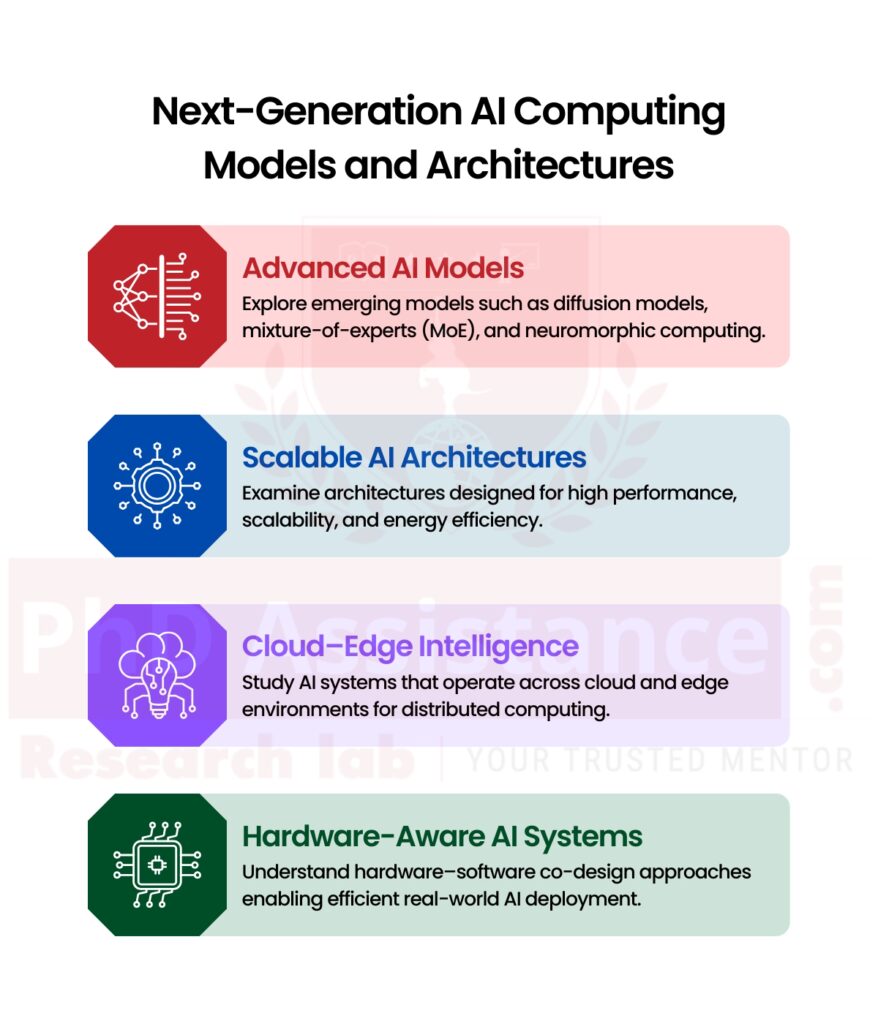
Key Themes
How We Support Your Submission
The high-impact Special Issue requires researchers to demonstrate their theoretical expertise through precise technical writing abilities. Our expert team supports researchers preparing manuscripts for this Call for papers AI computing initiative through:
Journal Guidelines:
Important Dates
Submission Deadline: 30 June 2026
To ensure successful and timely submission to the special issue “Next-Generation AI Computing Models and Architectures,” researchers are encouraged to seek expert publication support from conceptualisation to final submission.
Free Guide: How to Write the Journal Manuscript
Book a free consultation to get guidance from the PhD assistance research lab for writing a credible research manuscript and submitting it in the high-quality journal.
Reference
Engineering. (2026, February 27). Next-generation AI computing models and architectures: Call for papers. Elsevier. https://www.sciencedirect.com/journal/engineering