
Call for Papers: HAIS 2025: Recent advancements in hybrid artificial intelligence systems and their application to real-world problems
Introduction
Hybrid Artificial Intelligence (AI) has advanced significantly and is revolutionising the way complicated computational problems are solved in different scientific and industrial fields. Using symbolic reasoning along with data learning, the AI system can efficiently deal with uncertainties, high dimensions, ambiguities, and decision-making. Hybrid AI systems utilise the combined power of soft computing, hard computing, evolutionary computing, and deep learning.
The rising need for hybrid applications in medicine, finance, production, cybersecurity, transportation, and urban areas has made research on explainable, scalable, and efficient hybrid intelligence solutions a global issue. The explainability of hybrid AI not only increases trust but also ensures transparency and accountability in hybrid systems by helping us know how the intelligent systems make predictions.
This Call for Papers encourages research papers reporting new theoretical insights, innovative computational frameworks, and AI for practical problems. Papers offering original perspectives on the design, development, and application of Hybrid Artificial Intelligence systems within diverse fields of study are encouraged.
Why publish in this issue?
This Special Issue presents an ideal platform for the publication of cutting-edge research papers by researchers, data scientists, AI professionals, and industrial practitioners in the rapidly growing field of intelligent computing. The accepted papers would be made available to the international community of researchers working in AI, machine learning, computational intelligence, and decision support systems.
Key advantages:
Scope
The following types of research papers are invited for publication on the topic of Hybrid Artificial Intelligence and their practical implementation. Topics of interest include, but are not limited to:
Contact PhD Assistance Research Lab today to publish your research papers in Scopus and PubMed-indexed journals!
Know More About This Issue
With the further development of Artificial Intelligence Systems, Hybrid Artificial Intelligence is becoming an increasingly effective approach to tackle problems that cannot be solved effectively by applying single AI approaches. By employing such components as symbolic reasoning, machine learning, deep learning, fuzzy systems, and evolutionary computation, hybrid approaches enable more accurate predictions, adaptability, and explainability.
The main goal of this Special Issue is to gather scientists involved in the creation of advanced AI Applications that can solve real-life problems via intelligent data analysis and optimisation. The following topics are of particular interest: Explainable AI, efficiency, and multi-disciplinary applications.
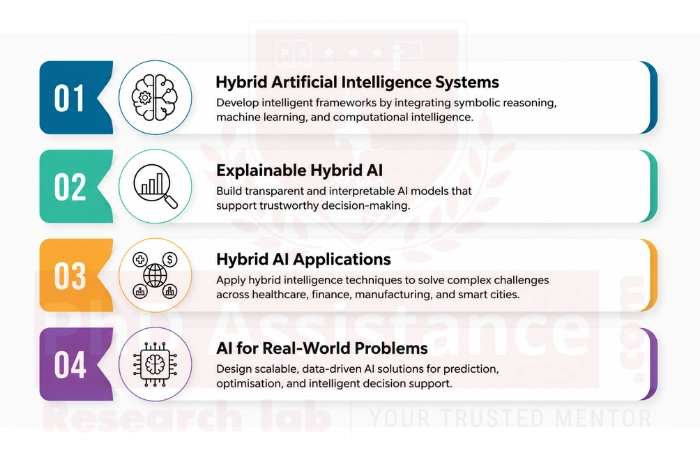
Key factors
How We Support Your Submission
We offer all-around manuscript preparation assistance to ensure you have a quality paper that can compete among other top AI research papers featured in the best journals and Special Issues. We guarantee that your manuscript will exhibit professionalism and methodological rigour.
Our services include:
Our publication experts will assist you in ensuring that your manuscript meets the scientific requirements for the Special Issue on Hybrid Artificial Intelligence and Applications to Real-World Problems.
Journal Guidelines:
If you are a researcher interested in publishing research papers in the journal titled “HAIS 2025: Recent advancements in hybrid artificial intelligence and its application to real-life problems,” then you can get help from the PhD Assistance Research Lab to publish your manuscript.
Free Guide: How to Write the Journal Manuscript
Book a free consultation to get guidance from the PhD Assistance Research Lab for writing a credible research manuscript and submitting it to a high-quality journal.
Reference
Neurocomputing. (2026, May 28). Call for papers: HAIS 2025: Recent advancements in hybrid artificial intelligence systems and its application to real-world problems. Elsevier.