
Call for Papers: Energy Security in a Shock-Prone World: Clean Energy, Innovation, and Resilience Dynamics
Introduction
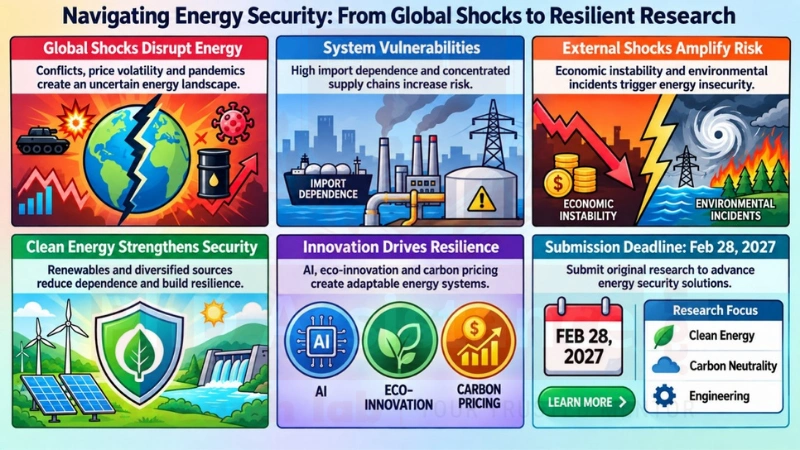
As geopolitical risks and energy prices become increasingly volatile, and other disruptions arise more often, research into the issue of energy security has become even more important. The global energy system is becoming increasingly susceptible to various disruptions, which may affect energy imports, prices, self-sufficiency, and energy supply security. At the same time, the transition to renewable energy is changing how energy-system vulnerabilities are addressed.
The Call for Papers on energy security research invites studies related to the impact of external shocks on energy security and ways in which clean energy, innovation, and policies may contribute to increasing resilience.
The Special Issue “Energy Security in a Shock-Prone World: Clean Energy, Innovation, and Resilience Dynamics” gathers studies related to the impact of external shocks on energy security and ways in which clean energy, innovation, and policies may contribute to increasing resilience.
Why publish in this issue?
This Special Issue offers researchers the chance to contribute to new research on the link between energy security and clean energy transitions, innovation, and resilience amid uncertainty.
Key advantages:
Scope
Submission of papers on original research work, review papers, and other related studies on energy security under exogenous shock conditions and the impact of clean energy on improving resilience is welcome.
Engineering-based contributions are also welcome where they clearly address economic, policy, market, or system-level implications. Research on carbon neutrality and decarbonization is considered where it is explicitly connected to energy security outcomes.
Know More About This Issue
Energy security is seen as a changing and shock-prone phenomenon rather than a stationary one. Geopolitical conflicts, price variations in energy, disruption in supplies, economic instability, environmental incidents, and pandemics may impact energy security.
The clean energy transition brings a critical aspect into this discussion. However, renewable energy, clean energy technologies, diversification of energy sources, and innovation can influence import dependency and energy system resilience to external shocks. Nevertheless, the relationship between clean energy transition and energy security can be country-specific, market-specific, technology-specific, and regulation-specific.
This Special Issue seeks to collect research on these issues that explores how energy systems can become more resilient in an uncertain world. Empirical research papers with policy implications are especially welcome.
Key factors
How We Support Your Submission
PhD Assistance Research Lab offers research and publication assistance for researchers, helping them create papers that they can submit to appropriate journals and special issues. We have been providing manuscript writing services to researchers for many years.
Our services include:
- Scientific Manuscript Writing and Editing
Problem: Energy research can involve complex economic, technical, and policy concepts.
Solution: Technical writing, editing, and polishing of research content.
Value: A clear and well-structured scientific manuscript.
- Research Design & Methodology
Problem: Selecting an appropriate methodology can be challenging for interdisciplinary energy research.
Solution: Guidance on research design, methodology, datasets, and analytical approaches.
Value: A more systematic and research-focused study.
- Journal Formatting & Manuscript Structuring
Problem: Manuscripts may require adjustments to meet journal and Special Issue requirements.
Solution: Organisation and structuring according to the relevant guidelines.
Value: Improved submission preparedness.
- Academic Language Editing & Proofreading
Problem: Language issues can affect clarity and readability.
Support: Academic editing and detailed proofreading.
Value: Clearer and more consistent scientific communication.
- Pre-Submission Review & Submission Support
Problem: Manuscripts may contain gaps or formatting issues before submission.
Support: Final manuscript review and submission-document preparation.
Value: A more organised and confident submission process.
Journal Indexing and Submission Information
Journal indexing, suitability, article type, submission requirements, and other such details can be verified from the journal’s official website and other indexing databases. The status of journal indexing may change over time; therefore, it is important for authors to verify the information themselves.
Journal Guidelines:
Verify the latest author guidelines before submission
If your research addresses energy security, clean energy, innovation, or resilience, consider submitting your manuscript to this Special Issue. Review the submission requirements and prepare your paper for submission before the deadline.
Is My Paper a Fit?
Your manuscript may be a good fit if it:
Check Your Manuscript’s Fit for This Special Issue
Get guidance on your manuscript’s scope, structure, and submission readiness for this Special Issue. The free guide covers manuscript preparation, formatting, Peer review, and submission readiness.
FAQs:
1. How do geopolitical shocks affect global energy systems?
Geopolitical shocks can disrupt energy supplies, increase price volatility, affect energy imports, and create uncertainty across global energy markets. Their effects can vary depending on a country’s energy dependence and market structure.
2. Where can I find a call for papers on energy security and clean energy innovation?
This Special Issue welcomes research on energy security, external shocks, clean energy transitions, technological innovation, and energy resilience, providing a platform for researchers to contribute to this emerging area.
3. What is the relationship between renewable energy transition and energy security?
The renewable energy transition can strengthen energy security by reducing dependence on imported fossil fuels and diversifying energy sources. Its effectiveness also depends on infrastructure, investment, technology, and supportive policies.
4. What are current research gaps in energy security and clean energy transitions?
Research opportunities include examining energy security under different external shocks, renewable energy resilience, energy price and supply vulnerabilities, and the role of innovation, digitalization, and policy responses.
5. How can energy systems become more resilient to supply chain disruptions?
Energy resilience can be improved through diversified energy sources, reduced import dependence, renewable energy deployment, stronger infrastructure, digital technologies, strategic investment, and flexible policy responses.
Reference
Special Issue Guidelines. (2026, June 8). Energy Security in a Shock-Prone World: Clean Energy, Innovation, and Resilience Dynamics. Submission deadline: 28 February 2027.