
Call for papers: Designing Artificial Intelligence for Mental Health Intervention & Support
Introduction
Artificial Intelligence (AI) has become the leading technology which transforms modern society because it develops more essential use cases for healthcare and mental health services. People now use AI-powered chatbots and conversational agents and intelligent decision-support systems to obtain psychological help and maintain their mental health and connect with their mental health practitioners. The development of Artificial Wisdom progresses through two technological advancements which enable machines to develop ethical reasoning skills and moral understanding and situation awareness abilities.
The AI system delivers new ways to improve mental health treatment through improved access and customised services and faster delivery of treatment, but the fast growth of technology creates major obstacles. The application of AI technology in mental healthcare creates essential issues, which include determining safe practices and establishing trust mechanisms, maintaining open information sharing and enforcing responsibility measures while assessing how AI impacts at-risk groups. People have not yet developed a deep understanding of how to design ethical AI systems that serve mental health needs through existing mental health support methods, which include mobile applications and digital games, outpatient monitoring systems and clinical decision tools.
Scope
The special issue enables researchers from different fields to investigate how artificial intelligence affects mental health assessment and treatment programs and training methods, and wellness services. The research should analyse how AI technologies affect human interactions with users, clinicians and healthcare systems while measuring the impact of design choices on treatment results, ethical standards and user protection.
The editorial team welcomes submissions that integrate theoretical frameworks with empirical evidence, methodological innovation, or practitioner insights. Research may address both the benefits and limitations of AI-driven mental health technologies, including their societal, ethical, and practical implications. Studies that examine vulnerable groups along with human-centred design methods and responsible innovation practices receive special endorsement.
Know More About This Issue
The field of mental health care is experiencing its most significant changes ever through artificial intelligence, which allows users to create personalised treatment methods using chatbots, predictive models and decision-support systems. The new technologies bring potential advantages to mental health services through improved accessibility and treatment outcomes, but they create important ethical, safety, transparency and user trust issues that affect vulnerable users.
The Special Issue investigates how technological advancements bring about operational changes that affect both personal and organisational workplace dynamics. The issue collects various viewpoints to create a framework that supports responsible AI work environment design while informing theoretical development, organisational procedures and policy debates.
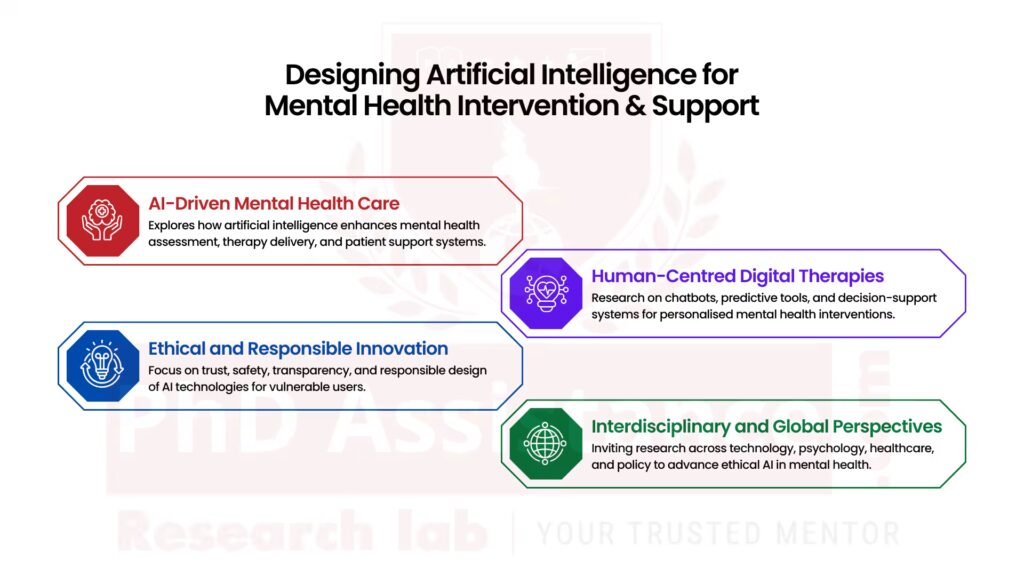
Key Themes
The submission process accepts papers that will cover all themes that follow this list of topics.
How We Support Your Submission
To publish research in Mental Health and Digital Technologies, authors must demonstrate strong theoretical foundations, implement strict research methods, and maintain a direct relationship with special issue content. Research support services can assist authors throughout the publication process by providing:
Journal Guidelines:
Important Dates
Manuscript Submission Deadline: 30 April 2026
To ensure successful and timely submission to the special issue “Designing Artificial Intelligence for Mental Health Intervention & Support,” researchers are encouraged to leverage the expert services of the PhD Assistance Research Lab, offering comprehensive support from conceptualisation to final manuscript submission within the specified deadline.
Reference
Emerald Publishing. (n.d.). Author guidelines and publishing ethics. Emerald Publishing.