
Call for Papers: Design and Integration of 2D Materials as Novel Semiconductive Materials and Electrolytes
Introduction
The field of research into advanced materials has been evolving constantly, yet many researchers encounter certain difficulties in writing papers suitable for publication.
The use of two-dimensional materials has been identified as one of the most promising fields in the area of materials science that has led to innovations in electronics, energy storage, sensors, catalysis, and many others. The unique characteristics of two-dimensional materials enable researchers to develop materials that are much better than before. In addition, as research in this field is growing day by day, these materials are being combined with many other materials like covalent organic frameworks, metal-organic frameworks, and hybrids.
Special Issue: Design and Integration of 2D technology as Novel Semiconductive Materials and Electrolytes is soliciting high-quality research papers and reviews to promote the development of 2D Semiconductive Materials. This Special Issue will cover innovations in material design, hybrid device integration, property/structure correlations, and multi-disciplinary applications for potential future advances in semiconductor science and technology as well as in electrolytes.
Why publish in this issue?
The present Special Issue is an ideal forum for researchers, academicians, and practitioners to showcase pioneering work in one of the most rapidly developing fields within materials chemistry and physics. It emphasises research advances at the intersection between basic science and technology.
In this regard, this Call for Papers on the Design and Integration of 2D Materials is looking to publish original research papers and review articles on advanced two-dimensional materials in terms of their synthesis, design, integration, and applications. In particular, it would like contributions on topics such as hybrid semiconductive materials, COFs, MOFs, new electrolytes, optoelectronic devices, energy storage, sensing platforms, and catalysis.
Key advantages:
Scope
We invite research articles, review articles, and short communications on aspects of the synthesis, design, characterisation, and applications of advanced 2D materials. Articles dealing with the Integration of 2D design with other systems are highly encouraged:
We invite students who would like to submit papers on Materials Chemistry and Physics.
Contact PhD Assistance Research Lab today to publish your research papers in Scopus and PubMed-indexed journals!
Know More About This Issue
With increased demand for efficient materials, there has been increasing attention to novel approaches aimed at improving the function of materials through hybrid structures and interface design. With the integration of 2D design with semiconductors, COFs, and MOFs, the prospects of enhancing charge transportation, catalytic activity, energy storage capability, and sensing have become more promising.
Recent advancements going beyond just material discovery to realisation in high-tech devices are featured in this Special Issue. Studies involving scalable synthesis routes, new architectures of the devices, performance optimisation, and basic investigation of material properties are encouraged. Special focus will be made on the design of 2D Semiconductive Materials with superior electrical conductivity and stability.
This thematic problem also encourages studies dealing with 2D Materials for sustainable energy systems, advanced electronics, green technologies, as well as Electrolyte Materials suitable for future-generation batteries and energy storage systems.
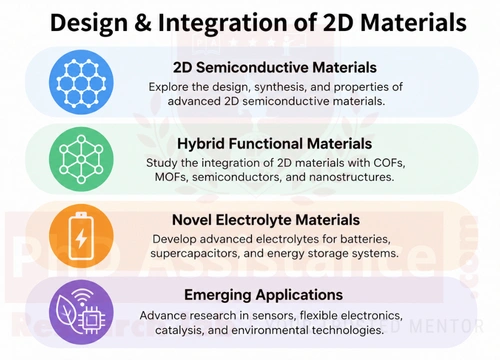
Key factors
How We Support Your Submission
PHD Assistance Research Lab can provide you with all the necessary assistance regarding manuscript development. Our experts will make sure that every manuscript is developed according to the requirements of the journal and properly highlights the scientific value of your research.
Our manuscript writers provide complete support to help researchers get their manuscripts published successfully in the present Special Issue. We also support researchers who have been engaged in the development and application of 2D materials in presenting the scientific aspects of their research work.
Our services include:
All manuscripts will be prepared in accordance with the Special Issue requirements while maintaining scientific quality and publication standards.
Journal Guidelines:
If you are a researcher interested in publishing research papers in “Semiconductive Materials and hybrid semiconductor systems,” then you can get help from the PhD Assistance Research Lab to publish your manuscript.
Free Guide: How to Write the Journal Manuscript
Book a free consultation to get guidance from the PhD Assistance Research Lab for writing a credible research manuscript and submitting it to a high-quality journal.
Reference
Materials Chemistry and Physics. (2026). Call for papers: Design and Integration of 2D Materials as Novel Semiconductive Materials and Electrolytes. Elsevier.