
Introduction
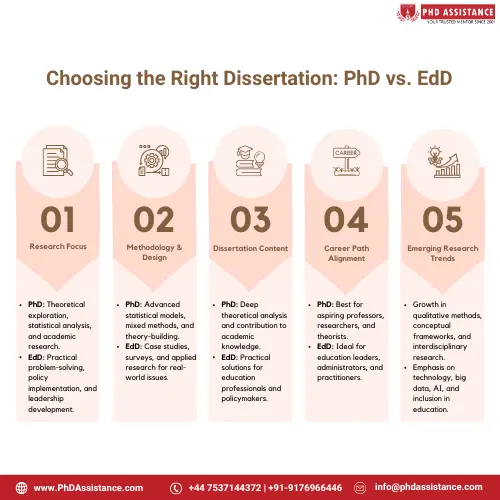
Students who need to select their dissertation topic must understand the essential differences between Doctor of Philosophy (PhD) and Doctor of Education (EdD) dissertations. PhD programs exist mainly to produce researchers who study theoretical concepts through statistical methods. The EdD program provides hands-on training that prepares practitioners to solve educational problems that exist in real-life situations.
This research examines key factors such as design approaches, methodology, theoretical structure, and academic requirements that distinguish PhD from EdD dissertations.
A review of past research helps us identify both the differences and similarities between these two types, guiding students toward appropriate research directions.
1. Research Methodologies and Design Differences
1.1 PhD Dissertations: Prioritizing Generalizability and Thorough Research
In order to ascertain the methodological distinctions between these degrees, Nelson and Coorough (1994) examined 1,007 PhD dissertations and 960 EdD dissertations from 1950 to 1990 [1].
Nelson and Coorough (1994) found that PhD dissertations typically exhibit the following characteristics:
- Advanced statistical methods help researchers achieve better generalization of their findings [1].
- Research studies should incorporate theoretical models that build on existing academic foundations [1].
- The research involves a wide spectrum of topics that integrate quantitative and qualitative investigation techniques [1].
- PhD dissertations aim to develop new theoretical frameworks or extend existing ones, reflecting their emphasis on academic and analytical research [1].
1.2 EdD Dissertations: Practical Applications and Educational Leadership
EdD dissertations focus on solving problems that appear in educational environments. According to Nelson and Coorough (1994), EdD dissertations demonstrated these characteristics:
- Dissertations for EdD programs utilize quantitative survey studies as their primary research method instead of advanced statistical modeling techniques.
- Frequently focus on educational administration and leadership topics.
- These dissertations tend to focus more on the practical problems encountered by educators and policymakers.
- The design of EdD dissertations provides practical solutions for educational professionals, making them more suited for leadership roles than for research.
2. Dissertation Content Analysis Across Specializations
2.1 Special Education Research: Differences in Theoretical Depth
Walker and Haley-Mize (2012) analyzed special education dissertations from 1997 to 2010 to evaluate their research design, methodology, and theoretical frameworks [2]. Their study found:
- The research methods in PhD dissertations became increasingly complex and theoretical [2].
- The research of EdD candidates concentrated on practical educational matters that included program assessment and educational policy implementation [2].
- PhD programs primarily focus on academic research, while EdD programs emphasize practical educational applications [2].
2.2 Educational Leadership: A Blended Approach
Augusto (2009) used case studies of PhD and EdD dissertations in educational leadership to show that students are trained as both scholars and practitioners [3].
Faculty perspectives revealed:
- The dissertation requirements for both PhD and EdD degrees combine educational development and academic research achievements.
- Faculty require equivalent standards of critical thinking, analytical skills, and writing excellence from students in both programs.
- The academic field together with professional development benefits from both styles of dissertation research even though they use different methods.
- Although the methodologies differ, there is a consensus on quality standards and contributions to knowledge in both dissertation types.
3. Evolution of Dissertation Trends Over Time
3.1 Shifts in Gender Representation and Research Methods
The research conducted by Melendez (2002) examined 192 higher education dissertations across 14 doctoral programs from 1977 to 1997 [4].
Key findings included:
- Increase in female doctorate recipients over the two decades.
- The number of dissertations implementing conceptual frameworks has increased.
- The research field shifted toward qualitative methodologies as education studies adopted broader research methods.
- Dissertation lengths have increased since 1997 because the average number of pages expanded from 199 to 218 pages.
- Research demonstrates that dissertation structures have adopted more qualitative along with theoretical elements without distinction between PhD and EdD degrees.
3.2 Integration of Theory and Practice
Melendez’s findings highlight an increasing emphasis on combining theoretical insights with practical applications. The educational process for both PhD and EdD programs requires students to pursue:
- Integrate theoretical concepts into their research design.
- Apply findings to real-world educational challenges.
- Contribute to both academic and professional fields.
- A suitable dissertation topic requires balancing theoretical value with practical usefulness.
4. The Process of Selecting Your Dissertation Topic Requires Both Practicaland Theoretical Factors
4.1 Identifying Your Research Goals
- Students need to choose dissertation topics which match their future professional goals.
- Students planning academic or research careers should pursue a PhD dissertation characterized by detailed statistical analysis and a strong theoretical foundation.
Education sector professionals aiming for leadership or management roles should pursue an EdD dissertation that emphasizes practical implementation and solution development.
4.2 Selecting a Research Methodology
- Advanced statistical analysis requires a PhD dissertation as the most suitable option.
- A dissertation focusing on case studies, policy evaluation or program assessment suits an EdD program best.
4.3 Considering Theoretical vs. Applied Research
- Research in the PhD level commonly leads to development of current models or new theoretical frameworks.
- EdD programs target current educational challenges encountered in learning institutions.
4.4 Adapting to Changing Trends in Education Research
- Education doctoral students should choose research themes that align with modern trends, including qualitative approaches, conceptual frameworks, and interdisciplinary methodologies.
- Incorporate both quantitative and qualitative methodologies.
- Research projects should address contemporary educational issues, such as equity, inclusion, and the use of technology in learning.
- Align with emerging trends in dissertation research, such as the integration of big data and AI in education.
Conclusion: Finding the Right Dissertation Topic
Students who want to select appropriate dissertation topics need to understand the distinctions between PhD and EdD research. EdD dissertation students focus on practical educational problem-solving while PhD dissertations require deep theoretical exploration and extensive statistical analysis and broad generalization.
Students should consider:
- Their career goals (academic research vs. educational leadership).
- The methodological approach that best suits their research interests.
- Students need to strike a balance between theoretical knowledge and practical implementation in their professional domain.
With this information, doctoral students can choose research topics for their dissertations that are both relevant to their professional objectives and advance knowledge in education.