
Two New Variables, Half a Paper Rewritten: Handling Mid-Study Scope Change

Recent Post
1.0 Introduction
Any research paper is an integral aspect of academic writing where information around a specific topic is accumulated from diverse sources. Essentially, it is founded on original research by an author, an assortment of expert ideas all put together, or conclusion which is validated using evidence, data analysis, and interpretation of the findings (Shrestha et al., 2021). Research papers are primarily of two varieties which includes primary research and secondary research. Primary research happens when a phenomenon is being examined through first-hand investigation such as executing an interview or a survey, analyzing historical or literary works, or a performance or a film or conducting an experiment in a laboratory (Cerar et al., 2021). On the other hand, secondary research tends to examine studies that have been carried out in the past by other researchers (Chong & Plonsky, 2024) on a similar subject as the topic under examination.
When an author embarks upon the process of writing a research paper, their goal is to add on to the existing body of knowledge. However, to ensure that the findings derived through research are effectively disseminated such that other scholars can access it, while making a robust impact on the scientific community, the research paper should be published in an appropriate and reputed journals. The process seems simple and easy but often there are unexpected twists that you might encounter while helping scholars with their research writing process. This article showcases an actual scenario about how an unexpected change in the process was handled in an effective and seamless manner.
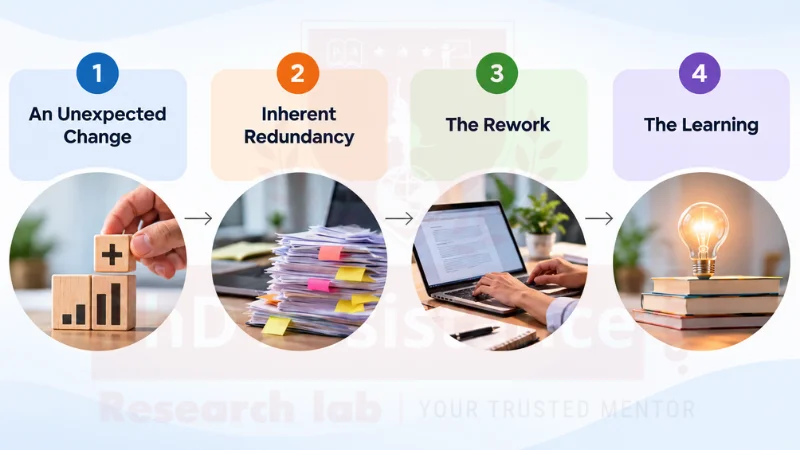
2.0 An Unexpected Change
A specific client had engaged us for their research writing work. We were supposed to develop an empirical research paper which they could eventually publish in a reputed journal. At the outset, based on their topic, we developed a skeleton (roadmap) of what their paper will comprise of. To be more specific, we gave them an outline that indicated the specific headings such as background, literature review, methods, analysis, interpretation, discussion, conclusion, and limitations. On the basis of a predefined topic, we also identified the specific variables that would be examined. The outline was approved and the writing process commenced smoothly and was on schedule. It was after we completed the methodology section that the client suddenly decided to introduce two new variables.
3.0 Inherent Redundancy
The client had their own reasons to bring in this change at a stage when we were done with the initial half of the paper. The introduction of the new variables meant that what was developed previously became partly or entirely redundant. For instance, the background, objectives, questions, and framework required a complete overhaul while parts of the literature review became redundant. This presented an unanticipated challenge of delivering the paper on the date initially confirmed.
4.0 The Rework
Though initially we did try to convince the client as to why introducing the two variables can be disastrous and would require rewriting portions that were completed, our attempts were futile. Ultimately, we function on the tenet ‘customer is king’, so we decided to accommodate the request. A quick brainstorming session helped in identifying the parts that needed to be entirely removed and parts that can be retained. Next, we allocated sections requiring rework to two different experts so as to not make a drastic impact on the delivery timeline. Once the rework was done, it was put together in sequence and flow. This was followed by a rigorous quality check to identify any flaws – technical or in writing style. Once the changes were incorporated, the reworked sections were resent to the client. Needless to say, they were pleased with the outcome more so, because the delivery was still on track.
5.0 The Learning
The unexpected change initially caused panic but eventually, the project was no doubt finished and delivered on time. Nonetheless, in the process we derived a significant learning from this experience. The introduction of a new element (such as a new variable) changes the whole direction of the research. It brings about a change in the background, research objectives, questions, framework and even methodology. At first glance, it might appear that a requirement to introduce new variables particularly when the writing was halfway through was simple. On the contrary, it became imperative for us to reevaluate what we had already done. In retrospect, even if we had probed the issue during the initial discussion with the client, there was no way this change could have been anticipated. Nonetheless, it has certainly brought about a major change in terms of how we approach a project. We are now more cautious when we are presented with a topic. We now literally break open the topic to understand what can be captured or cannot be captured within the scope of the current topic. This has definitely helped in streamlining the process flow and led to improved outcomes.