
How to Write a Literature Review in Qatar Economics: Evaluating FinTech Adoption and Digital Banking Frameworks
Sustainable Practices in Environmental Science
- Step 1: Understand the Scope of FinTech Adoption and Digital Banking Research
- Step 2: Conduct a Systematic Literature Search
- Step 3: Identify Research Gaps in FinTech Adoption
- Step 4: Critically Evaluate Digital Banking Frameworks
- Step 5: Organise Literature into Themes
- Strategies for Effective Literature Review
- Conclusion

Recent Post
Introduction
The financial sector is currently growing through a revolutionization process due to FinTech, digital banking, artificial intelligence (AI), blockchain, and digital payment platforms. Such revolutions are changing the way banks serve their customers and interact with consumers through banking services across the globe. To facilitate the realization of its Qatar National Vision 2030, the state is accelerating its digital transformation processes in the financial sector through innovation, financial inclusion, and digital banking. With this in mind, Ph.D. students in economics are encouraged to explore areas of research in FinTech and digital banking.
Writing an academic literature review on these dynamic areas involves much more than just compiling existing research work. Rather, students need to analyse existing research, determine areas of deficiency in knowledge, assess theoretical models and finally synthesise these in academic discourse. The importance of a good literature review cannot be overstated as it forms a strong base for the research, its importance and a conceptual framework for the research itself. In this article, the important stages of writing such a literature review are highlighted.
It also explains how PhD Literature Review Help in Qatar could help researchers in conducting a literature review.
What you will learn?
Step 1: Understand the Scope of FinTech Adoption and Digital Banking Research
Writing an academic literature review on these dynamic areas involves much more than just compiling existing research work. Rather, students need to analyze existing research, determine areas of deficiency in knowledge, assess theoretical models and finally synthesise these in academic discourse.
The importance of a good literature review cannot be overstated, as it forms a strong base for the research, its importance and a conceptual framework for the research itself. In this article, the important stages of writing such a literature review are highlighted.
What Research shows:
FinTech has changed the financial sector through technological innovation that is combined with banking systems, as stated by Arner, Barberis, and Buckley (2016) in their research article called The Evolution of FinTech: A New Post-Crisis Paradigm. The authors highlight the importance of the evolution of FinTech for assessing the effect of technological advancements on bank performance and client behaviour.
Tips
- Focus on current FinTech and digital banking trends.
- Define a clear and specific research scope.
- Align your topic with Qatar’s digital economy.
- Understand key concepts before reviewing the literature.
Step 2: Conduct a Systematic Literature Search
An effective literature review requires accessing authentic scholarly materials. Instead of using Google for a generic search, scholars are supposed to use academic databases to access peer-reviewed journals, books, conference papers, and policy documents on FinTech adoption and digital banking.
Some of the academic databases include Scopus, Web of Science, ScienceDirect, SpringerLink, and Google Scholar. By using relevant keywords like FinTech adoption, , digital banking, technology acceptance, financial innovations, and Qatar banking, an efficient literature review can be conducted.
What Research shows:
In Systematic Approaches to a Successful Literature Review, Booth, Sutton, and Papaioannou (2021) stress that carrying out a structured literature search enhances the quality of research by guaranteeing that all existing knowledge is covered completely without any selection biases. This shows the significance of utilising search strategies, inclusion criteria, and multiple databases for Economics Literature Review.
Tips
Step 3: Identify Research Gaps in FinTech Adoption
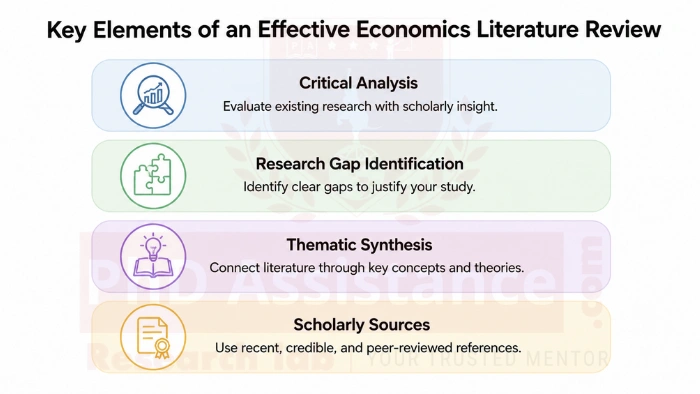
Identifying questions that have not been answered is one of the main aims of a literature review rather than merely summarising what has been done before. Research gaps can emerge due to developments in technology, developments in consumer behaviour, geographical limitations, and lack of theory development.
For instance, while many studies focus on the use of Digital Banking Frameworks all over the world, few studies focus on the use of Islamic FinTech products by customers, the digital banking behaviour of SMEs, and regulatory issues in the Qatar financial sector.
What Research shows:
The theory of UTAUT was proposed by Venkatesh, Morris, Davis & Davis in 2003 and suggests that the acceptance of the technology is affected by factors like performance expectancy, effort expectancy, social influence, and facilitating conditions. The model of UTAUT has been among the most popular models for the study of FinTech and digital banking.
Tips
Step 4: Critically Evaluate Digital Banking Frameworks
The effective literature review must provide a critical comparison of the theoretical frameworks rather than describing them separately. In the case of FinTech and Digital Banking, there are several theoretical approaches, such as TAM, UTAUT, DOI, and TOE Frameworks, which can be utilised to explain technology adoption. It is necessary to analyse these theoretical assumptions, strengths, and weaknesses to identify the proper theoretical framework.
What Research shows:
The model for technology acceptance was suggested by Davis in 1989, which postulates that usage of technologies depends mainly on the perception of usefulness and the ease of use of those technologies. While the TAM has been extensively used in research related to FinTech and online banking, it has also been found that it might fail to account for factors such as trust and risk perception.
Tips
Step 5: Organise Literature into Themes
In contrast to evaluating studies separately, the students are recommended to organise the literature around specific themes. A thematic organisation will help make the literature review more logical and allow the reader to see how each of the studies relates to the topic of research.
Some possible themes that can be considered for the literature review on FinTech Adoption in Qatar include consumer adoption of digital banking, financial inclusion, mobile payment technologies, cybersecurity and trust, digital banking regulations, and AI-driven financial services.
What Research shows:
Theme-based organisation of literature is more powerful than the author-based approach to organising literature, as described by Creswell & Creswell (2023) in Research Design: Qualitative, Quantitative, and Mixed Methods Approaches, because it provides a stronger theoretical foundation for the research.
Tips
Strategies for Effective Literature Review
Conclusion
A properly conducted literature review will serve as the basis for conducting a good Economics study since it entails analysis of current knowledge, identification of research gaps, and formation of solid theories. In the case of FinTech adoption and digital banking models in Qatar, one should avoid simply describing literature and apply an organised approach which encompasses literature searching, organisation, critical analysis, and evidence synthesis.
Master’s students will be able to write literature reviews meeting university requirements, improving their dissertations, and adding to the development of digital finance system in Qatar, by conducting such literature review in these methods.
Structured PhD Literature Review Services in Qatar from PhD Assistance Research Lab will be helpful to ensure critical analysis previous research conducted in the selected topic.
References
- Arner, D. W., Barberis, J., & Buckley, R. P. (2016). The evolution of FinTech: A new post-crisis paradigm. Georgetown Journal of International Law, 47(4), 1271–1319.
- Booth, A., Sutton, A., & Papaioannou, D. (2021). Systematic Approaches to a Successful Literature Review (3rd ed.). SAGE Publications.
- Creswell, J. W., & Creswell, J. D. (2023). Research Design: Qualitative, Quantitative, and Mixed Methods Approaches (6th ed.). SAGE Publications.
- Davis, F. D. (1989). Perceived usefulness, perceived ease of use, and user acceptance of information technology. MIS Quarterly, 13(3), 319–340.
- Venkatesh, V., Morris, M. G., Davis, G. B., & Davis, F. D. (2003). User acceptance of information technology: Toward a unified view. MIS Quarterly, 27(3), 425–478.
- Webster, J., & Watson, R. T. (2002). Analyzing the past to prepare for the future: Writing a literature review. MIS Quarterly, 26(2), xiii–xxiii..