
How to Overcome PhD Data Analysis Challenges in Saudi Arabia Management: Using Predictive Analytics and AI-Driven Decision Models
Sustainable Practices in Environmental Science
- Step 1: Prepare High-Quality Data for Advanced Statistical Analysis
- Step 2: Select Predictive Analytics Techniques Based on Research Objectives
- Step 3: Select Predictive Analytics Techniques Based on Research Objectives
- Step 4: Validate Statistical Models and Interpret Research Findings
- Step 5: Demonstrate Research Contribution Through AI-Driven Insights
- Strategies for Effective Primary Data Collection
- Conclusion

Recent Post
Introduction
The evolution of Saudi Arabia in line with Vision 2030 has led to an increase in research on management and economics fields such as digital transformation, strategic management, entrepreneurship, sustainability of business practices, FinTech, and organisational performance. With increasing use of AI and predictive analytics for enhancing efficiency and decision-making, doctoral researchers need to utilise more sophisticated data analysis methods that can yield accurate managerial insights.
The field of management studies now relies heavily on predictive analytics and machine learning models to understand organisational behaviour, forecast business outcomes, and formulate evidence-based policies. In combination with sound statistical verification, such an approach considerably enhances the quality of PhD studies.
This article illustrates how PhD researchers could address their problems related to data analysis by incorporating predictive analytics and AI-based decision models in the field of management studies. It also explains how PhD Data Analysis Help in Saudi Arabia could help researchers in carrying out statistically sound analyses.
What you will learn?
Step 1: Prepare High-Quality Data for Advanced Statistical Analysis
Empirical research relies on sound data. Whatever kind of data researchers have collected, be it from surveys, organisationally collected data, or secondary data, low data quality could affect the validity of the statistical analysis conducted based on the research results.
Any statistical analysis must begin with data screening for such things as missing values, duplicates, outliers, coding problems, and odd patterns of response. Also, descriptive statistics, testing for normality, multicollinearity tests, and reliability tests need to be done before hypothesis testing.
For management research, surveys conducted using questionnaires generally involve checking for the values of Cronbach’s Alpha, Composite Reliability (CR), and Average Variance Extracted (AVE) to make sure that the measuring instruments used measure the latent variable correctly.
Example:
As Hair et al. (2022) point out, the processes of thorough data preparation and measures evaluation are crucial preconditions for Structural Equation Modelling (SEM) and PLS-Structural Equation Modelling (PLS-SEM). This approach shows that checking such issues as construct reliability, convergent validity, and discriminant validity before structural model estimation considerably strengthens the research results of management studies.
Step 2: Select Predictive Analytics Techniques Based on Research Objectives
Choosing an appropriate method of analysis should always be based on research objectives, not on the popularity of the software used for statistics. Various management research objectives require varied analytical methods.
Regression analysis is still appropriate to study relationships between observable variables, while Structural Equation Modelling is needed to examine complicated relationships between multiple latent constructs. For exploratory prediction research, PLS-SEM will be more flexible if models contain multiple constructs, mediation effects, moderation effects, and small sample sizes.
It is important to consider the predictive accuracy of the results through methods like cross-validation, holdout validation, and performance measures like RMSE, MAE, precision, recall, and F1-score.
Example
Sahoo et al. (2018) have shown through their research that medical students who took part in the exercise of developing a research protocol improved their abilities in appraising, evaluating critically, and reasoning scientifically. They concluded that incorporating current research evidence into academic writing helped improve the capability of students to make justified decisions through evidence-based medicine.
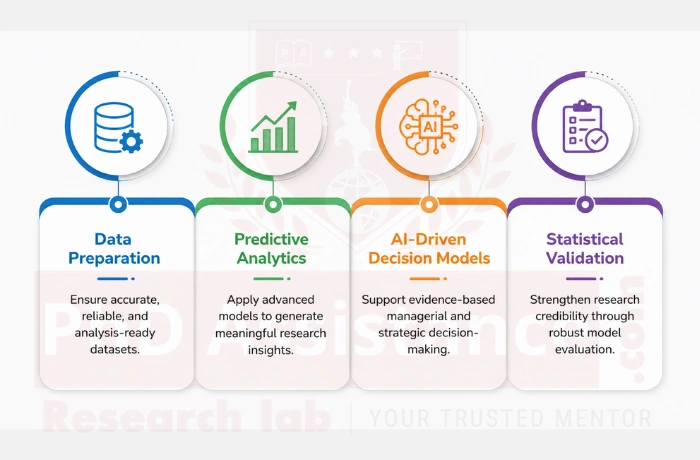
Step 3: Integrate AI-Driven Decision Models into Management Research
Artificial Intelligence is revolutionising management research in that it provides researchers with the ability to conduct data analysis, uncover hidden patterns, and make evidence-based recommendations for management practices. AI decision models will facilitate research on such topics as customer behaviour, employee productivity, financial risks, digital transformation, and strategy formulation by increasing the quality of forecasts and decisions.
Researchers should also use Explainable Artificial Intelligence (XAI), which enhances transparency and interpretability. In contrast to “black-box” AI models that were traditionally used, XAI allows explaining the logic behind the forecasts generated by AI models.
Example: Kim et al. (2021) observed that students of medicine who had undergone academic writing training were able to organise their ideas well, make logical arguments and integrate scientific evidence well. The results show that academic writing training improves both the learning experience and the performance of assignments in medical education.
Step 4: Validate Statistical Models and Interpret Research Findings
Choosing the right analytical method may just be the beginning. It is also important for the researcher to validate his or her statistical model to make sure that the results generated by such analysis will be valid and appropriate in addressing the research questions posed. In management research, the validation of the model adds to its credibility.
In the case of SEM and PLS-SEM research models, before examining any structural relationships, one must examine the quality of the measurement model by using construct reliability, convergent validity, and discriminant validity measures. Once that is done, the structural model can then be investigated by using path coefficients, coefficient of determination (R²), effect size (f²), predictive relevance (Q²), and bootstrapping to test the hypothesis of the relationship.
Statistical assumptions, including normality, multicollinearity, heteroscedasticity, and model fit must be validated to reduce biases in analysis. Interpretation of the results in terms of theory and research goals guarantees their academic and practical significance.
Example: The scoping study conducted by Hilario et al. (2025) included an analysis of 43 studies and revealed that inclusion of critical thinking in academic writing had a positive effect on students’ abilities to evaluate scientific literature and evidence and write better academic papers. This study stressed that proper citation and referencing of credible sources of scientific evidence is the essence of good academic writing.
Step 5: Demonstrate Research Contribution Through AI-Driven Insights
Quality PhD thesis work not only encompasses statistical findings but also provides significant theoretical, managerial, and practical implications. Researchers need to elaborate on their contributions to the existing body of knowledge, addressing the research gap that exists and using evidence for decision-making in organisations.
Predictive analytics and artificial intelligence-enabled decision-making tools help in identifying hidden patterns, making predictions about organisational outcomes, and providing recommendations for managers and policymakers. Statistical significance of the findings alone is not enough; researchers must interpret these findings in terms of their organisational efficiency, digitalisation, innovation, and sustainability. It makes the field of management studies more relevant for the situation in Saudi Arabia through the Vision 2030 program.
Where the technology of artificial intelligence is used, the implementation of XAI (Explainable Artificial Intelligence) makes the process more transparent since it shows the mechanism of prediction made.
Example: Meta-analytical studies in 2022 conducted by Schemmer et al. concluded that AI-driven decisions could enhance the decision-making process of humans, especially if transparency is utilised within the analysis process. In the same way, literature on Explainable AI has emphasised the importance of transparent AI systems to boost trustworthiness and applications of Predictive Analytics for PhD Research.
Strategies for Effective Primary Data Collection
Conclusion
Advanced data analysis has become a vital part of modern-day management studies. With more firms becoming dependent on predictive analytics and AI in making decisions, PhD scholars are supposed to use advanced methods of analysis, which will yield accurate, understandable and applicable results. Good data preparation, correct modelling, thorough statistical testing and sound interpretation improve the scientific value of PhD research.
Under the Saudi Vision 2030 framework, management research developed by predictive analysis and AI is possible for tackling complex organisational problems and making informed decisions. With a focus on high-quality analytics and decision models, management research can increase the quality of dissertations, enhance publication chances and generate valuable knowledge for academia, business, and government.
Professional PhD Data Analysis Services in Saudi Arabia will be helpful to ensure proper use of advanced statistical methods, increase methodological rigor, and generate research that is ready for publication.
References
- Hair, J. F., Hult, G. T. M., Ringle, C. M., & Sarstedt, M. (2022). A primer on partial least squares structural equation modeling (PLS-SEM) (3rd ed.). Sage Publications.
- Richter, N. F., Tudoran, A. A., Ringle, C. M., & Sarstedt, M. (2024). Elevating theoretical insight and predictive accuracy in business research: Combining PLS-SEM and selected machine learning algorithms. Journal of Business Research.
- Schemmer, M., Hemmer, P., Nitsche, M., Kühl, N., & Vössing, M. (2022). A meta-analysis of the utility of explainable artificial intelligence in human–AI decision-making.
- Hair, J., Alamer, A., et al. (2022). Partial least squares structural equation modeling (PLS-SEM): Applications and methodological guidance.
- SHaque, A. K. M. B., Islam, A. K. M. N., & Mikalef, P. (2022). Explainable Artificial Intelligence (XAI) from a user perspective: A synthesis of prior literature and problematizing avenues for future research. arXiv.