
How to Write a Literature Review in UK Management: Using AI Strategy and Digital Leadership Models
Sustainable Practices in Environmental Science
- Step 1: Identify Relevant Literature in AI Strategy and Digital Leadership Models
- Step 2: Conduct Literature Review and Research Gap Analysis
- Step 3: Apply Management Theories and AI Framework Selection for PhD Research
- Step 4: Evaluate Research Methodologies and Digital Leadership Models
- Step 5: Develop Research Questions and Literature-Based Contributions
- Strategies for Writing a Strong Management Literature Review
- Conclusion

Recent Post
Introduction
The management discipline in the UK is experiencing radical changes through AI adoption, digital transformation and technology-enabled leadership. AI-powered decision-making technologies, prediction capabilities and intelligent automation are being applied by organisations across sectors to enhance organisational performance and gain competitive advantages. All these have opened numerous research opportunities in areas of challenges of new types of leadership, strategic change processes, and organisational innovativeness.
UK-based postgraduate and doctoral students researching management-related areas of interest to AI strategy implementation, digital leadership, organisational resilience, technology adoption and innovation management are currently conducting research. However, one of the difficult stages of producing research is the creation of a good-quality literature review.
This article briefly outlines the procedures of construction of a strong literature review for management researchers based on AI strategy and leadership models. Further, it discusses how Literature Review Writing Support in UK can facilitate doctoral researchers in the accomplishment of their studies.
What you will learn?
Step 1: Identify Relevant Literature in AI Strategy and Digital Leadership Models
Identifying appropriate, high-quality literature on the topic is the crucial first step of a Management Literature Review UK. This generally involves academic and professional peer review of reports, papers presented in journals, publications in industry or public government, along with business data (For example, Scopus, Web of Science, Emerald Insight, and ScienceDirect, etc.).
While reading on AI Strategy and Digital Leadership, priority should be given to contemporary literature reviews, theoretical seminal scholars or most cited journals/articles. For instance, relevant literature could be categorised by the following major themes: AI-enabled strategic management, Digital leadership capabilities, Organisation Transformation, Innovation Management & Technology Adoption &diffusion, amongst others.
Example:
Dwivedi and colleagues’ (2023) analysis of the strategic capabilities that organisations need to navigate the generative AI revolution reveals how AI is changing business innovation, leadership decision-making, and organisational learning. They found that organisations need the new leadership capabilities that are essential to enable successful integration of AI into organisational strategy.
Step 2: Conduct Literature Review and Research Gap Analysis
Review literature beyond a narrative of past articles; the present research should: Analyse previous findings, strengths, weaknesses, methodologies used and outcomes of prior works; identify gaps in our knowledge base; justify the study.
Research has the tendency to have researchers focus on simply recounting results instead of critiquing contradictions, methodological issues, or theory debates that exist between published papers. A review should examine evidence for and against competing claims, contradictions in results, question the validity of findings, as well as critique research methods. Such gaps may arise because new technologies emerge, organisations, environments and leaders change, or gaps remain in prior studies’ designs.
Example
Verhoef et al. (2021) suggested that as the organisational digital transformation increases in prominence, comparatively little research has yet investigated the extent to which leadership skills and competencies affect AI transformation projects. It is a significant area for exploration in contemporary studies of management.
Step 3: Apply Management Theories and AI Framework Selection for PhD Research
A well-executed AI Strategy Literature Review will create an applicable theoretical base for the relationships between concepts/variables. Theory informs the researcher’s understanding of their findings and models. How best to situate their contribution to scholarly debates, and, in management literature, can inform the systematic analysis of leadership, technology adoption, or performance of a specific company or set of.
Among some commonly used theories in AI strategy and digital leadership studies are: Dynamic Capabilities Theory, Resource-Based View (RBV), Technology Acceptance Model (TAM), Unified Theory of Acceptance and Use of Technology (UTAUT), Transformational Leadership Theory, Digital Leadership Frameworks, and Organisational Change Theory.
Choose the one that suits the context of the study and the research questions. Also keep in mind AI Framework Selection for PhD Research, as this should correspond to the type of theory. A good one makes the review stronger.
Common theories used in AI strategy and digital leadership research include:
Example: For an organisation undertaking the implementation of an AI strategy, the relevance of the Dynamic Capabilities Theory as suggested by Teece (2023) is the explanation of how firms may identify opportunities, capture innovations and reorganise resources to continue outperforming competitors.
Step 4: Evaluate Research Methodologies and Digital Leadership Models
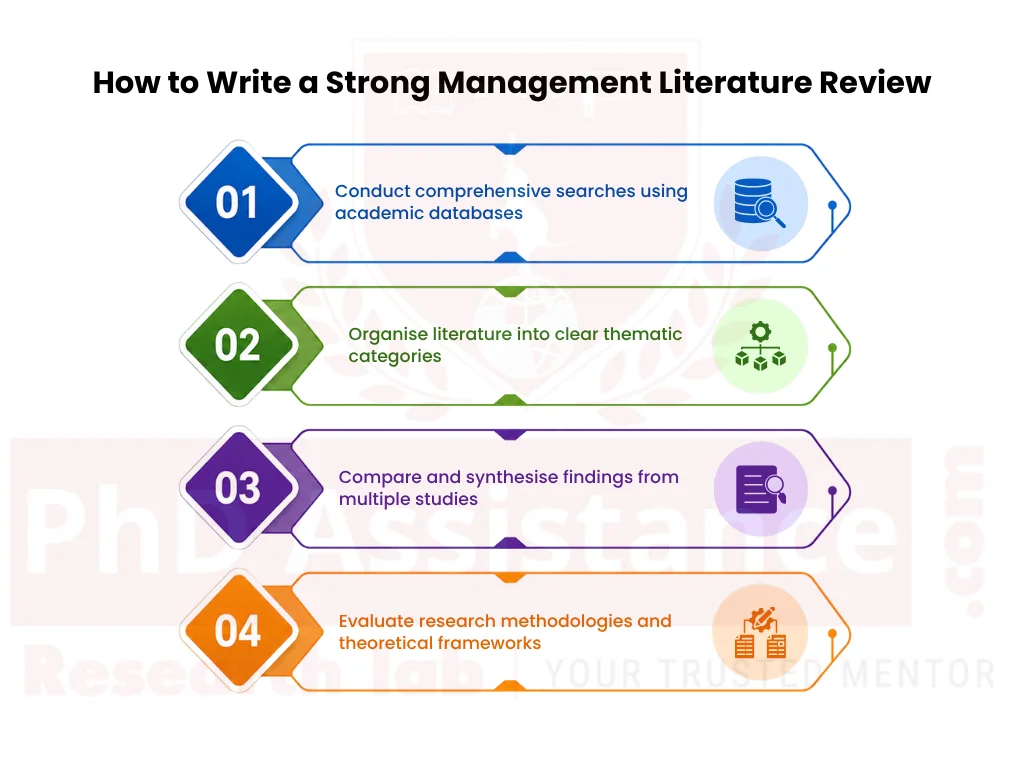
As with most literature reviews of this sort, you need to assess the techniques used to establish the research, the way to present proof of idea, the evaluation strategies used, and the confines of the individual analysis reports, thus assisting you in discovering a fitting methodology.
For example, in the field of management, management issues for Digital Leadership and Artificial Intelligence Strategy routinely make use of methods consisting of equation modelling, Regression, time periods, longitudinal modelling, and prediction via methods centred on machine learning.
Quantitative methods commonly used in management research include:
Example: Avolio, Sosik, Kahai and Baker (2024) highlighted that digital leadership is best explored by use of a mixed methods approach since quantitative indicators alone cannot adequately describe any of these behaviours in the more modern technology-focused working environment.
Step 5: Develop Research Questions and Literature-Based Contributions
In this last step, we take the gaps we have uncovered in the literature review and translate these into meaningful research questions. We write a concise question; it is theoretically based, it is current, and the current topic needs to reflect something to do with management.
AI strategy and digital leadership – Possible questions for a paper could revolve around areas such as organisational transformation, technological adoption, innovation management and leadership competencies. The Research question, well formulated, represents originality of the suggested work and its importance.
Management theory, AI strategy application, the deployment of AI strategy into an organisation, the leadership styles in digital and transformational organisations, and organisational decision-making all might get more than adequate explanations from the suggested study work.
Researchers should clearly explain how their proposed study contributes to:
Example: Research by Raisch and Krakowski (2024) highlighted a significant research gap as there is an identified lack of research on the integration of human Leadership Competences in conjunction with AI-supported strategic decision-making. Research to explore this area could lead to further Hybrid Leadership Models and provide AI-enabled intelligence.
Strategies for Writing a Strong Management Literature Review
Conclusion
Within the current United Kingdom management research, AI strategy and digital leadership models are a dynamic field of growing interest and potential. The literature review provides a means to assess previous findings, determine potential future research avenues, identify areas of theory that may have different viewpoints, and build a base on which future work can be constructed.
Writing an excellent review requires identifying appropriate literature efficiently and reliably; assessing the strength of the evidence; integrating management theory, considering appropriate methodological criteria; and writing using a clear, step-by-step process to produce a review of sufficient quality for submission in a higher education context.
Get customised Strategic Management Literature Review support for your Leadership Models from experts at PhD Assistance Research Lab.
References
- Avolio, B. J., Sosik, J. J., Kahai, S. S., & Baker, B. (2024). Digital leadership and technology-enabled leadership in contemporary organizations. The Leadership Quarterly. https://www.researchgate.net/publication/392381841_Digital_leadership_a_systematic_literature_review_and_research_direction
- Dwivedi, Y. K., Kshetri, N., Hughes, L., Slade, E. L., Jeyaraj, A., Kar, A. K., Baabdullah, A. M., Koohang, A., Raghavan, V., Ahuja, M., Albanna, H., Albashrawi, M., Al-Busaidi, K. A., et al. (2023). So what if ChatGPT wrote it? Multidisciplinary perspectives on opportunities, challenges and implications of generative conversational AI for research, practice and policy. International Journal of Information Management, 71, 102642. https://doi.org/10.1016/j.ijinfomgt.2023.102642
- Raisch, S., & Krakowski, S. (2024). Artificial intelligence and management: The automation–augmentation paradox revisited. Academy of Management Perspectives. https://www.researchgate.net/publication/339184283_Artificial_Intelligence_and_Management_The_Automation-Augmentation_Paradox
- Teece, D. J. (2023). Dynamic capabilities and organizational agility in the age of artificial intelligence. California Management Review. https://papers.ssrn.com/sol3/papers.cfm?abstract_id=2771245
- Verhoef, P. C., Broekhuizen, T., Bart, Y., Bhattacharya, A., Dong, J. Q., Fabian, N., & Haenlein, M. (2021). Digital transformation: A multidisciplinary reflection and research agenda. Journal of Business Research, 122, 889–901. https://doi.org/10.1016/j.jbusres.2019.09.022.