
How to Write a Literature Review in UK Economics: Using FinTech Innovation, ESG Strategy and Predictive Models
- Home
- Academy
- PhD Literature Review
- How to Write a Literature Review in UK Economics: Using FinTech Innovation, ESG Strategy and Predictive Models
Sustainable Practices in Environmental Science
- Step 1: Identify Relevant Literature in FinTech Innovation, ESG Strategy and Predictive Models
- Step 2: Conduct a Critical Literature Review and Research Gap Analysis
- Step 3: Apply Economic Theories and Conceptual Frameworks
- Step 4: Evaluate Research Methodologies and Predictive Models
- Step 5: Develop Research Questions and Literature-Based Contributions
- Strategies for developing a management proposal
- Conclusion

Recent Post
Introduction
The UK is evolving in financial innovation, sustainable investing, and data-driven economic choices. With growing FinTech ecosystems, ESG strategies, and predictive analytics use, there are amazing chances for researchers to look into today’s economic issues and policy changes. So, the future looks bright for studies in these areas.
Postgraduate and doctoral students in the UK studying economics are diving into topics like digital finance and sustainable investing. They also look at ESG performance, use of machine learning, and predictive models in economics. Still, creating solid literature reviews is tough.
The article explains how UK economics researchers can craft a great literature review. They need to find relevant material, look at different theories, put together the facts they find, and spot areas that need more study in FinTech, ESG, and predictive analytics. There is professional Literature Review Writing Help in UK that assists researchers conduct high quality literature reviews and making them ready for publication.
What you will learn?
Step 1: Identify Relevant Literature in FinTech Innovation, ESG Strategy and Predictive Models
First, find reliable sources for your economics literature review on FinTech, ESG, and predictive models. UK researchers can consult journals (peer-reviewed), government sources or industry journals.
It’s wise to focus on recent papers, top-cited works, and key studies laying down theories and facts. Using solid search strategies with the right keywords boosts both the quality and relevance of a review. Some students often consider a structured Economics Dissertation Literature Review Help UK to excel at their literature review.
It’s also key to sort the literature by themes like digital financial innovation and sustainable finance. This includes looking at ESG performance, machine learning apps, and economic forecasting too. This is useful for researchers because it identifies potential patterns, contradictions and the areas that still need further research.
Example:
For example, Arner, Barberis, and Buckley (2015) explained how FinTech are changing traditional finance using digital technology, AI, and blockchain. This article is highly beneficial to researchers interested in the study of financial technology and the economic shifts within the UK.
Step 2: Conduct a Critical Literature Review and Research Gap Analysis
A literature review is not just a summary of previous work; it also involves criticism. Researchers have to look at the significant contributions, limitations, methods, and results of prior work, and find what needs more digging into. This helps lay the groundwork for your research and shows you get the field’s current knowledge.
Often economics students will only summarise past studies rather than identify the contradictions, methodological flaws or areas which have yet to be investigated. In a critical review you should compare the evidence of available studies, highlight conflicting results, evaluate the evidence and explain how the new study has built on prior research.
Shortcomings in prior research can be highlighted by changes in the market, technology, policy or problems within the research topic and errors in studies carried out before. This identification will justify the current study and support key research questions.
Example
Gomber et al (2018) acknowledged that FinTech adoption has led to increased financial efficiency, but there is very limited research carried out concerning the long-term effects of FinTech adoption on financial stability and regulations. Such aspects have led to areas for further research into UK financial markets.
Step 3: Apply Economic Theories and Conceptual Frameworks
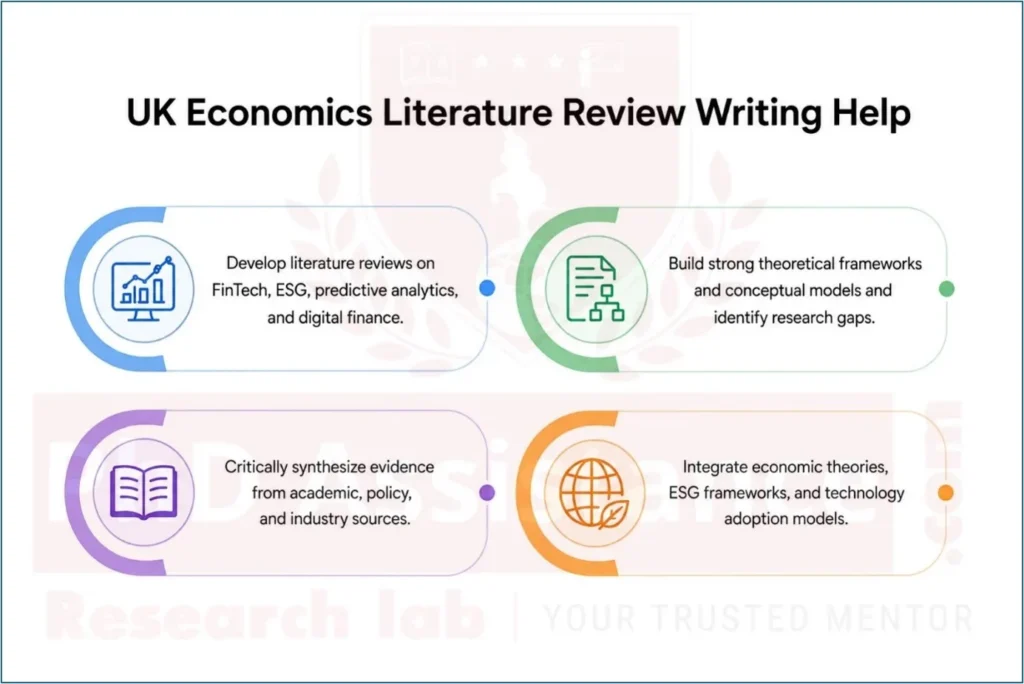
The literature review should first determine a solid theoretical framework that describes significant variables. The relevant theory will help the researchers in the interpretation of the results, develop the conceptual framework and give support to the analysis of the economic phenomenon. A theoretical framework that is properly developed may help in placing the research within a relevant academic debate. Structured FinTech Literature Review Writing Help assist students to conduct their review based on key theories in economics.
Some theories frequently adopted in research concerning FinTech, ESG and predictive analytics include Diffusion of Innovation Theory, Technology Acceptance Model (TAM), Stakeholder Theory, Institutional Theory, Resource-Based View (RBV) and Sustainable Finance Theory. The choice of the theory is determined by research objectives, variables and the research problem.
Researchers need to explain how theoretical arguments fit in with what we already know, and how they direct the course of future research. The integration of strong theoretical links raises the standard, and increases the persuasiveness and analytical rigour of the literature review
Example: The TAM developed by Davis (1989) provided understanding of how user acceptance towards technology is related to perceived usefulness and ease of use. TAM has since been widely used in the study of FinTech, with its focus on user acceptance of various forms of digital financial services and tech-driven financial innovation.
Step 4: Evaluate Research Methodologies and Predictive Models
One of the crucial elements in a literature review is being aware of the research methods which have been employed in that area of study. The researcher needs to critically evaluate the methodology of previous literature and illustrate how they can be applied to their own study. Assessing the advantages and disadvantages of previous methods allows for greater credibility and validity of past literature.
Quantitative techniques like regression analysis, panel data analysis, machine learning and SEM (Structural Equation Modelling) are widely used to examine the nexus between FinTech innovation and ESG performance in economics. While case studies, interviews, etc., qualitative analysis methods are often employed in studies of new economic phenomena and opinions of stakeholders.
Predictive models are gaining importance in economic studies. Financial, ESG, and market forecasting, as well as risk prediction, are frequently performed using machine learning algorithms like Random Forest, Support Vector Machines, Artificial Neural Networks, and Deep Learning. The appropriateness of these methods can be judged on data availability with Expert ESG Strategy Literature Review Assistance.
Example: The usefulness of Random Forest algorithms for modelling tasks was established by Biau and Scornet (2016), where they provided a detailed study of its accuracy on forecasting, which is often complicated in economic scenarios.
Step 5: Develop Research Questions and Literature-Based Contributions
The literature review and the discovered gap in the research should be the direct sources from which research questions arise. The questions need to be targeted, observable and relevant to both theoretical and applied issues. Well-formed questions enable the researcher to structure the direction of the research and provide an issue which merits study.
Researchers are expected to articulate their contribution to theory, policy and practice. In the case of economics, such contribution could take many forms, such as advancing economic theory, better modelling of economic behaviour, filling a void in the empirical literature and/or providing input into the policy-making process and financial sector.
This contribution section articulates the originality and relevance of the proposed research and supports its relevance in the literature. A well-argued contribution section may also support the overall relevance of the research project.
Example: The research done by Berg, Kbel and Rigobon (2022) found disagreement between the different ESG providers and revealed gaps in the measurement and evaluation systems of ESG practices. Such conclusions could create some further research possibilities concerning the standardisation and transparency of ESG evaluation.
Strategies for Writing a Strong Economics Literature Review
Conclusion
FinTech innovation, ESG strategy and predictive models are three highly developing fields of research within UK economics. An efficient literature review supports in discovering new knowledge, research gaps and robust theories on which to base subsequent studies.
To write a high-quality literature review that systematically identifies the literature, critical appraisal of the literature and integration and evaluation of the theory and methodology have to be taken into consideration. Following this step-by-step approach, the researcher will be able to write a literature review as expected from university standards and add their part to economic literature. Scholars can improve the quality of their literature review through guidance from a professional guidance.
Get professional Custom Economics Literature Review Writing support for your economic literature review from experts at PhD Assistance Research Lab.
References
- Arner, D. W., Barberis, J. N., & Buckley, R. P. (2015). The evolution of FinTech: A new post-crisis paradigm? Georgetown Journal of International Law, 47(4), 1271–1319.
- Berg, F., Kölbel, J. F., & Rigobon, R. (2022). Aggregate confusion: The divergence of ESG ratings. Review of Finance, 26(6), 1315–1344.
- Biau, G., & Scornet, E. (2016). A random forest guided tour. TEST, 25(2), 197–227.
- Davis, F. D. (1989). Perceived usefulness, perceived ease of use, and user acceptance of information technology. MIS Quarterly, 13(3), 319–340.
- Friede, G., Busch, T., & Bassen, A. (2015). ESG and financial performance: Aggregated evidence from more than 2000 empirical studies. Journal of Sustainable Finance & Investment, 5(4), 210–233.
- Gomber, P., Kauffman, R. J., Parker, C., & Weber, B. W. (2018). On the FinTech revolution: Interpreting the forces of innovation, disruption, and transformation in financial services. Journal of Management Information Systems, 35(1), 220–265. https://doi.org/10.1080/07421222.2018.1440766