Dissertation Length and Methodology: Key Insights for Researchers and Scholars
- Home
- Academy
- Dissertation Page Length and Methodology Choice
Dissertation Page Length and Methodology Choice: Insights for Researchers and Scholars
Published 6th March 2025

Doctoral students are worried about the issue of how long their dissertations should be. The needed length varies depending on the field of study and methodology, but it remains subject to institutional rules. However, the precise influence of approach bias on dissertation length is still poorly understood, particularly in PhD and EdD programs.
The article will discuss the key findings of Randolph et al. (2014)‘s methodological evaluation of education dissertations, as well as other relevant studies on dissertation length and methodology selection[1]. Students, researchers, and scholars can make informed decisions about their dissertations and research projects based on these tendencies.
1. Dissertation Methodology: Quantitative, Qualitative, and Mixed-Methods Approaches
1.1 Overview of Dissertation Methodologies Doctoral dissertations typically follow one of three main research methodologies:
Quantitative Research
- Based on statistical analysis and numerical data.
- Grounded in positivism, aiming for objectivity and generalizability.
- Often employs structured surveys, experiments, or secondary data analysis.
Qualitative Research
- Focuses on interpretation, meaning, and social context.
- Uses open-ended interviews, case studies, ethnography, or document analysis.
- Rooted in constructivism and interpretivism, aiming for in-depth understanding rather than generalizability.
Mixed-Methods Research
- Integrates both quantitative and qualitative approaches.
- Provides a comprehensive perspective, capturing both numerical trends and in-depth insights.
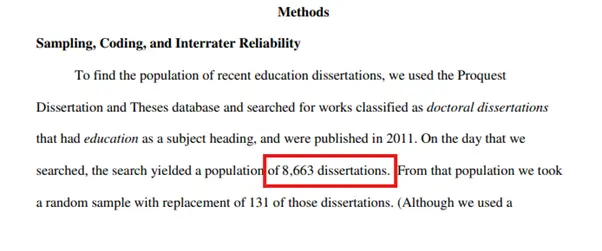
- Randolph et al. (2014) analyzed a total of 8,663 dissertations in education and randomly selected 131 dissertations; they evaluated them based on page length, methodological type, gender, and institutional type (i.e. online versus residential) [1].
2. Methodology Trends in Education Dissertations
2.1 “Distribution of Research Methodologies” A study by Randolph et al. (2014) ascertained the fact that quantitative research was being used most widely in educational disintegration.
The distribution was as follows:
Methodology Choice | Percentage |
Quantitative | 53% |
Qualitative | 34% |
Mixed-Methods | 13% |
Meta-Analysis | 0% |
From the results, it can be said that more than half of the dissertations in education are quantitative, as they help in formulating a hypothesis and yielding generalizable results. Although qualitative studies are in a small number, they constitute a huge percentage in education research in terms of context, experiences, and close observation.
3. Dissertation Page Length: Key Findings
3.1 Randolph and others (2014) have given descriptive statistics regarding measures of length dissertations tend to have with the fact that qualitative and mixed-methods dissertations tend to be significantly longer than their quantitative counterparts.
Methodology | Mean (M) | Standard Deviation (SD) | Minimum (Min) |
Entire Sample | 183 pages | 84 pages | 47 pages |
Quantitative | 155 pages | 70 pages | 47 pages |
Qualitative | 216 pages | 85 pages | 49 pages |
Mixed-Methods | 212 pages | 97 pages | 106 pages |
Key Takeaways:
- Dissertations of the quantitative route are on the shorter end of the spectrum, generally with an average length of 155 pages.
- Qualitative dissertations are expected to be the longest, with an average length of 216 pages, with substantive narrative descriptions, interviews, and case studies.
- Mixed-methods dissertation work would be an average of 212 pages long, given that it demands quantitative analysis as well as qualitative discourse.
The trends suggest that students electing to work with qualitative or mixed-methods research are in for a longer writing time, while those choosing quantitative research will need to be more focused on data analysis and statistical interpretation.
4. Dissertation Length in Online vs. Residential Programs
4.1 Need for Clearer Distinctions
Multiple studies indicate that DBA and PhD dissertations share more similarities than differences (Banerjee & Morley, 2013; MacLennan et al., 2018). To establish clearer distinctions:
- Business accreditation bodies should refine evaluation criteria for DBA dissertations.
- Universities should develop alternative assessment methods to better reflect practitioner-focused nature of DBA research.
4.2 Integrating Innovation in Dissertation Research
- The growing use of machine learning, AI, and data analytics in business research presents new opportunities for DBA students to apply emerging technologies to real-world problems.
- PhD students can explore new theoretical frameworks and interdisciplinary approaches to advance business knowledge.
4.3 Strengthening Professional Practice in DBA Programs
- By restructuring DBA dissertation guidelines, universities can create a distinct research pathway that better aligns with industry needs and executive leadership training [2][1].
5. Gender and Dissertation Methodology Choice
5.1 Randolph et al. (2014) investigated the potential influences of gender on methodological selection.
Key Findings:
- More females (53%) than males (47%) authored dissertations in education [1].
- Contrary to prior studies, Randolph et al. (2014) found that slightly more males chose qualitative research than females [1].
- Plowman and Smith (2011) found the opposite trend in management research, where female scholars were more likely to use qualitative methods than their male counterparts [2].
5.2 Field-Specific Differences Randolph et al. (2014) suggested that these differences may be discipline-dependent.
For instance:
- In education research, methodology decisions seem to be balanced between males and females.
- On the contrary, in management and business, female scholars seem to favour qualitative methods, whereas male scholars use quantitative methods.
Some disciplines determine gender; however, this would not seem the case for methodology choice in educational dissertations.
6. The Need for Further Research on Dissertation Trends
Randolph et al. (2014) noted that studies on dissertation methodology and dissertation page length are sparse and has therefore resulted in:
6.1 More recent research on PhD and EdD dissertation trends.
- Comparative studies across different academic fields (e.g., business, STEM, social sciences).
- Further exploration of online vs. traditional dissertation structures.
6.2 Implications for Future Research
- Future studies should involve larger samples from different institutions to see whether these trends apply nationally or internationally.
- It will facilitate understanding preferences can help universities customize their research training programs more appropriately to specific needs of applicants.
Conclusion
Key Takeaways for Doctoral Students
While selecting an appropriate methodology for dissertation, a student should consider the following:
- Quantitative research for hypothesis-testing and statistical relationships analysis.
- Qualitative research to explore perspective, behavior, or other complex phenomena.
- Mixed-methods research when blending numerical data with richer contextual understanding is preferred.
Understanding Dissertation Length Expectations
- Quantitative dissertations tend to be shorter, averaging around 155 pages.
- Qualitative and mixed-methods dissertations require more extensive writing, averaging over 210 pages.
- Online university dissertations may be slightly shorter than those from traditional residential programs.
The Role of Institutional and Individual Factors
- Program type, discipline, and institutional guidelines contribute much to dissertation expectations.
- Gender differences in methodology choice most likely differ across fields but do not seem a strong factor in education research.
Understanding these factors will help doctoral students make decisions regarding dissertation structure, methodology, and research methods, thus facilitating a more successful academic journey.
Research Methodology Writing Services
PhD Assistance provides research methodology writing services that fixates and deploys the right kind of methodology suitable for the nature of your study.
Our experts assist you in every stage of research methodology writing services that tests the true essence of your study.
Visit PhD Assistance for extended services!