
Reporting Correlation Analyses in Research Manuscripts
Reporting Correlation Analyses
- Introduction
- State the Purpose of the Analysis
- Summarize the Variables Involved
- Identify the Correlation Coefficient Used
- Verify Statistical Assumptions
- Report Statistical Significance and Precision
- Include Visual Support
- Specify the Statistical Software Used
- Summary Checklist for Reporting Correlation Analyses
Recent Post
Introduction
State the Purpose of the Analysis
- “To analyse how cloud technology adoption relates to the efficiency of accounting functions.”
- “To analyse how sleep time and depression are predictors of cognitive development in adolescents. “
In Georgiev (2025) the study was to establish the relationship of cloud technology adoption to improved IFRS compliance and accounting efficiency. The authors set out to determine if the technology brought forth a transformation, and the extent to which this transformational technology impacted the overall accounting function performance in organizations. This was a primary goal used to assess the transformational implications of digital systems in financial reporting.
Similarly, Cao (2025) also undertook correlation analysis to quantify sleep time and symptoms of depression as predictors of cognitive development in adolescents without explicit mention; however, to understand the indirect implications for long-term and underlying influence on adolescent learning and development.
Summarize the Variables Involved
- “Cloud technology adoption (the independent variable) was scored on a scale of one to five (1- no adoption, 5- full adoption). Average processing time per financial transaction was the dependent variable (accounting efficiency).”
In Daver et al. (2025), data points containing descriptive statistics (survival rate and remission duration) related to leukaemia treatment were presented to provide context for interpreting the survey research aimed at determining how combination therapy impacted treatment outcomes. Descriptive data points also allowed the reader to consider the baseline, such as age and medical history of participants, which is essential to understanding the way treatment relates to survival outcomes.
It is important to determine the type of correlation coefficient used in your analysis because it informs how you can think about relationships among variables – dependent on the data type.
- Pearson’s r is used on a linear relationship where the data are continuous, and the data are directly distributed normal.
- Spearman’s rho is used for ordinal data or when data are not normally distributed.
Rico-Bordera et al. (2025), decided to use Pearson’s correlation because they looked at the relationship of the Dark triad personality traits and inter-rater agreement on those traits, which were based on continuous and normally distributed data.
In contrast, Peng et al. (2025), used Spearman’s correlation coefficient since they examined relationships between physical abuse, internet addiction, and anxiety in adolescents by assessing ordinal variables (e.g., severity of abuse) and not normally distributed data.
Prior to conducting the correlation analysis, it is important to check that the statistical assumptions of the analysis method are met. For example, Pearson’s correlation requires data to be linear and have a normal distribution while Spearman’s correlation is a non-parametric analysis and thus has no assumptions.
If the assumptions of normality or linearity are not met, it is appropriate to justify the use of non-parametric analyses or to apply transformations. This demonstrates transparency in your analysis, which is paramount to analysing the data correctly and confirming your conclusions are warranted.
- Fu et al. (2025) determined that the data was normally distributed prior to applying Pearson’s r to the multiplex graph diffusion network analysis. They applied the Shapiro-Wilk test to check for normality and subsequently determined if the data were not normally distributed, appropriate transformations were applied.
- “r = 0.62, p < 0.05 , 95% CI: 0.45–0.76”
In Wei et al., (2025), the researchers stated oil pollution and community changes in microorganisms of ecosystems, including specific statistical significance and confidence intervals of the correlation. This provided clarity in the communication of strength and confidence of the finding in their study.
The use of weak, moderate, or strong also has ambiguity unless using established alpha thresholds. The weakness or strength of a correlation may depend on the researchers where the variables were located on a continuum of rankings of larger distributions, where empirical studies often occur.
Include Visual Support
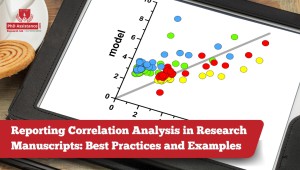
- Fu et al. (2025) presented a scatter plot as an illustration of the relationships they examined in their multiplex graph diffusion networks. They included correlation coefficients, confidence intervals, sample size, and P-values in the visual representation.
Specify the Statistical Software Used
Summary Checklist for Reporting Correlation Analyses
| Reporting Element | Required? |
|---|---|
| Purpose of the correlation analysis | Yes |
| Descriptive statistics for each variable | Yes |
| Type of correlation coefficient stated | Yes |
| Assumptions confirmed | Yes |
| Alpha level and p-value reported | Yes |
| Correlation coefficient with 95% CI | Yes |
| Subjective labels used cautiously | Recommended |
| Scatter plot included | Recommended |
| Software identified | Yes |
Conclusion
By following these best practices ensure a correlation analysis that is scientifically valid, statistically significant, and suitable for publication. Adequate documentation of correlation analyses not only enhances the quality and reproducibility of the research work but also provides the peer reviewer with important context for assessing the reliability of the ultimate hypothesis being validated. Consequently, following these guidelines enables the researcher to reach ample clarity, conciseness, and context with systematic reporting of their correlation analysis which ultimately enhances the reliability of their academic work and public health potential.
Require Professional Help Alongside Reporting Association Analyses for Your Biomedical Work?
PhD Assistance Research Lab has dedicated services to help you report your association analyses accurately and transparently in your study.
Contact us today to ensure that your study complies with the best statistical reporting practices to enhance the credibility and reproducibility of your research to successfully publish your work!
References
1. Cao, X. (2025). Sleep time and depression symptoms as predictors of cognitive development among adolescents: A cross-lagged study from China. Psychological Reports, 128(3), 1566-1587.
2. Rico-Bordera, P., Pineda, D., Galán, M., & Piqueras, J. A. (2025). Assessing the dark personality traits with observer reports: A meta-analysis of inter-rater agreement on the Dark Triad and Dark Tetrad traits. Personality and Mental Health, 19(1), e1639. https://doi.org/10.1002/pmh.1639
3. Wei, Y., Zhu, Y., Yang, L., Chen, C., Yue, M., Mao, Z., … & Xue, W. (2025). Effects of oil pollution on the growth and rhizosphere microbial community of Calamagrostis epigejos. Scientific Reports, 15(1), 1278. https://doi.org/10.1038/s41598-025-12356-1
4. Yahaya, P. D. O. A. (2025). Sustainability reporting quality in the face of the board of directors. Available at SSRN 5094168. https://ssrn.com/abstract=5094168