Critical Review of Work-integrated learning for working life in academia – experiences from online learning activities with PhD students
Introduction
Doctoral researchers receive essential academic career training from higher education institutions, which prepare them for their future work in research environments. The academic field in recent years has seen an increase of universities that use Work-Integrated Learning in Academia to connect practical professional skills with doctoral theoretical training. Work-integrated learning helps doctoral students develop academic competencies, collaborative abilities, and professional experience that prepare them for working life both inside and outside universities.
The article Work-integrated learning for working life in academia – experiences from online learning activities with PhD students examines how structured digital learning activities can support doctoral education. The research investigates PhD students’ online learning activities which help them develop professional skills and academic writing abilities and collaborative research capabilities. The COVID-19 pandemic forced universities to shift to digital education which made online collaboration essential for doctoral training.
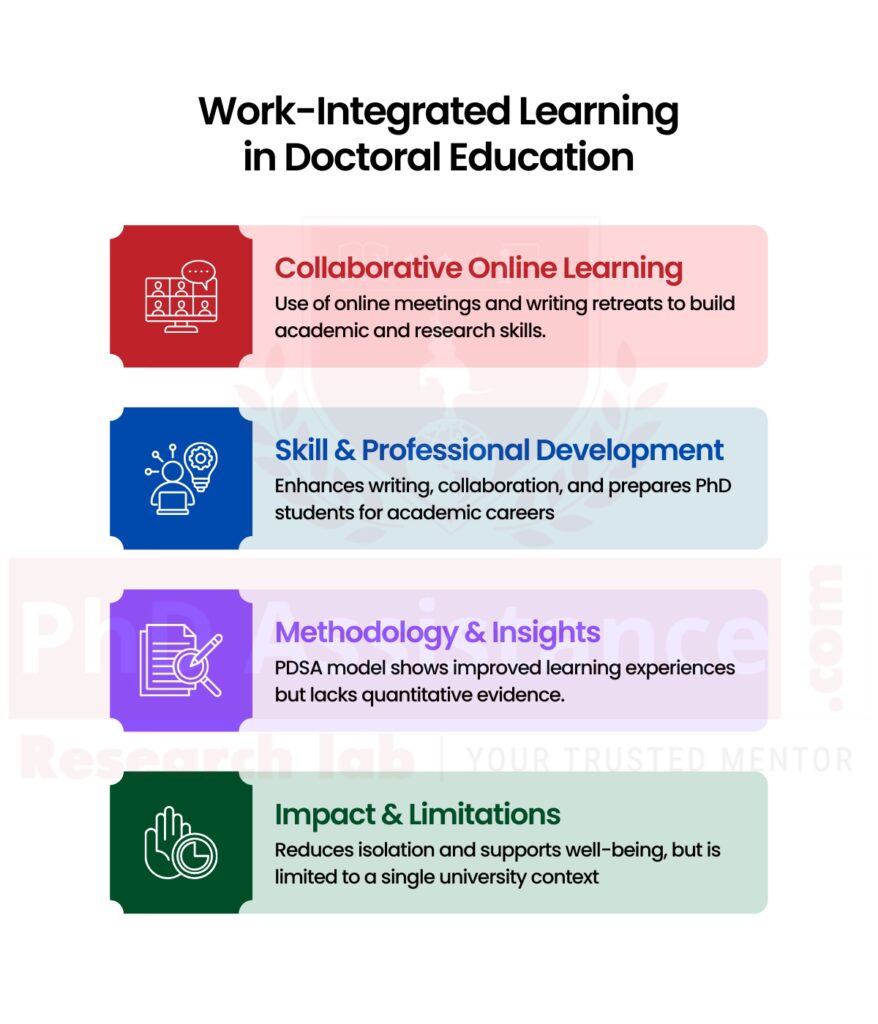
It studies work-integrated learning through the examination of collaborative learning environments which include online monthly meetings and online writing retreats. Through these activities doctoral students develop their academic skills by participating in actual academic work and interacting with their fellow students.The review assesses the research methods and research findings of the study while evaluating its impact on understanding how work-based learning programs in universities benefit doctoral education and academic skill development.
Summary of the article
The article investigates how Work-Integrated Learning can be implemented through collaborative online learning environments for doctoral students. The research took place at a Swedish university which studied two different online learning methods for PhD students: they conducted online monthly meetings and structured online writing retreats.
The online monthly meetings created a collaborative space which allowed PhD students to talk about their research problems while they exchanged academic knowledge and assessed their doctoral studies. The meetings provided students with a platform to explore research methods and share their experiences with publishing academic work while learning about different pathways for their professional growth.
The second learning activity involved organized online writing retreats which doctoral students used for concentrated writing work and writing goal sharing and writing progress assessment. The activities required participants to establish achievable writing objectives while they learned to create academic writing solutions.
The Plan–Do–Study–Act (PDSA) improvement model was used to evaluate the effectiveness of these activities. Data collection used participant feedback and observations and reflections from learning activities.
Critique
Significance and contribution of the field
A valuable contribution to research on work-integrated learning in higher education by demonstrating how collaborative learning environments can support doctoral education. The research shows that doctoral students acquire academic and professional skills through their structured peer interactions and their experiences of academic activities.
The academic work-integrated learning models while demonstrating that online collaboration creates authentic academic work environments for students. The activities of academic writing retreats and peer discussions enable doctoral students to practice authentic academic work while they prepare for their future academic careers.
It presents another key finding by demonstrating that doctoral student well-being serves as a central point of its research. The research results show that doctoral students experience decreased social isolation in collaborative learning environments, which help them build supportive academic relationships.
Methodology and research design
A qualitative improvement method was used, which derives its foundation from the Plan-Do-Study-Act (PDSA) model. The researcher can test fresh educational initiatives while studying participant responses and enhancing the initiatives throughout their development.
The methodology provides a proper examination of university-based work-based learning because its design emphasises actual learning experiences and ongoing development. The research method enables the researcher to observe learning activity changes that occur as participants reach expert proficiency.
The limitation is the lack of quantitative data, which serves as its second restriction, while it depends on participant qualitative feedback as its primary source of information. The research study should use surveys and statistical methods to assess how it affects online learning activities for PhD students’ academic performance and their rate of completing doctoral programs.
Argumentation and Use of Evidence
A clear argument supporting the importance of Work-Integrated Learning in doctoral training was presented in the study. The author supports the argument by referencing previous research on doctoral supervision, academic writing development, and doctoral student well-being.
They establish a link between academic experiential learning and the development of professional skills. The study shows that doctoral students learn to write and conduct research through their participation in joint writing and research activities.
The argument requires strengthening through the addition of comparative research, which studies other universities and international locations. The research needs to be compared to determine whether different academic work-integrated learning models succeed in various higher education systems.
Ethical considerations and omissions
It does not present major ethical concerns because it is primarily based on voluntary participation and feedback from doctoral students involved in the learning activities. The Swedish research regulations state that educational research studies that do not involve human subjects need no formal ethical assessment.
The research fails to provide a thorough examination of how various demographic characteristics impact the learning experiences of doctoral students. The study participants will show distinct patterns of work-integrated learning engagement, which will differ based on their academic field, cultural heritage, and international student background.
Writing Style and Structure
Your training program uses data that extends up to the month of October in the year 2023. The article uses clear and accessible language to explain complex concepts that deal with doctoral education and professional development. The paper begins with theoretical background information, which leads into a research methodology presentation, followed by the results section and final discussion.
The discussion section effectively connects the study’s findings with broader academic debates about experiential learning in academia and doctoral student development. The article presents universities with practical guidelines that they can use to create collaborative learning spaces that improve their doctoral training programs.
The theoretical discussion needs additional components through which researchers can create detailed frameworks that demonstrate how work-based learning operates in universities and doctoral education.
Conclusion
The article shows how Work-Integrated Learning programs in academic settings help doctoral students develop their academic skills and professional capabilities. The research shows that online collaborative learning activities, which include monthly meetings and writing retreats, can boost academic abilities and enhance student partnerships while improving doctoral student health.
Academic work-integrated learning programs improve doctoral student training, as the research was conducted with a restricted group of participants from one university. The research results show that universities need to incorporate collaborative learning methods into their doctoral programs because these methods will boost academic progress and student mental well-being.
For researchers seeking expert support in developing research publications, the PhD Assistance Research Lab offers specialised academic guidance tailored to doctoral scholars and early-career researchers.
Reference
Josefsson, K. A. (2025). Work-integrated learning for working life in academia – experiences from online learning activities with PhD students. Studies in Continuing Education, 47(3), 546–561. https://doi.org/10.1080/0158037X.2024