
Critical Review of Teaching Training in Canadian Political Science PhD Programs
Introduction
Doctoral education traditionally prioritises research training, while it permits research training to develop without developing teaching methods. However, many PhD graduates pursue academic careers where teaching plays an important role. The teaching training process for Political Science PhD Teaching Training in Canada has developed into an essential research area for higher education institutions.
The article Teaching Training in Canadian Political Science PhD Programs investigates the teaching preparation systems that Canadian Political Science PhD programs implement. Although several studies examine teaching preparation in American doctoral programs, there is limited research on doctoral teaching in Canada. The authors address this gap by analysing how teaching training is organised across Canadian institutions.,
It evaluates the article’s methodology, findings, and contribution to the study of teaching development in doctoral education and career preparation in Canada.
Summary of the article
Political Science PhD teaching training programs across Canada, which they assess through an anonymous online survey distributed to Graduate Chairs of doctoral programs in various departments. The 14 departments that responded to the contact from 19 departments provided information about their teaching training programs, which exist throughout Canadian Political Science PhD programs.
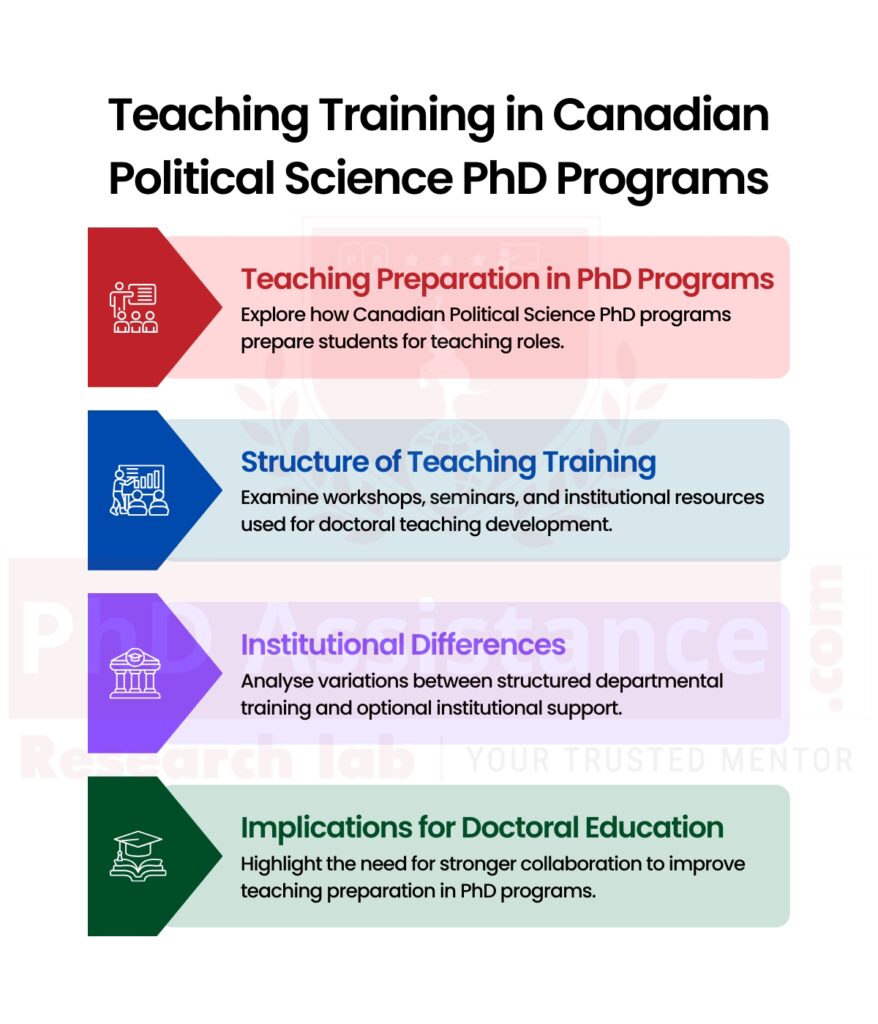
The results demonstrate that educational training programs mainly function as informal training sessions, which most universities provide through their teaching and learning centres instead of through departmental programming. The programs offer workshops and seminars that develop graduate teaching assistant training in Canada while teaching doctoral students classroom instruction techniques.
Both credential inflation and technological demand have been reported. The results demonstrate considerable institutional disparities between different educational organisations. Some departments offer structured training programs, while others rely mainly on optional institutional resources. More formal doctoral teaching preparation in Canada would enhance doctoral program quality, according to most respondents who participated in the study.
This conclude that improving faculty administrator graduate student collaboration will enhance teaching development programs for doctoral education in Canadian Political Science departments.
Critique
Significance and contribution of the field
It contributes to research on doctoral education through its examination of doctoral teaching training for Political Science PhD programs, which Canadian institutions currently practice. Most previous studies examine American doctoral programs, making this study useful for understanding how Political Science PhD programs in Canada approach teaching preparation.
Teaching abilities serve as essential requirements for success in academic professions. The authors demonstrate through research on graduate teaching assistant training programs in Canada that various educational institutions implement different methods for teaching their students.
It could have increased its value by showing how better teaching leads to improved academic performance for doctoral graduates in Canadian institutions and their subsequent professional development.
Methodology and research design
An anonymous online survey directed at Graduate Chairs in departments offering PhD programs in Canada. The method enables institutions to provide their perspectives on the structure of Canadian Political Science PhD teaching and training programs.
The research design achieves its main strength through the fact that administrators possess information about both departmental policies and institutional resources that support doctoral teaching preparation throughout Canada.
The design depends on administrative viewpoints because it does not consider the direct experiences of doctoral students. Graduate Teaching Assistant Training Canada training programs receive mixed reviews from students who participate in them.
It faces another restriction because it uses a small sample size, which shows the restricted number of Political Science PhD programs available in Canada. The analysis included most programs, but the available cases limited the ability to conduct advanced statistical tests.
Argumentation and Use of Evidence
They uses anonymous survey data from administrators, which raises minimal ethical concerns. The anonymous responses protect user identity while preventing organisational bias from appearing in the study results.
The research fails to study how gender, international student status and disciplinary specialisation affect graduate teaching assistant training participation in Canadian universities. The study does not investigate how teaching training prepares doctoral students for academic and non-academic career paths in Canada.
Future research should investigate these elements because they will better explain doctoral education teaching development.
Ethical considerations and omissions
This uses anonymised secondary data, which lacks any ethical issues. The research study needs to explore three main areas, which include gender differences, migration history, and insecure work environments. The economic worth of PhD degrees requires assessment through these factors, which should be examined in upcoming studies.
Writing Style and Structure
It provides clear writing that displays organised content. The authors present their research design, findings, and recommendations in a logical structure that helps readers understand the state of Political Science PhD training in Canada.
The discussion section provides an effective summary of research results while offering useful suggestions that will enhance doctoral teaching preparation throughout Canada. The article requires more comprehensive theoretical engagement with the Academic Career Preparation in Canada literature that focuses specifically on Canadian institutions.
Conclusion
The article provides an important overview of Political PhD teaching training in Canada. The findings show that teaching preparation in Political PhD programs in Canada is often informal and varies significantly across institutions.
This identifies a requirement for improved and standardised doctoral teaching training programs, which will assist academic professionals in Canada. The study promotes teaching development in PhD education by encouraging administrators, faculty members, and graduate students to work together.
Future research should include doctoral student perspectives and examine how graduate teaching assistant training in Canada influences long-term career outcomes.
Reference
D’Orazio, D., Sammons, E., Reist, R., Jaipaul, N., & Auer, M. (2026). Teaching Training in Canadian Political Science PhD Programs. Journal of Political Science Education, 1–23. https://doi.org/10.1080/15512169.2025.2608237