
Critical Review of Green Infrastructure for Urban Heat Island Mitigation and Climate-Resilient Cities
Introduction
Urbanisation, construction, deforestation, and greenhouse gas emissions have increased concern about the Urban Heat Island (UHI) effect in cities. The Urban Heat Island (UHI) effect refers to higher temperatures in urban areas compared with surrounding suburban and rural areas.
Cuce et al. (2025) investigate the application of green infrastructure, including green roofs, facades, grass, shrubs, and trees, for Urban Heat Island Mitigation and to create sustainable and resilient cities that are resistant to climate change. This research is based on findings obtained from a variety of empirical studies and presents a holistic approach in which all greenery systems are considered.
The critical review assesses the contribution, evidence, methodological approach, key findings, limitations, and possible areas for further research of the article, especially its practical importance concerning green infrastructure for urban heat reduction.
Summary of the article
This journal article titled “Towards Sustainable and Climate-Resilient Cities: Mitigation of Urban Heat Islands Using Green Infrastructure” is authored by Cuce, Cuce, and Santamouris and published in Sustainability in 2025.
The article evaluates different green infrastructure strategies for mitigating UHIs.:
The authors evaluate evidence from empirical research and modelling to assess temperature reduction, thermal comfort, energy efficiency, and environmental gains. This article claims that by integrating the greenery systems within an urban planning framework, more benefits can be achieved.
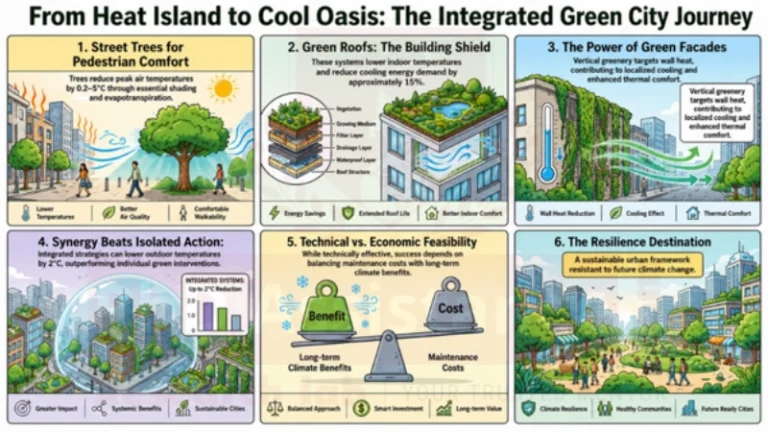
The review reports that urban greenery can reduce outdoor temperatures by up to approximately 2 °C under specific conditions, while some integrated strategies can produce substantial improvements in thermal comfort. It also reports approximately 15% reductions in cooling energy demand in the reviewed evidence.
Significance and contribution of the field
The primary contribution of the paper is that it provides a holistic approach toward green infrastructure. As opposed to considering green roofs, trees, grass, and walls as individual technologies, the authors highlight the possibility of combining them into a cooling mechanism.
This is relevant because the effectiveness of each of these actions depends on the context where it is implemented and its function. Street trees, for example, may provide localised cooling because of their shade and evapotranspiration properties, while green roofs can contribute to the energy efficiency of buildings.
This paper makes a good conceptual contribution because it argues that urban planners should think about using multiple interventions rather than focusing only on one form of intervention.
The contribution to knowledge is, however, more in the form of a synthesis of available literature as opposed to presenting results from an experiment. It is, therefore, based on the quality, validity, and analysis of the research reviewed in this article.
Critical Analysis of the Main Findings
- Effectiveness of green roof:
Green roofs are shown to be capable of cooling through evapotranspiration and thermal insulation, thus lowering room temperature and cooling needs. Daytime cooling capacity of around 2 to 5 °C is indicated in some cases of green roofs.
Interpretation: This demonstrates that green roofs can be valuable for reducing building-level heat exposure and energy demand.
Limitation: The cooling benefit is not necessarily equivalent to city-wide UHI reduction. The paper itself mentions the fact that green roofs usually have a smaller impact on lowering air temperatures at street level due to their cooling effect decreasing with height.
Implication: Green roofs need to be taken into consideration along with other measures but not as a solution in isolation from other mitigation options for UHI.
- Effectiveness of Trees and Vegetation
Studies report that trees can reduce peak air temperature by 0.2–5 °C, mainly through shading and evapotranspiration. Properly placed trees can even lower temperatures by about 1.87 °C.
Interpretation: Trees appear to be particularly effective in reducing temperature at pedestrian level.
Limitation: This effectiveness depends on factors like density of trees, types of trees planted, position, climatic conditions, and access to water. Overdoing the planting could also be counterproductive.
Implication: Tree planting should be used as one of the techniques to mitigate UHI effects.
- Integrated Green Infrastructure
Herath et al. (2018) reported temperature reductions of 1.76–1.86 °C for different green-roof and green-wall coverage levels. Studies also found that tree-and-grass combinations can reduce ambient temperature by up to 2.29 °C and improve thermal comfort.
Interpretation: A combination of green infrastructure features can create more effective cooling outcomes than depending on one type of feature.
Limitation: Findings vary owing to different climates, urban form, types of vegetation, and approaches utilised in the studies.
Implication: The integration of trees, green roofs, facades and other green spaces is more appropriate in developing climate-resilient cities.
Technical Feasibility versus Economic Feasibility
The distinction between the technical and economic feasibility of green infrastructure is a crucial point in the study.
From the technical side, green roofs, walls, trees, shrubs, and grass can provide effective cooling benefits thanks to shading, evapotranspiration, and insulation. According to the study, outdoor air temperatures can be lowered by 2 °C, and trees can cool the environment by 1.87 °C.
However, economic feasibility is more uncertain. Extensive green roofs require lower investment and maintenance, while intensive systems involve higher costs, structural requirements, and routine maintenance. Green roofs and walls can also be more expensive than conventional systems when installation and maintenance are considered.
Therefore, the study demonstrates strong technical feasibility, but economic feasibility depends on the type of green infrastructure, building characteristics, maintenance, and long-term benefits.
Comparison with the Literature
The performance of green infrastructure is compared with several previous studies. Shashua-Bar et al. (2011) reported that trees and grass can reduce outdoor temperature by up to 2 °C in hot-arid environments, while Srivanit and Hokao (2013) reported an ambient temperature reduction of up to 2.29 °C through urban greening.
Similarly, Shahidan et al. (2011) found that combining trees with ground materials could achieve an average temperature reduction of up to 2.70 °C, particularly in tropical climates.
Regarding green roof technology, Razzaghmanesh et al. (2016) presented the cooling effect in Adelaide, whereas Herath et al. (2018) presented a temperature decrease of 1.76 to 1.86°C at different green roof types.
Manso et al. (2021) conducted a review on green roofs and walls, emphasising their benefits in terms of the environment and energy, and stating that costs are based on installation and maintenance. Morakinyo and Lam (2016) demonstrated the influence of tree placement, configuration, and wind on cooling and thermal comfort.
Based on Rui et al. (2018), the design and arrangement of green space affect the microclimate of the city and the quality of air. Balany et al. (2020) explored the role of green infrastructure in mitigating the UHI effect, emphasising the dependency of the efficiency of this strategy on many variables, including climate and urban design.
Overall, the literature indicates strong Green Infrastructure Effectiveness, but the results cannot be treated as a direct comparison because the studies were conducted in different climatic zones, urban structures, vegetation configurations, and research conditions.
Methodology and research design
The article uses synthesis research, using various empirical, numerical, and model-based studies. The researchers provide comparisons of results regarding green roofs, walls, trees, bushes, grasses, cool pavements, and other ways of combating UHI.
Moreover, the paper elaborates on thermal comfort parameters like apparent temperature, heat index, Humidex, THIC, mean radiant temperature (MRT), PMV, and PET.
Strength: The use of multiple thermal-comfort and environmental indicators provides a multidimensional understanding of UHI mitigation.
The evidence comes from studies using different climates, modelling tools, measurement approaches, vegetation configurations, and evaluation metrics. The authors themselves acknowledge this variation and note the importance of standardised performance measures for better comparisons.
Thus, although the literature review offers general information, the heterogeneity of the studies underpinning the review weakens the validity of any quantitative comparison.
Theoretical and Interdisciplinary Analysis
The article is inherently interdisciplinary, combining:
The idea of green urbanism is another very significant theory. This theory is a framework that links vegetation, water, energy, land use, transport, and urban design to sustainable development.
This multidisciplinary approach can be viewed as a key advantage of this theory, as UHI is not only related to temperature issues but is also related to energy consumption, air pollution, human well-being, health, and urban planning.
Nevertheless, it would be possible to make this framework even stronger by adding more economic, social, and governance aspects into consideration. This would provide a broader basis for Sustainable Urban Heat Mitigation.
Practical Implementation and Policy Considerations
This research study provides valuable insights for urban planners and policymakers. Green roofs, green walls, trees, bushes and grass can be incorporated into urban buildings, improving thermal behaviour along with a sustainable approach.
Green roof system selection, however, needs to take into consideration the structure of the building, cost, maintenance, and its use. Extensive roofs have lower soil depth, weight, maintenance requirements, and initial investment, whereas intensive roofs require greater structural capacity and higher investment.
This demonstrates that one green infrastructure strategy cannot be universally applied to every urban environment.
Limitations of the Study
Limitation | Critical Significance | Required Improvement |
Variation among reviewed studies | Makes direct comparison difficult | Develop standardised evaluation metrics |
Strong reliance on modelling studies | Some results may differ from real-world conditions | Increase long-term field measurements |
Context-specific cooling effects | Results may not transfer directly between climates | Conduct cross-climate comparisons |
Limited long-term evidence | Durability and performance over time remain uncertain | Undertake longitudinal studies |
Cost considerations are not consistently quantified | Limits assessment of economic feasibility | Conduct lifecycle cost-benefit analysis |
Vegetation performance varies by species and placement | General conclusions may oversimplify outcomes | Evaluate species, density, and spatial configuration |
Table 1. Critical Limitations of the Reviewed Study
Research Gaps from the Study
Research Gap 1: Long-Term Performance
Despite the promising opportunities for cooling presented by the reviewed literature, the long-term success of green infrastructure remains poorly understood. Vegetation growth and maintenance, seasonality, water supply, and ageing could influence its effectiveness.
Future research: Long-term monitoring should assess performance over multiple years and seasons.
Research Gap 2: Cost-Effectiveness
This paper shows that there is little evidence regarding the cost-effectiveness of green roofs and green walls over the long run, as their construction and maintenance can be more costly compared to traditional options.
Future research: Comparison of lifecycle cost, energy efficiency, maintenance and environmental effects should be done.
Research Gap 3: Standardised Evaluation
Different results of studies arise because of different climatic environments, locations, the nature of the vegetation, the period of the study, and the methods used.
Future studies: It is necessary to develop a standardised methodology that involves similar temperature and thermal comfort indicators.
Overall Critical Appraisal
Dimension | Finding | Critical Judgement | Assessment |
UHI mitigation | Green infrastructure reduces urban heat | Strong evidence, but highly context-dependent | Strong |
Green roofs | Reduce roof temperatures and cooling demand | More effective at building level than street level | Strong |
Street trees | Provide shading and evapotranspiration | Strong pedestrian-level benefits | Strong |
Thermal comfort | Several interventions improve comfort | Results vary between climates and methods | Strong |
Integrated strategies | Combining interventions offers greater potential | Requires further urban-scale validation | Strong |
Economic feasibility | Green systems may involve higher initial costs | Long-term benefits need stronger quantification | Moderate |
Standardisation | Different studies use different metrics | Limits direct comparison | Moderate–weak |
Long-term performance | Important knowledge gap remains | Requires longitudinal evidence | Moderate–weak |
Climate resilience | Green infrastructure supports sustainable urban adaptation | Strong conceptual relevance | Strong |
Table 2. Critical appraisal of the Reviewed Study
Conclusion
Overall, the article by Cuce, Cuce, and Santamouris (2025) is a useful critical analysis of green infrastructure as an option for combating urban heat islands and building climate-resistant cities. The most important point that this article makes is that it makes people realise how all these elements are interrelated to one another – green roofs, green facades, trees, bushes, and grass.
From research, it has been observed that using green infrastructure results in lower temperatures, which leads to more comfortable temperatures, decreased cooling loads, and environmental benefits. However, these benefits depend on climatic conditions, vegetation characteristics, urban form, and other contextual factors.
The major problem lies in assessing the heterogeneous data and making predictions through analysis of the results obtained from each test. Therefore, future research needs to focus on practical tests, performance assessments, cost-benefit analysis, climate comparison, and modelling at an urban scale through GIS.
These limitations also highlight the importance of rigorous literature comparison, critical evaluation, and evidence-based assessment when developing research on green infrastructure for urban heat mitigation and climate-resilient cities.
Need Support with Your Green Infrastructure Critical Review?
Get expert support with literature comparison, UHI mitigation analysis, green infrastructure assessment, evaluation of study limitations, research gap identification, and evidence-based recommendations to strengthen the quality, academic rigour, and critical depth of your green infrastructure and climate-resilient cities review.
Frequently Asked Question
Green infrastructure reduces urban heat through shading, evapotranspiration, and thermal insulation. Trees, green roofs, green walls, grass, and shrubs can lower air and surface temperatures and improve outdoor thermal comfort.
Its effectiveness varies by climate, vegetation type, density, spatial arrangement, and urban form. The reviewed studies report temperature reductions of up to several degrees under specific conditions, with trees often providing strong pedestrian-level cooling.
Key strategies include green roofs, green walls, street trees, grass, shrubs, and integrated greenery systems. Combining multiple interventions can provide broader cooling benefits than using a single strategy.
Key limitations include installation and maintenance costs, water requirements, context-dependent performance, and limited long-term evidence.
There is no single best option. Trees can provide strong outdoor cooling, while green roofs are particularly useful for building-level cooling and reducing energy demand.
Reference
- Balany, F., Ng, A. W. M., Muttil, N., Muthukumaran, S., & Wong, M. S. (2020). Green infrastructure as an urban heat island mitigation strategy—A review. Water, 12(12), 3577. https://doi.org/10.3390/w12123577
- Cuce, P. M., Cuce, E., & Santamouris, M. (2025). Towards sustainable and climate-resilient cities: Mitigating urban heat islands through green infrastructure. Sustainability, 17(3), 1303. https://doi.org/10.3390/su17031303
- Herath, H., Halwatura, R., & Jayasinghe, G. Y. (2018). Evaluation of green infrastructure effects on tropical Sri Lankan urban context as an urban heat island adaptation strategy. Urban Forestry & Urban Greening, 29, 212–222. https://doi.org/10.1016/j.ufug.2017.11.013
- Manso, M., Teotónio, I., Silva, C. M., & Cruz, C. O. (2021). Green roof and green wall benefits and costs: A review of the quantitative evidence. Renewable and Sustainable Energy Reviews, 135, 110111. https://doi.org/10.1016/j.rser.2020.110111
- Morakinyo, T. E., & Lam, Y. F. (2016). Simulation study on the impact of tree-configuration, planting pattern and wind condition on street-canyon’s micro-climate and thermal comfort. Building and Environment, 103, 262–275. https://doi.org/10.1016/j.buildenv.2016.04.025
- Razzaghmanesh, M., Beecham, S., & Salemi, T. (2016). The role of green roofs in mitigating urban heat island effects in the metropolitan area of Adelaide, South Australia. Urban Forestry & Urban Greening, 15, 89–102. https://doi.org/10.1016/j.ufug.2015.11.013
- Rui, L., Buccolieri, R., Gao, Z., Ding, W., & Shen, J. (2018). The impact of green space layouts on microclimate and air quality in residential districts of Nanjing, China. Forests, 9(4), 224. https://doi.org/10.3390/f9040224
- Shahidan, M. F., Jones, P. J., Gwilliam, J., & Salleh, E. (2012). An evaluation of outdoor and building environment cooling achieved through combination modification of trees with ground materials. Building and Environment, 58, 245–257. https://doi.org/10.1016/j.buildenv.2012.07.012