
Critical Review of Emerging Applications of Gene Editing Technologies for Climate-Resilient Crop Development
Introduction
Climate change impacts agriculture in many ways, such as drought, heat stress, soil salinity, rainfall patterns, among others. This may have an adverse effect on crops and productivity, which emphasises the importance of having crops that can tolerate these climate changes.
Chavhan et al. (2025), in “Emerging Applications of Gene Editing Technologies for the Development of Climate Resilient Crops,” focus on how CRISPR/Cas9, base editing, and prime editing can contribute to the development of climate-stress-tolerant crops. The paper highlights various drought-, heat-, and salinity-stress-tolerant genes.
This critical review evaluates the article’s contribution, evidence base, methodology, findings, limitations and research gaps, while comparing it with additional studies to assess the potential of Gene editing for climate-resilient crops in addressing climate-related agricultural challenges.
Summary of the article
The article examines key technologies including CRISPR/Cas9, base editing, prime editing, emerging RNA-guided editing technologies, and TALEN and ZFN crop editing as earlier genome-editing platforms.
CRISPR/Cas9 gene editing allows for precise modifications of DNA sequences, whereas base editing helps in making nucleotide changes without any break in double-stranded DNA molecules. Likewise, prime editing enables precise modifications.
The current review highlights the genes involved in drought, heat, and salt tolerance, such as DREB, HSP, SOS, ERECTA, HsfA1, and NHX. This review also suggests that using gene editing in conjunction with genomics, phenomics, and artificial intelligence will fast-track climate-smart breeding. Some of the problems related to this technology include off-target effect, delivery problem, inefficiency, and regulations.
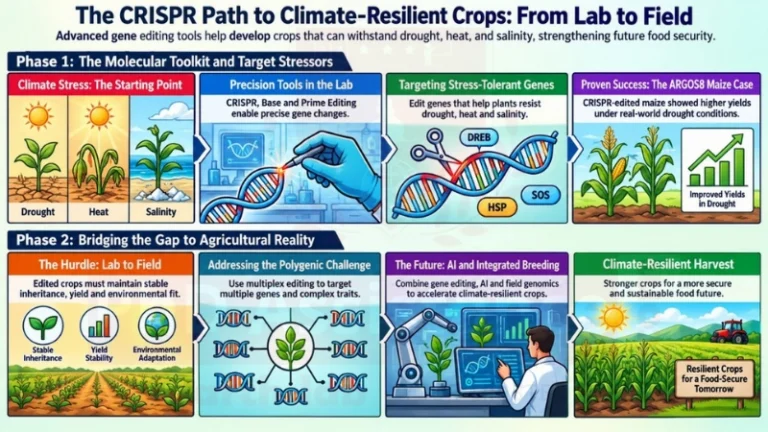
Significance and contribution of the field
The important contribution of Chavhan et al. (2025) is the integration of various genome editing techniques within the climate resilience framework. Unlike previous studies that have discussed individual crops or stresses, this review brings together genome editing techniques with various environmental stresses.
This can be an effective strategy because plant responses to drought, heat, and salinity stresses can overlap. For example, a plant experiencing drought stress can simultaneously experience heat and salinity stress in the soil. Thus, relying on one type of stress-response strategy might not be enough for future agricultural practices.
This article also makes a contribution through the evaluation of more advanced techniques like base editing and prime editing. Base editing allows for nucleotide substitution, while prime editing allows for more advanced modifications without double-stranded breaks.
However, the contribution is more synthetic than experimental because the paper does not report field trials of the edited crops. The validity of its conclusions thus depends on the reliability of the studies reviewed.
Critical Analysis of Gene Editing for Climate-Resilient Crops
- CRISPR/Cas9 and Drought Tolerance:
CRISPR/Cas9 shows potential for improving drought tolerance by targeting genes involved in water-use efficiency, root development, and stress-response pathways.
Interpretation: This shows that genetic engineering can enhance specific traits in terms of drought resistance.
Limitation: Much of the evidence remains based on controlled experiments, with limited validation under diverse field conditions and combined environmental stresses.
Implication: CRISPR-based drought improvement should be supported by multi-location field trials before its wider agricultural application.
- Heat Stress Resistance through Gene Editing
Gene editing must be considered a complementary technique in crop improvement programs and not as a substitute for traditional breeding. Even though the use of CRISPR/Cas gene editing could lead to targeted changes in the genes responsible for drought, heat, and salinity tolerance, the responses could differ depending on genetics and environment. Hence, successful gene editing does not always ensure reliable performance.
Future crop breeding programs must incorporate gene editing along with conventional and genomic-assisted breeding, especially in relation to genotype by environment interaction. Field trials conducted at multiple locations and multiple environments are thus necessary to assess whether edited traits offer stable benefits in terms of productivity and stress tolerance.
Overall, gene editing can strengthen existing breeding strategies through precise modification of selected genes or regulatory regions, while breeding and field evaluation remain essential for achieving stable agronomic performance.
Technical Feasibility versus Agricultural Feasibility
One of the most important critical issues is the distinction between editing a gene successfully and developing a useful crop variety.
At the laboratory level, CRISPR can generate targeted mutations with considerable precision. However, agricultural deployment requires additional stages:
The ARGOS8 study is particularly important because it included field testing and demonstrated yield improvement under drought stress. In contrast, several salinity and heat studies have focused primarily on seedlings, controlled environments or physiological responses.
This creates an evidence gap between molecular proof-of-concept and agricultural deployment.
Therefore, the article’s claim that gene editing has considerable potential is justified, but the evidence should be interpreted as demonstrating strong developmental potential rather than universal field readiness.
Comparison with the Literature
The main strength of Chavhan et al. is the breadth of evidence, but comparison with additional studies demonstrates that the maturity of the evidence varies considerably.
| Study | Crop | Editing / Approach | Stress or Trait | Main Finding | Critical Assessment |
|---|---|---|---|---|---|
| Chavhan et al. (2025) | Multiple crops | CRISPR, base editing, prime editing | Drought, heat, salinity | Reviews broad potential for climate resilience | Strong synthesis but mainly secondary evidence |
| Shi et al. (2017) | Maize | CRISPR/Cas9 | Drought | ARGOS8 variants improved field yield under drought | Stronger field-level evidence |
| Zhang et al. (2019) | Rice | CRISPR/Cas9 | Salinity | OsRR22 mutants showed improved salt tolerance | Strong genetic validation, but mainly early-stage testing |
| Cui et al. (2020) | Rice | CRISPR/Cas9 | Heat/chilling | OsCNGC14/16 required for temperature tolerance | Strong mechanistic evidence |
| Wu et al. (2022) | Rice | CRISPR + GWAS | Heat | HTG3 positively regulated heat tolerance | Strong combination of genomic and functional evidence |
| Lin et al. (2023) | Rice | CRISPR/Cas9 | Heat | OsHSP60-3B supported pollen fertility under heat | Important reproductive-stage evidence |
| Shukla et al. (2009) | Maize | zinc-finger nuclease (ZFN) | Targeted genome modification | Demonstrated precise genome modification in maize using ZFNs | Early proof of targeted genome editing; not focused on climate-stress tolerance. |
Methodology and research design
Chavhan et al. use a narrative review methodology that consolidates information from various research studies that have been done about gene-editing technologies in relation to climate-stress responses.
Search Strategy: Chavhan et al. (2025) present a comprehensive review of the literature on genome editing and climate-resilient crops; however, it is not clear from the review which databases were searched, how they were searched, what criteria were used, and during what time period. The lack of such details in the review limits its replicability.
Selection Criteria: The explicit inclusion and exclusion criteria are not reported in this study. The process by which individual studies were selected and prioritised is therefore unclear. Clearly defined eligibility criteria and a transparent study-selection process would strengthen the methodological rigour of the review.
Quality Appraisal: The authors do not describe a formal framework for assessing the methodological quality of the studies included in the review. This is a limitation because the cited evidence differs considerably in experimental design and validation.
Evidence grading: Although the study discusses different experimental contexts, they do not explicitly grade evidence by validation level. Mechanistic, controlled-environment, and field studies are presented without a formal hierarchy. Distinguishing these levels would strengthen evaluation of the agricultural relevance of genome-editing applications.
Strength: The approach allows the authors to connect molecular mechanisms with broader agricultural applications. It also provides a useful overview of CRISPR/Cas9, base editing and prime editing.
Limitation: Because the review synthesises studies using different crops, genotypes, stress conditions, experimental designs and outcome measures, direct comparison between results is difficult.
For example, improved seedling survival under controlled salinity cannot be considered equivalent to increased grain yield under multi-location field salinity. Similarly, improved physiological heat tolerance may not necessarily result in improved harvestable yield.
Theoretical and Interdisciplinary Analysis
The interdisciplinary nature of the paper connects molecular biology, genetics, genome editing, crop breeding, genomics, phenomics, bioinformatics, artificial intelligence, and CRISPR applications in plant science. Interdisciplinarity is a strength, as climate resilience relies on the action and interactions of various biological pathways and mechanisms.
Water-use efficiency, root-system architecture, and signal transduction are closely associated with drought stress tolerance. The stability of cell membranes, heat shock proteins (HSP) accumulation, ROS elimination and reproductive capability are of crucial importance to tolerate heat stress. Ionic balance, osmoregulation and detoxification are related to salt stress tolerance.
Therefore, future studies on gene editing for climate-resilient crops should focus more on networks of genes and G x E interaction rather than focusing solely on individual gene functions.
Practical Implementation and Policy Considerations
The practical value of gene editing depends not only on biological effectiveness but also on regulatory and breeding considerations. Chavhan et al. identify regulatory barriers as an important limitation.
The development of transgene-free edited plants may simplify some aspects of regulatory assessment in certain jurisdictions, but regulatory approaches remain variable. Furthermore, successful editing must be followed by breeding, field validation, seed multiplication and farmer adoption.
Another practical issue is whether a stress-tolerant trait produces a yield penalty under normal conditions. The ARGOS8 study is encouraging because the edited variants improved drought-stress performance without yield loss under well-watered conditions.
Future research should therefore prioritise yield stability under both stress and non-stress conditions rather than evaluating stress tolerance alone. This is particularly important for salinity tolerance genome editing, where improved stress tolerance should also be assessed for its effects on crop yield and performance under field conditions.
Limitations of the Study
| Limitation | Critical Significance |
Required Improvement |
|---|---|---|
| Heavy reliance on published secondary evidence |
Limits direct assessment of experimental quality |
Include
systematic evidence grading |
| Different crop species and genotypes |
Makes direct comparison difficult |
Compare results within specific crop systems |
| Limited field validation |
Laboratory tolerance may not translate into yield |
Increase multi-location field trials |
| Strong focus on single genes |
Climate resilience is often polygenic |
Prioritise network and multiplex editing |
| Variable stress conditions |
Results may not represent real climate scenarios |
Use combined drought–heat–salinity experiments |
| Delivery challenges | Successful editing depends on transformation efficiency |
Develop crop-specific delivery systems |
| Off-target concerns | Unintended mutations may affect phenotype | Use high-fidelity editing and comprehensive screening |
| Regulatory uncertainty | May delay commercial deployment | Develop clearer, evidence-based regulatory frameworks |
Table 1. Critical Limitations of the Reviewed Study
Research Gaps from the Study
Research Gap 1: Combined Climate Stresses
Crops often experience combinations of stresses such as drought and heat or drought and salinity, which can produce responses that differ from those observed under individual stresses (Khan et al., 2025; Ali et al., 2026). Recent reviews highlight the need to better understand combined-stress responses and their implications for crop productivity and stress tolerance.
Future research:
Gene-edited crops should therefore be evaluated under realistic combinations of environmental stresses to determine whether observed tolerance is maintained under field-relevant conditions.
Research Gap 2: Field-Level Validation
One of the key priorities should be the validation of gene-edited plants in field trials in a variety of environments. Even though the study on the effect of gene-edited maize, such as the one on ARGOS8 maize, shows an increase in yield during field droughts, data on this issue is not sufficient in terms of various crops and environments (Khan et al., 2025; Szabados et al., 2026).
Future research:
Multi-location and multi-season field trials should be prioritised to assess the stability of stress tolerance, yield, and agronomic performance across environments.
Research Gap 3: Polygenic Climate Resilience
Drought, heat, and salinity tolerance are complex traits involving multiple interacting pathways and environmental effects, with responses often influenced by genotype and growing conditions (Shelake et al., 2022; Omer et al., 2026). These complexities can make it challenging to achieve stable stress tolerance across different environments.
Future research:
Multiplex CRISPR, regulatory-element editing, and genomic selection could be integrated to target multiple pathways and improve climate resilience.
Overall Critical Appraisal
| Dimension | Finding | Critical Judgement | Assessment |
|---|---|---|---|
| Drought resilience | CRISPR can modify stress-response pathways |
Strong potential, but field validation remains limited |
Strong |
| Heat tolerance | Multiple genes and pathways have been validated |
Evidence is growing but remains crop-specific |
Strong |
| Salinity tolerance | CRISPR improves physiological tolerance |
Yield-level evidence is less consistent |
Moderate–strong |
| CRISPR technology | Programmable and versatile |
Strong advantage over earlier platforms |
Strong |
| TALEN/ZFN | Demonstrated early targeted editing |
More complex than CRISPR for many applications |
Moderate |
| Base editing | Precise nucleotide changes |
Useful where suitable target substitutions exist |
Strong potential |
| Prime editing | Broad sequence modification capacity |
Efficiency and delivery remain challenges |
Developing |
| Field translation | Some successful examples exist |
Insufficient multi-environment evidence |
Moderate |
| Polygenic resilience |
Multiple pathways are involved |
Single-gene approaches may be insufficient |
Moderate |
| Climate resilience | Strong conceptual relevance | Requires integration with breeding and agronomy | Strong potential |
Table 2. Critical appraisal of the Reviewed Study
Conclusion
Chavhan et al. (2025) provide an insightful overview of the technologies related to genome editing in the context of climate-resilient crop development. The primary advantage of this review is that it covers all of the key technologies, including CRISPR/Cas9, base editing, prime editing, and stress-induced genes.
Confrontation with other experimental research makes the core argument stronger. The ARGOS8 maize study demonstrated that specific CRISPR/Cas9-generated ARGOS8 variants improved grain yield under field drought conditions, and research on OsRR22, OsCNGC14/16, HTG3, and OsHSP60-3B shows genetic factors for salinity and heat tolerance.
However, the evidence also demonstrates that genome editing is not a standalone solution to climate change. Multiple genes, environmental conditions and management practices influence climate resilience. The most important future direction is therefore the integration of genome editing with genomics-assisted breeding, speed breeding, phenomics, AI-supported target identification and rigorous field testing.
The strongest research direction is likely to move from editing individual stress-response genes toward multiplex and network-based genome engineering, followed by validation under combined drought, heat and salinity conditions. This would provide a more realistic foundation for developing crops that maintain yield and quality under future climate scenarios.
Need Support with Your Gene-Editing Critical Review?
Get expert support with literature comparison, CRISPR research analysis, drought and heat tolerance evaluation, salinity-response analysis, gene-editing technology comparison, research-gap identification and evidence-based recommendations to strengthen the academic rigour and critical depth of your review.
Frequently Asked Question
Gene editing technologies are molecular tools that make targeted changes to a crop’s DNA to improve its ability to withstand climate-related stresses. Major tools include CRISPR-Cas9, TALENs, and zinc-finger nucleases.
CRISPR uses a guide RNA and Cas enzyme to target specific genes and introduce desired genetic changes. These edited plants can then be selected for improved stress tolerance and agronomic performance.
CRISPR-Cas9 is applied to improve crop yield, disease resistance, nutritional quality, plant architecture, and stress tolerance. It can also modify genes associated with crop quality and other economically important traits.
Key limitations include off-target effects, complex genetic control of stress tolerance, difficulties in plant transformation, and unpredictable field performance. Regulatory concerns, high research costs, and public acceptance may also affect its wider adoption.
Genome editing can alter genes involved in water regulation, root development, heat-shock responses, antioxidant defence, and reproductive processes. This can help crops maintain growth, productivity, and fertility under drought and high-temperature conditions.
Reference
- Chavhan, R. L., Jaybhaye, S. G., Hinge, V. R., Deshmukh, A. S., Shaikh, U. S., Jadhav, P. K., Kadam, U. S., & Hong, J. C. (2025). Emerging applications of gene editing technologies for the development of climate-resilient crops. Frontiers in Genome Editing, 7, 1524767. https://doi.org/10.3389/fgeed.2025.1524767
- Shi, J., Gao, H., Wang, H., Lafitte, H. R., Archibald, R. L., Yang, M., Hakimi, S. M., Mo, H., & Habben, J. E. (2017). ARGOS8 variants generated by CRISPR-Cas9 improve maize grain yield under field drought stress conditions. Plant Biotechnology Journal, 15(2), 207–216. https://doi.org/10.1111/pbi.12603
- Zhang, A., Liu, Y., Wang, F., Li, T., Chen, Z., Kong, D., Bi, J., Zhang, F., Luo, X., Wang, J., Tang, J., Yu, X., Liu, G., & Luo, L. (2019). Enhanced rice salinity tolerance via CRISPR/Cas9-targeted mutagenesis of the OsRR22 gene. Molecular Breeding, 39, 47. https://doi.org/10.1007/s11032-019-0954-y
- Cui, Y., Lu, S., Li, Z., Cheng, J., Hu, P., Zhu, T., Wang, X., Jin, M., Wang, X., Li, L., Huang, S., Zou, B., & Hua, J. (2020). Cyclic nucleotide-gated ion channels 14 and 16 promote tolerance to heat and chilling in rice. Plant Physiology, 183(4), 1794–1808. https://doi.org/10.1104/pp.20.00591
- Wu, N., Yao, Y., Xiang, D., Du, H., Geng, Z., Yang, W., Li, X., Xie, T., Dong, F., & Xiong, L. (2022). A MITE variation-associated heat-inducible isoform of a heat-shock factor confers heat tolerance through regulation of JASMONATE ZIM-DOMAIN genes in rice. New Phytologist, 234(4), 1315–1331. https://doi.org/10.1111/nph.18068
- Lin, S., Liu, Z., Sun, S., Xue, F., Li, H., Tursun, A., Cao, L., Zhang, L., Wilson, Z. A., Zhang, D., & Liang, W. (2023). Rice HEAT SHOCK PROTEIN60-3B maintains male fertility under high temperature by starch granule biogenesis. Plant Physiology, 192(3), 2301–2317. https://doi.org/10.1093/plphys/kiad136
- Shukla, V. K., Doyon, Y., Miller, J. C., DeKelver, R. C., Moehle, E. A., Worden, S. E., Mitchell, J. C., Arnold, N. L., Gopalan, S., Meng, X., Choi, V. M., Rock, J. M., Wu, Y.-Y., Katibah, G. E., Zhifang, G., McCaskill, D., Simpson, M. A., Blakeslee, B., Greenwalt, S. A., … Urnov, F. D. (2009). Precise genome modification in the crop species Zea mays using zinc-finger nucleases. Nature, 459(7245), 437–441. https://doi.org/10.1038/nature07992
- Khan, N. A., Owens, L., Nuñez, M. A., & Khan, A. L. (2025). Complexity of combined abiotic stresses to crop plants. Plant Stress, 17, 100926. https://doi.org/10.1016/j.stress.2025.100926
- Ali, B., Hafeez, A., & Imin, N. (2026). Transcriptional Regulation, Epigenetic Memory, and CRISPR-Based Engineering of Combined Abiotic Stress Tolerance in Cereal Crops. Biology, 15(15), 1249. https://doi.org/10.3390/biology15151249
- Szabados, L., Kant, K., Rabilu, S. et al.Crops exposed to extreme conditions: perspectives of gene editing to improve stress tolerance. Plant Cell Rep 45, 207 (2026). https://doi.org/10.1007/s00299-026-03891-w
- Shelake, R. M., Kadam, U. S., Kumar, R., Pramanik, D., Singh, A. K., & Kim, J. Y. (2022). Engineering drought and salinity tolerance traits in crops through CRISPR-mediated genome editing: Targets, tools, challenges, and perspectives. Plant communications, 3(6), 100417. https://doi.org/10.1016/j.xplc.2022.100417
- Omer, R., Singh, S. & Mathur, J. Deciphering abiotic stress resilience in crop plants through multiomics insights and CRISPR-Cas9-mediated genome editing. Plants3, 382 (2026). https://doi.org/10.1007/s44372-026-00856-x
- Li, T., Liu, B., Spalding, M. H., Weeks, D. P., & Yang, B. (2012). High-efficiency TALEN-based gene editing produces disease-resistant rice. Nature Biotechnology, 30(5), 390–392. https://doi.org/10.1038/nbt.2199