
How to Write a Computer Science PhD Proposal (Expose) for German Universities: Problem, Novelty and Feasibility

Recent Post
Introduction
Identifying a new technology is not, by itself, sufficient for defining a viable PhD research topic. A researcher needs a well-defined problem, a defensible research gap, and a contribution that can be investigated systematically. Researchers exploring Computer Science PhD topics in Germany should also assess feasibility, methodological requirements, and alignment with a prospective supervisor’s expertise.methodology
The following examples illustrate three PhD research directions in artificial intelligence, distributed computing, and computer security. These dissertation ideas are starting points for developing a research proposal rather than ready-made dissertation projects. For those who wish to get professional guidance, they may consider using Expert PhD Computer Science Research Proposal Writing Service.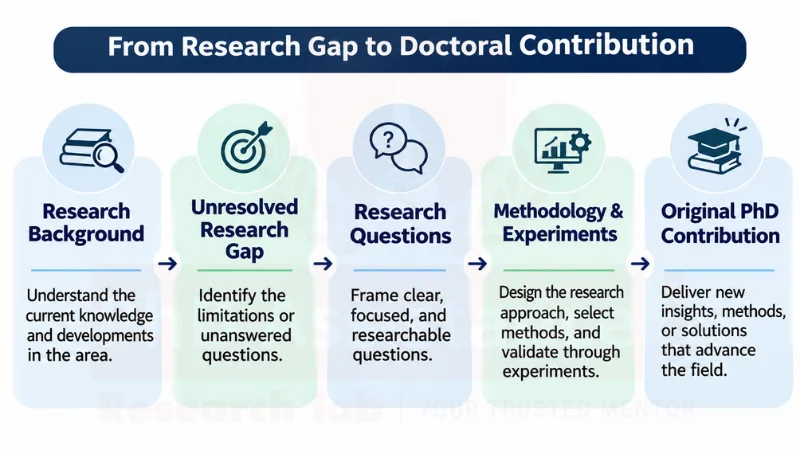
Background / Research Gaps
AI models increasingly support decisions in healthcare, finance, and industrial operations. However, explaining why a model produces a particular prediction remains challenging. Existing explanation methods may differ in consistency, stability, and faithfulness across datasets and model architectures. An important research gap concerns whether explanations remain dependable when models encounter distribution shifts or unfamiliar situations, and whether those explanations are useful to the intended decision-makers. A feasible study should narrow this problem to a defined high-stakes application, selected model families, and specified explanation methods.
Research Questions
- How can explanation methods be evaluated for consistency and stability across selected model architectures and datasets?
- To what extent do explanations remain faithful to model behaviour when input data distributions change?
- How can explanation quality and human usefulness be assessed alongside predictive performance?
PhD-Level Contribution
This research could develop and validate an evaluation framework for explanation stability, consistency, and faithfulness under defined data shifts. Experimental comparisons across selected AI models and explanation methods could identify the conditions under which explanations remain reliable and useful. The study should operationalise each criterion separately rather than treating explanation quality as a single universal measure.
Suggested Readings
- Kowald et al. (2024). “Establishing and evaluating trustworthy AI: Overview and research challenges.” Frontiers in Big Data, 7, 1467222. https://doi.org/10.3389/fdata.2024.1467222
Topic 2: Energy-Efficient Distributed AI for Resource-Constrained Edge Systems
Background / Research Gaps
Edge computing allows AI models to process information closer to where data is generated. Yet devices often operate with limited energy, memory, and computing capacity. Distributed learning can also introduce communication overhead and performance variation across heterogeneous machines. A specific research gap concerns how resource allocation can adapt to device capability and intermittent connectivity while balancing energy use, communication cost, convergence, and model performance. The proposed scope here is distributed training across heterogeneous edge devices; it should not be labelled federated learning unless the study specifically uses a federated setting.
Research Questions
- How can distributed training across heterogeneous edge devices reduce energy consumption without substantial loss of model accuracy?
- Which scheduling strategies best balance device capability, communication cost, and training progress?
- How does intermittent connectivity affect convergence, energy use, and model performance?
PhD-Level Contribution
A doctoral contribution could be a dynamic resource-allocation and scheduling scheme for distributed edge training. Its value should be demonstrated through reproducible comparisons with clearly stated baseline strategies, measuring energy per training round, communication overhead, convergence time, and model accuracy under defined device heterogeneity and connectivity conditions.
Suggested Readings
- Poncinelli Filho et al. (2022). “A systematic literature review on distributed machine learning in edge computing.” Sensors, 22(7), 2665. https://doi.org/10.3390/s22072665
• Singh and Gill (2023). “Edge AI: A survey.” Internet of Things and Cyber-Physical Systems, 3, 71–92. https://doi.org/10.1016/j.iotcps.2023.02.004
Topic 3: Post-Quantum Cryptography for Secure Cloud and Distributed Systems
Background / Research Gaps
Quantum-resistant cryptography is becoming important as organisations prepare for future quantum-computing threats. However, integrating post-quantum cryptographic mechanisms into existing infrastructure can introduce computational overhead, larger keys or signatures, and implementation challenges. A focused research gap concerns the performance and deployment implications of migrating a defined cloud communication workflow to post-quantum or hybrid cryptography. The study should specify the protocol and deployment environment rather than treating all post-quantum algorithms as interchangeable. NIST’s FIPS 203 specifies ML-KEM for key establishment, while FIPS 204 (ML-DSA) and FIPS 205 (SLH-DSA) specify digital-signature schemes.
Research Questions
- What performance and resource costs arise when post-quantum mechanisms are integrated into a specified cloud communication protocol?
- How do classical, post-quantum, and hybrid migration configurations compare in a defined deployment environment?
- How can implementation choices preserve the required security properties while managing performance overhead?
PhD-Level Contribution
The research could develop an evidence-based assessment of post-quantum migration for a defined cloud or distributed-systems use case. Reproducible benchmarks may compare handshake latency, throughput, CPU and memory use, and key, ciphertext, or signature sizes across relevant classical, post-quantum, and hybrid configurations. Performance benchmarking should be complemented by a separate security analysis; lower overhead alone does not establish security.
Suggested Readings
- Howe, Prest, and Apon (2021). “SoK: How (not) to Design and Implement Post-Quantum Cryptography.” In: Topics in Cryptology – CT-RSA 2021. https://doi.org/10.1007/978-3-030-75539-3_19
• National Institute of Standards and Technology (NIST). (2024). FIPS 203: Module-Lattice-Based Key-Encapsulation Mechanism Standard; FIPS 204: Module-Lattice-Based Digital Signature Standard; and FIPS 205: Stateless Hash-Based Digital Signature Standard. https://csrc.nist.gov/pubs/fips/203/final ; https://csrc.nist.gov/pubs/fips/204/final ; https://csrc.nist.gov/pubs/fips/205/final
Research Development Pathway
Each stage connects the research problem to a measurable doctoral outcome. These examples can be refined through a focused literature review, discussion with a prospective supervisor, and feasibility assessment before a dissertation proposal is finalised. For German doctoral programmes, applicants should check the fit between the proposed topic and the relevant research group’s expertise, available datasets or infrastructure, supervision arrangements, and funding context; requirements vary by institution and doctoral route.research problem
Have you identified a promising Computer Science research topic for your doctoral journey in Germany? Take the next step with PhD Assistance’s research proposal guidance and consultation to refine the research problem, assess novelty and feasibility, and develop a structured proposal aligned with your research interests.PhD Assistance’s Research Proposal Writing
After identifying a suitable research direction from these Computer Science PhD topics for German doctoral programmes, the next step is to turn the selected idea into a structured research proposal. Our next guide, How to Write a Computer Science PhD Proposal (Exposé) for German Universities: Problem, Novelty and Feasibility, explains how to define a research problem, establish scientific novelty, and demonstrate research feasibility before approaching prospective supervisors.