
Call for Papers: Adult Education Research between Innovation & Continuity – Research Methods and Methodology
Introduction
Adult education research is growing in the context of a shifting learning environment, social environment, and research environment. With digital learning, artificial intelligence, and interdisciplinarity, new avenues have been created for researching adult learning. At the same time, established theoretical traditions and rigorous research methods remain essential to the development of the field (Cohen et al., 2018)
Zeitschrift für Weiterbildungsforschung (ZfW) invites original contributions for its issue, “Adult Education Research between Innovation & Continuity: Research Methods and Methodology.” The issue examines how research methods in adult education shape research questions, evidence, interpretation, and knowledge production. It accepts studies that look at not only traditional but also new techniques for adult learning research.
The central contribution should be methodological: papers are expected to make research methods, methodological assumptions, epistemological positions, or the relationship between research questions and methods an explicit object of analysis. A study that merely applies a familiar method to an adult-learning topic should explain what it contributes to methodological debate, rather than relying on its subject matter alone.
Why publish in this issue?
This special issue offers an opportunity to contribute to existing scholarly debates about methods of studying adult and continuing education. Authors are expected to offer methodological justification of their approach, prove its relevance, and describe what novelty their research brings.
• Provide methodological information that might be useful in future adult education research.
• Critically evaluate the advantages and drawbacks of qualitative, quantitative, and mixed methodologies.
• Offer a perspective (empirical, theoretical, historical, or critical) to an international academic debate.
• Explain how methodological decisions influence evidence, interpretation, and knowledge production.
Scope
Particularly relevant questions include how disciplinary traditions shape what counts as evidence in adult education; how epistemological and theoretical commitments influence method selection; how established and emerging methods can be compared; and what ethical, privacy, transparency, and data-management responsibilities arise when using digital tools or AI. Contributions may also critically examine participatory inquiry, social network analysis, and cross-national or interdisciplinary methodological developments.
The issue welcomes theoretical, empirical, historical, and methodological papers concerned with adult education methodology and the wider development of educational research methods. Relevant contributions may address:
• Qualitative research, quantitative research, and mixed-methods designs in adult and continuing education.
• Historical development of research methods and methodological traditions.
• Epistemology of research, research paradigm, and production of knowledge.
• Research design, sampling, data collection and analysis methods.
• Research methodology for digital era and application of AI in educational research.
• Ethical issues related to research, privacy, transparency and data management.
• Participant research methodologies, inquiry and practice approaches.
• Cross-disciplinary, cross-comparative and international perspectives of adult learning research.
• Social network analysis and other innovative methodologies.
Need support with your research design or methodology? Explore PhD Assistance’s research methodology services to strengthen your study for journal submission.
Know More About This Issue
Theme is Innovation vs. Continuity in adult education research. New technology and methodologies can enable researchers to study learning in various contexts, but innovation always demands a reflective consideration of what a methodology shows, what it hides, and how it influences conclusions.
Contributions may focus on research epistemology, methodological premises, and the link between the research question, theory, and evidence. Explanation on why specific method is chosen and how it leads to knowledge on adult and continuing education should be provided in the papers. Comparisons of new and traditional methodologies are especially timely.
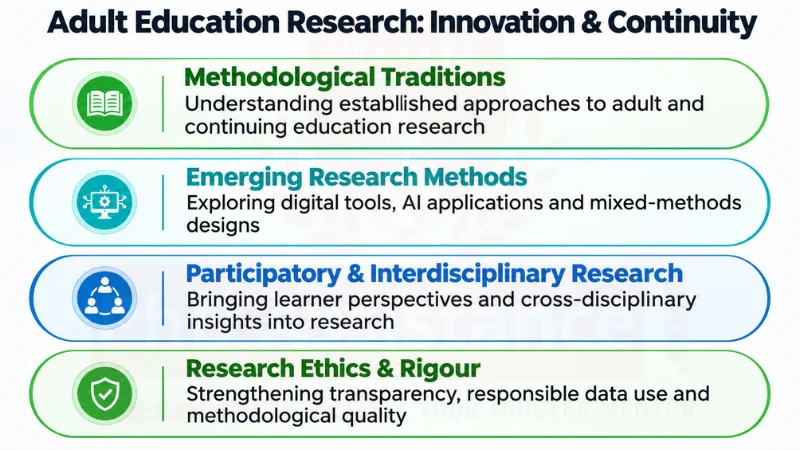
Figure 1. Key methodological themes shaping innovation and continuity in adult education research.
Key factors
Authors preparing a submission should consider the following factors:
• Clear methodological contribution: State what the paper adds to research methods in adult education.
• Well-formulated rationale for research: The research problem, theoretical base, and chosen method should be linked.
• Critical Reflection: Discuss the advantages and disadvantages of your approach. What are the possible assumptions and implications for your methodology?
• Relation to the Field: Provide a clear connection of your study and findings to the field of adult education, continuing education research or adult learning.
• Talk about the Ethical Issues: Give information on the ways of collecting, analyzing, and appropriately using the data.
• Originality: Provide a new and fresh outlook on your methodology or make a conclusion about the issue.
How We Support Your Submission
The issue welcomes theoretical, empirical, historical, review and methodological contributions, provided that they engage substantively with research methods or methodology in adult and continuing education.
Research methodology is very significant in ensuring reliability and validity of research studies. At PhD Assistance, we offer help in selecting suitable methodology for research studies, designing research studies effectively, and expressing research methodologies clearly.
Our services include:
•Academic Language Editing and Proofreading Service
• Reviewing Research Design and Methodology.
• Checks for manuscript structure, consistency, tables, and figures.
• Reference and citation formatting.
• A final check against the journal’s publicly available submission requirements.
Any support is independent of the journal’s editorial and peer-review process. It does not influence editorial decisions or guarantee acceptance. Authors remain responsible for the originality, accuracy, and integrity of their work.
Contributions may use qualitative, quantitative or mixed-methods approaches; the methodological rationale, epistemological assumptions and implications for knowledge production should be made explicit.
- Original research articles, review articles and perspectives related to adult education research are welcomed.
- Manuscripts should address current developments, challenges and emerging perspectives in adult learning research and continuing education.
- Contributions may adopt qualitative research, quantitative research or mixed-methods research approaches.
- Studies focusing on research methods in adult education, adult education methodology, theoretical perspectives and innovative research designs are encouraged.
- Articles demonstrating methodological rigour, practical relevance and meaningful contributions to the field are highly appreciated.
- Submitted manuscripts must follow the journal’s author guidelines, including formatting, referencing and citation requirements.
- Authors should consult the journal’s official submission guidelines before preparing their manuscripts.
- Submissions must be made through the journal’s designated submission system.
- Submission deadline: 30 November 2026.
- Expected publication date: 1 April 2027.
Ready to strengthen your research before submission? Get expert research methodology support from PhD Assistance to improve the clarity and rigour of your manuscript.
FAQs:
- What topics does this special issue cover? It covers innovation, continuity and emerging approaches in adult education research.
- Are qualitative and quantitative studies accepted? Qualitative, quantitative and mixed-methods studies are welcome.
- Will manuscripts undergo peer review? All submissions undergo double-blind peer review.
Reference
- Cohen, L., Manion, L., & Morrison, K. (2018). Research methods in education (8th ed.). Routledge.
- Creswell, J. W., & Poth, C. N. (2018). Qualitative inquiry and research design: Choosing among five approaches (4th ed.). SAGE Publications.