
Works Councils and AI Adoption in German Manufacturing: A PhD Research Design
- Why most “AI at work” topics fail at the proposal stage
- The institutional hook: German law names AI explicitly
- Heterogeneous evidence, and a field that is no longer empty
- Defining the treatment: what counts as AI adoption
- Defining the moderator: a works-council dummy is not innocent
- The dataset: IAB Establishment Panel
- Getting access: the FDZ rule most students miss
- The econometrics: an interaction, not a story
- The three traps, and how a proposal disarms them
- Study design checklist
- Research questions
- Contribution, and what a supervisor will ask

Recent Post
“AI and the future of work” is not a topic. It is a subject area, and a supervisor will say so. What turns it into a topic is a setting where something institutional varies, a dataset where that variation is observed, and a question whose answer is not already known.
Who is this for: PhD scholars in management, industrial relations, labour economics and organisation studies; and supervisors scoping empirical technology-adoption projects on German or European establishment data.
Scope. This article separates published evidence, cited to source, from research hypotheses, labelled as such, and design guidance. It is not legal advice on codetermination, employment or data protection, and it is not a statement about any named firm, works council or establishment.
1. Why most “AI at work” topics fail at the proposal stage
Three failures recur. The topic has no institutional variation, so there is nothing to compare. It has no dataset, so feasibility is assumed. And its answer is already in the literature, so the contribution is a replication nobody asked for.
The topic in this title addresses all three. What it can no longer claim, in 2026, is an empty field — and §3 is where that is dealt with honestly.
2. The institutional hook: German law names AI explicitly
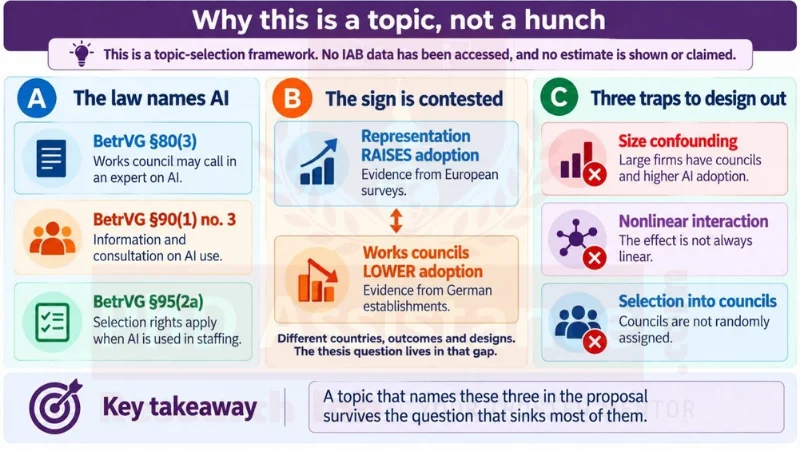
Figure 1. Why this is a topic, not a hunch. Panel A gives the statutory hooks that make codetermination a variable in this setting; Panel B shows the contested sign in the published evidence; Panel C names the three design traps. The figure is a topic-selection framework and contains no data or estimates.
Anglo-American studies treat worker representation as background. German law makes it a mechanism, and the Works Constitution Act names artificial intelligence specifically. Three provisions matter [1]:
- 80(3) — the works council may call in an expert where it has to assess the introduction or application of artificial intelligence to carry out its tasks.
- 90(1) no. 3 — the employer must inform and consult the works council on working procedures and operations, including the use of artificial intelligence.
- 95(2a) — the provisions on selection guidelines apply where artificial intelligence is used in drawing them up.
What this establishes, and what it does not. The legislation makes works-council involvement an institutionally grounded variable; it does not establish that works councils statistically moderate AI adoption. The chain a proposal has to walk is legal institutional relevance → theoretical mechanism → empirical hypothesis → statistical test, and only the first link is settled by the statute. Stating the chain explicitly makes the mechanism legible and gives a supervisor a clearer basis for evaluating the design.
The legal pathway differs by application, which matters because the outcome definition in §4 turns on it:
AI application | Potentially relevant provision | Right engaged |
AI in production or process | §90(1) no. 3 | Information and consultation |
AI used in drafting selection guidelines | §95(2a) | Selection-guideline provisions |
AI monitoring employee behaviour or performance | §87(1) no. 6 | Co-determination over technical monitoring devices |
AI structuring mobile work via ICT | §87(1) no. 14 | Co-determination over mobile-work organisation |
- 87 is the one most topic proposals miss. Where AI is used to monitor behaviour or performance, the right engaged is co-determination rather than consultation [1] — a materially stronger institutional lever, and the reason algorithmic management may behave differently from AI in production.
3. Heterogeneous evidence, and a field that is no longer empty
A topic needs an open question. The literature reports heterogeneous associations across institutional settings, technology measures and identification strategies — which is not the same as evidence that contradicts itself.
Using the 2019 European Company Survey with a regression-discontinuity design around Italy’s 15-employee threshold, one study finds workplaces with shop-floor employee representation are more likely to use robots and advanced digital tools, with representation raising investment in advanced digital tools by roughly six percentage points, alongside more training and lower layoff rates [5].
Working on German establishments from the 2016 IAB Establishment Panel, a peer-reviewed study reports a different association: works councils linked to lower equipment with digital technologies, around 0.3 points on a 1–10 scale, surviving entropy balancing, with no robust relationship for whether digital topics were merely considered [6]. Its authors explicitly avoid causal claims — which is itself a modelling lesson.
The two are not directly comparable: different countries, outcome measures and estimands. One identifies a local causal effect at a size threshold; the other reports a conditional association after balancing. Reading them as a simple contradiction misstates both.
And the field is not empty. The IAB’s own project listing shows several live establishment-level AI projects, including AI Adoption in Establishments (15 December 2025 to 31 December 2028), Establishments’ demand for AI skills and employment development (1 June 2025 to 31 May 2027), Investments into artificial intelligence and the effects on labor demand (1 June 2025 to 1 June 2028) and Different Mines, Same Canaries? Microevidence on the Labor Market Effects of AI in Germany (1 November 2025 to 31 December 2027) [9].
A defensible thesis question must therefore be located within this heterogeneous evidence base and differentiated from current German research on AI and codetermination. That is a narrowing exercise, not a retreat:
Where current work sits | Where a PhD can differentiate |
AI adoption across all sectors | Manufacturing specifically, with the sector justified |
Whether AI is adopted | Adoption intensity, type or application |
Employment outcomes | The organisational implementation pathway |
Works-council presence | Strength or activity of representation |
AI in general | Algorithmic management as a distinct class |
Average effects | Theoretically motivated heterogeneity |
Adoption as an event | Timing between consultation and implementation |
4. Defining the treatment: what counts as AI adoption
“Adoption” is where most designs quietly fall apart. Decide and write down: whether the outcome is use of AI, investment in it, or intensity of use; whether algorithmic management — AI used to allocate, monitor or evaluate work — is separated from AI in production; and whether the measure is binary, ordinal or continuous, since that determines the estimator and the interaction problem in §8.
Keeping algorithmic management distinct is what connects the outcome to §87(1) no. 6 and §95(2a) rather than to §90 alone [1]. An undifferentiated “uses AI” variable cannot speak to the codetermination channel at all.
Why manufacturing, and not all establishments? The restriction needs a methodological reason, not a preference. Three are defensible, and a proposal should pick one and defend it: manufacturing has the highest works-council density of the large sectors, so the moderator has support; production technology and algorithmic management are separable there in a way they are not in knowledge-intensive services; and restricting the sector reduces the heterogeneity that otherwise competes with the interaction. Published adoption figures run the other way — generative AI use is most common in knowledge-intensive services [8] — so a manufacturing restriction trades statistical power for interpretability and must say so.
5. Defining the moderator: a works-council dummy is not innocent
Works-council presence looks like a clean binary and is not. Official IAB figures for 2025 report a works or staff council (Betriebs- oder Personalrat) in 6% of all establishments, or 9% of those with five or more employees, covering 42% of employees, or 44% in the five-plus group [3]. That category is not works councils alone — it includes public-sector staff councils — so a study about Betriebsräte specifically needs a table that isolates them, or must say which category it is using.
The distinction matters methodologically: council presence is relatively uncommon across establishments but covers a much larger share of employees, because representation is concentrated in larger workplaces. Any estimated interaction between works-council presence and AI adoption is therefore competing with establishment size, sector and everything that travels with them. The German study above used entropy balancing precisely for this [6]; a thesis needs its own stated answer.
6. The dataset: IAB Establishment Panel
The IAB Establishment Panel is a representative longitudinal employer survey of roughly 15,000 establishments a year, a stratified random sample of establishments with at least one employee subject to social insurance contributions. Its core questionnaire covers employment, business policy, investment and innovation, personnel structure, training, hours and pay — and its rotating modules have included robot use and artificial intelligence [2].
What the panel can and cannot identify longitudinally. That the instrument carries both variables does not by itself make a panel design feasible, and this is where most proposals on this topic are aspirational.
What is established: generative-AI use among German establishments rose from 5% in 2023 to 24% in 2025, measured in the IAB Establishment Panel [8]. So a comparable generative-AI measure exists at more than one point — but that is a short series, and a two- or three-point comparison is not the same as a long panel.
Six things a proposal must verify in the questionnaires before claiming a longitudinal design, and which the FDZ publishes per wave [2]:
- the exact AI question wording;
- the exact waves in which it appears;
- whether the same construct is measured across those waves;
- whether algorithmic-management use is separately measured, or only AI in general;
- whether works-council status changes often enough to support within-establishment identification;
- whether the manufacturing subsample remains large enough after those restrictions.
Until items 1 to 4 are checked against the questionnaires, RQ2 and RQ5 are provisional. Saying so in the proposal is a strength; discovering it after access is granted is not.
7. Getting access: the FDZ rule most students miss
The data is confidential and reached through the Research Data Centre (FDZ): on-site use at FDZ guest workplaces, remote desktop access, or remote execution, where scripts go through the JoSuA system and output is disclosure-checked before release [4].
Three facts belong in the proposal’s feasibility section [4]:
- A student cannot apply alone. Data may be used for a final thesis, but the supervising chair must submit the application, and at least one member of that chair must be listed as a user.
- Review takes time — the FDZ states a request review could take up to one month, before any analysis begins.
- Remote desktop access is still under development, is limited to a few data products, and is currently open only to research institutions in Germany.
A proposal that names the access route, the applicant chair and the lead time is addressing a major feasibility failure in this literature.
8. The econometrics: an interaction, not a story
The design is an establishment-level panel with a works-council indicator, an AI-adoption outcome, and their interaction. Three decisions carry it.
Where the claim sits. Association → moderation → quasi-causal identification → causal claim. Unless the identification strategy establishes exogenous variation in works-council status or AI adoption, the proposed interaction should be interpreted as conditional association rather than a causal moderation effect. A fixed-effects model with an interaction term is not automatically a credible causal design, and saying otherwise is the fastest way to lose a viva.
Specification. Establishment fixed effects absorb time-invariant heterogeneity, but also absorb works-council status wherever it never changes — so state whether identification comes from within-establishment changes in council status, from between-establishment comparison, or both, and what each is vulnerable to. Report the expected number of switchers. If council status changes in only a handful of establishments over the usable waves, within-unit identification is weak and should be declared weak rather than presented as the design’s strength.
Nonlinearity. If the outcome is binary and the model is logit or probit, the interaction effect is not the coefficient on the product term, and its sign and significance can differ across observations [7]. Report marginal effects at stated covariate values, or use a linear probability model and say why.
Timing. Codetermination rights are consultative and operate before and during adoption, so the lag structure is a substantive claim. Specify it in advance rather than selecting it from results.
9. The three traps, and how a proposal disarms them
Trap | Why it bites | What the proposal should say |
Size confounding | Councils concentrate in larger establishments [3] | The balancing or matching strategy, named in advance |
Nonlinear interaction | The product-term coefficient is not the effect [7] | Which marginal effects will be reported, and where |
Selection into councils | Councils are founded, not assigned | The named strategy — entropy balancing, matching on size and sector, establishment fixed effects, or a difference-in-differences design around founding events |
Measurement drift | Rotating modules change wording across waves [2] | Which waves are comparable, and on what evidence |
Survey reporting | Adoption is self-reported by the establishment | How reporting error is treated, not whether it exists |
And have a fallback before you need one. If access is refused, if the AI variable does not span enough waves, if algorithmic management is not separately measured, or if the manufacturing subsample is too small, the options are: narrow to a cross-sectional moderation design and say so; move to establishment data with comparable technology measures; or reframe as a mechanism study using qualitative or mixed methods. A proposal that names its fallback is not hedging — it is showing the supervisor that the project survives contact with the data.
10. Study design checklist
Dimension | Evidence to hold before submission | Risk if unresolved |
Novelty | A check against current research programmes [9] | A gap claim that is already occupied |
Institutional claim | The statutory provisions, read and cited [1] | Codetermination treated as a vague proxy |
Wave feasibility | AI question wording and waves verified [2,8] | A panel design the data cannot support |
Outcome definition | Algorithmic management separated from other AI | The result cannot speak to the mechanism |
Moderator | A stated treatment of size confounding [3,6] | The interaction is a size effect in disguise |
Estimator | Fixed-effects strategy and its identifying variation | Unclear what the coefficient means |
Interaction | Marginal effects reported, not product terms [7] | A reported effect that is not the effect |
Wave comparability | Module wording checked across waves [2] | A trend that is a questionnaire change |
Data access | Supervising chair, access mode, lead time [4] | A major feasibility risk |
11. Research questions
RQ1 (primary): does works-council presence moderate the probability of AI adoption in German manufacturing establishments, and in which direction? Estimation of an interaction, not confirmation of a prior. RQ2: does the association between works-council presence and AI adoption differ by the organisational function of the technology, where such a distinction is directly observable in the available data? RQ3: is any estimated moderation robust to the balancing strategy chosen for establishment size [3,6]? RQ4: does the association change with the lag structure, and does it differ between applications engaging information and consultation rights and those potentially engaging co-determination under §87(1) no. 6 [1]? RQ5 (exploratory): among establishments where council status changes within the panel, does adoption behaviour change with it?
12. Contribution, and what a supervisor will ask
A completed thesis would need to deliver a clearly differentiated German institutional contribution—for example, a manufacturing-specific mechanism, an outcome that existing AI-adoption studies do not examine, a distinct identification strategy, or a theoretically motivated analysis of algorithmic-management applications.
Common weaknesses that require revision: “AI and jobs” with no institutional variable; a novelty claim written without checking current research programmes; a works-council dummy with no treatment of size; a product-term coefficient reported as an interaction effect; wave-to-wave comparisons across changed question wording; a causal claim from an association; and a data-access plan written after the proposal was accepted.
Need help turning this into a defensible proposal?
The methodological problem is straightforward: a topic can sound current while still lacking an identifiable institutional variable, a secured dataset or a defensible identification strategy — and, in a fast-moving field, while overlapping work already under way.
What the review covers: the research gap and its novelty against current projects; the theoretical mechanism; variable operationalisation; dataset and wave feasibility; the identification strategy; the interaction or moderation specification; and data-access requirements. The deliverable is a written research-design assessment — a gap audit, an identification audit and a data-feasibility memo — stating what can be tested, what must be narrowed, and what must be verified before the proposal is submitted.
Request a PhD Topic and Research Design Review with PhD Assistance’s research-methodology team. The review covers whether the proposed moderation can be identified from the data you will actually have, whether the outcome definition supports the mechanism you intend to claim, and what must be in place — including the data-access route — before the proposal is submitted. The consultation advises on methodology; you carry out the research.
Related support: PhD research proposal development · PhD data analysis and statistics · PhD literature review support
Frequently Asked question
Because German law gives works councils specific, named rights over the introduction of artificial intelligence [1], which makes the moderator an institutional mechanism rather than a general proxy for worker power. Union density does not carry the same statutory content.
Yes, for a final thesis — but the supervising chair submits the application, not the student, and at least one member of that chair must be listed as a user. Access is on-site, by remote desktop or by remote execution, and the FDZ states that review of a request could take up to one month [4].
Not completely. Existing studies report heterogeneous relationships between worker representation and technology adoption, while current German research is examining AI adoption and codetermination directly. The research opportunity therefore lies in a narrower question—such as a manufacturing-specific mechanism, a distinct AI outcome, a different identification strategy or a clearly defined form of algorithmic management.
Not in its broadest form. Current research already examines AI adoption and worker representation in Germany, and the IAB’s own project listing shows several live establishment-level AI projects running into 2027 and 2028 [9]. A defensible PhD therefore needs a narrower contribution — a manufacturing-specific mechanism, a distinct outcome, a different identification strategy, or a clearly differentiated analysis of algorithmic management. §3 sets out those options.
Because in logit and probit models the interaction effect is not the coefficient on the product term, and it can vary in sign and significance across observations [7]. Reporting that coefficient as if it were the moderation effect is a common and avoidable error.
Reference
- Federal Republic of Germany. Works Constitution Act (Betriebsverfassungsgesetz – BetrVG), §§80(3), 87(1) nos. 6 and 14, 90(1) no. 3 and 95(2a). Official English translation, Federal Ministry of Justice. https://www.gesetze-im-internet.de/englisch_betrvg/englisch_betrvg.html
- Institute for Employment Research (IAB). The IAB Establishment Panel. https://iab.de/en/the-iab/surveys/the-iab-establishment-panel
- Institute for Employment Research (IAB). Daten zur Tarifbindung und betrieblichen Interessenvertretung [Data on collective bargaining coverage and establishment-level representation], 2025 figures, IAB-Betriebspanel, extrapolated values. https://iab.de/daten/daten-zur-tarifbindung-und-betrieblichen-interessenvertetung/
- Research Data Centre (FDZ) of the Federal Employment Agency at the IAB. Data access: on-site use. https://fdz.iab.de/en/data-access/on-site-use/
- Belloc F, Burdin G, Landini F. Advanced technologies and worker voice. Economica. 2023;90(357):1–38. doi:10.1111/ecca.12446
- Genz S, Bellmann L, Matthes B. Do German works councils counter or foster the implementation of digital technologies? First evidence from the IAB-Establishment Panel. Jahrb Natl Okon Stat. 2019;239(3):523–564. doi:10.1515/jbnst-2017-0160
- Ai C, Norton EC. Interaction terms in logit and probit models. Econ Lett. 2003;80(1):123–129. doi:10.1016/S0165-1765(03)00032-6
- Friedrich M, Kagerl C. Künstliche Intelligenz in deutschen Betrieben: Jeder vierte Betrieb nutzt mittlerweile generative KI. IAB-Kurzbericht 08/2026. Nürnberg: Institut für Arbeitsmarkt- und Berufsforschung; 2026. doi:10.48720/IAB.KB.2608
- Institute for Employment Research (IAB). Projects on the topic: the labour market and artificial intelligence (project listing, consulted 8 October 2026). https://iab.de/en/topics/special-topics/the-labour-market-and-artificial-intelligence/projects-on-the-topic-the-labour-market-and-artificial-intelligence/