
Engineering PhD fieldwork can be disrupted by laboratory access, equipment availability, site access, partner changes or measurement constraints. Laboratory access may be delayed, specialised equipment may become unavailable, an industry partner may withdraw, or field conditions may prevent the planned measurements. When this happens, changing the data-collection approach does not necessarily mean changing the entire research project.
For Engineering PhD researchers in Canada, the key is to identify what evidence is required to answer the research question and then select a reliable alternative data-collection method. This may involve laboratory experiments, simulations, sensor measurements, case studies, or existing datasets, depending on the research design.
This guide explains how to adapt an Engineering PhD data-collection plan while maintaining data quality, methodological consistency, and research validity. The structured PhD Data Collection Services in Canada can support researchers in selecting appropriate data sources, refining collection methods, and maintaining methodological alignment.
What Will You Learn from This Blog?
Engineering research may depend on conditions that researchers cannot fully control.
Common problems include:
The important question is not simply “How can I replace my data?” but:
“What type of evidence is required to answer my research question?”
This distinction helps researchers select an appropriate alternative rather than collecting data that are convenient but scientifically unsuitable.
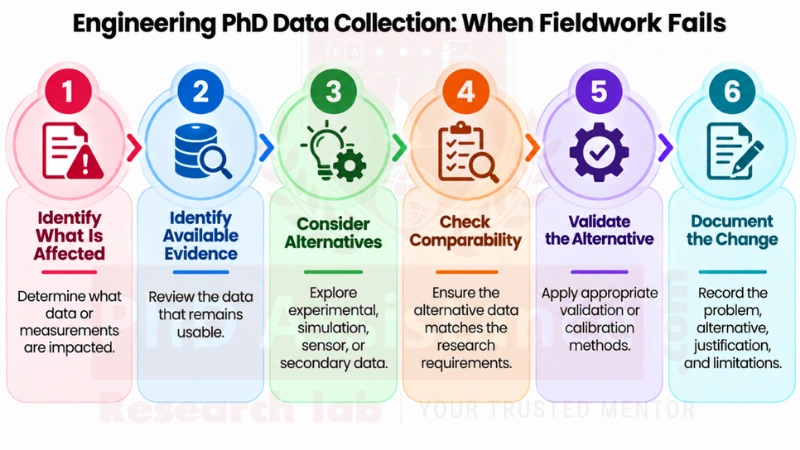
When fieldwork fails, return to the research question before changing the methodology.
Identify:
A useful sequence is:
Research Question → Required Evidence → Data Source → Collection Method → Analysis
PhD Research Example:
A 2020 McGill University study investigated 3D-printed wood-fibre-reinforced architected cellular composites and evaluated their thermomechanical performance experimentally (Estakhrianhaghighi et al., 2020).
This example shows why researchers should define the engineering problem and required evidence before selecting a data-collection method.
Do not assume that the entire research design has failed.
Determine whether the problem affects:
This allows the researcher to identify what can still be collected and what needs an alternative.
For example:
Original Plan:
Field measurements from three Canadian sites.
Problem:
Access to one site becomes unavailable.
Possible Response:
Retain the available sites and evaluate whether another suitable site or validated secondary dataset can address the missing evidence.
Research Example:
A University of Waterloo doctoral thesis by Ning Qin investigated the hydrodynamics and mass transfer of dense carbon dioxide segments in water. The research focused on obtaining specific experimental evidence about the behaviour of the system, illustrating the importance of identifying the measurements (Qin, 2017).
This example supports the principle that researchers should identify which variables, measurements, or experimental observations are affected before redesigning the entire data-collection plan.
Different engineering research questions require different forms of evidence.
|
Research Need |
Possible Alternative |
|
Material performance |
Laboratory testing |
|
System behaviour |
Simulation or modelling |
|
Structural monitoring |
Sensor or instrumentation data |
|
Industrial process research |
Industry or secondary datasets |
|
Infrastructure research |
Case study or field data |
|
Environmental measurements |
Existing monitoring datasets |
|
Process optimisation |
Experimental + computational data |
The alternative should be methodologically justified, not selected simply because it is easier to obtain.
Research example:
Yiju Zhao’s PhD thesis developed a numerical simulation framework for two-dimensional material MOSFETs operating at cryogenic temperatures. The research used computational modelling to investigate device behaviour and incorporated experimental data, including HfS₂ MOSFET data, to evaluate the framework (Zhao, 2024).
This example demonstrates how computational modelling can provide an alternative or complementary source of evidence when direct experimental investigation alone does not fully address the research objective.
When selecting alternative sources, the data-collection strategy should remain focused on the original research objectives, required evidence, and methodological requirements.
When direct field measurements become difficult, engineering researchers may be able to combine different forms of evidence.
For example:
Experimental Data + Simulation → Model Validation
or
Field Measurements + Existing Dataset → Comparative Analysis
Research example:
Ning Qin’s University of Waterloo doctoral research on dense carbon dioxide segments in water provides an example of engineering research involving experimental investigation of hydrodynamics and mass transfer. The thesis was conducted within Mechanical and Mechatronics Engineering and focused on obtaining evidence about the physical behaviour of the system (Qin, 2017).
This example shows that the appropriate data strategy depends on the research problem and the evidence needed to investigate it.
Alternative data should not automatically be treated as equivalent to the original data.
Check:
Where appropriate, researchers can conduct method comparison, calibration, validation experiments, or sensitivity analysis to establish confidence in the revised approach.
Research Example:
Piotr Wiciak’s PhD thesis investigated ultrasonic non-destructive testing of composite materials. The research compared ultrasonic evaluation with destructive shear testing and numerical simulations. In Wiciak’s thesis, the comparison reported a maximum error of 7% for the specific GFRP-bar application studied (Wiciak, 2020).
This demonstrates why alternative measurements should be validated against other evidence rather than automatically assumed to be equivalent.
Consider PhD Assistance Research Lab for customised PhD Data Collection Support in Canada and identifying an alternative method for your research.
If the original fieldwork method changes, document:
Original Method → Problem → Alternative Method → Justification → Validation → Limitations
This creates a transparent record of why the research design changed.
For a Canadian Engineering PhD, the researcher should also consider whether the change affects research ethics approval, data permissions, participant consent, collaboration agreements, or institutional requirements. Where human participants or identifiable human data are involved, researchers should check their institution’s REB requirements and applicable TCPS 2 guidance (Government of Canada, 2022).
Research example:
A University of Toronto engineering PhD project by Meagan Flus used 24-hour observation at hackathons to study conflict and dynamics within engineering design teams. The project illustrates how researchers can define the research setting, observation period, and data-collection approach around a specific research question (University of Toronto, 2026).
This example demonstrates why researchers should clearly document the research setting, data sources, collection procedures, and methodological decisions so that changes to the research plan remain transparent and traceable.
Quick PhD Data Quality Checklist
|
Check |
Question |
|
Completeness |
Are required observations available? |
|
Consistency |
Were similar procedures followed? |
|
Accuracy |
Are measurements reliable? |
|
Relevance |
Does the data answer the research question? |
|
Comparability |
Can different data sources be compared? |
|
Documentation |
Are collection procedures recorded? |
|
Validation |
Has the alternative approach been checked? |
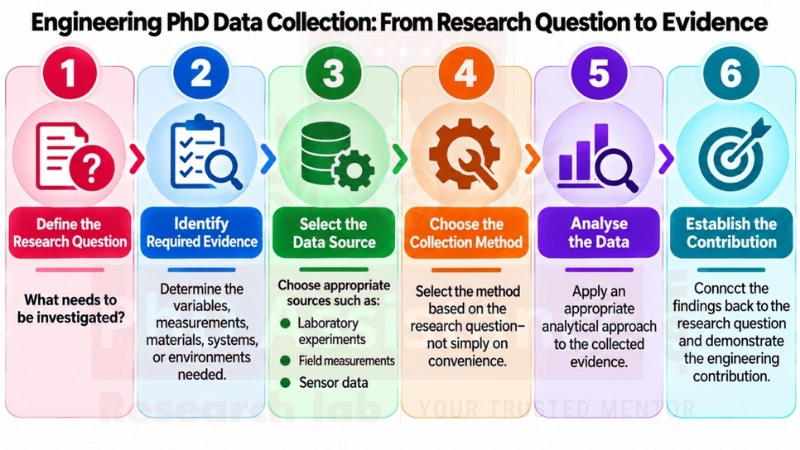
If Engineering PhD fieldwork in Canada fails to meet expectations, it does not mean that researchers should abandon their research objectives. A practical response is to assess the evidence required, identify the missing data, evaluate viable alternatives, and validate the revised method.
If the evidence is derived from experiments, sensors, simulations, case studies, or available databases, its appropriateness should be determined by the research problem and methodology involved.
Need Support with Your Engineering PhD Data Collection in Canada? Talk to our experts to improve your research question, data sources, collection methods, alternative datasets, validation, and methodological alignment. PhD Assistance Research Lab can help you review and strengthen your data-collection approach so your evidence remains relevant, reliable, and defensible.
Book a Free Expert Consultation and get support for your PhD data collection.
Identify what evidence the site was expected to provide and whether the remaining sites can answer the research question. If a gap remains, consider another suitable site or a validated secondary dataset.
Only if the difference does not undermine the research objective. Compare the variables, measurement methods and research context, then use validation or sensitivity analysis where appropriate.
Not necessarily. First identify which part of the research design is affected. If the research question and required evidence remain supported, only the affected data-collection component may need to change.
Check whether the data measure the required variables, follow sufficiently comparable procedures and represent the intended research setting. Validation or method comparison may also be needed.
Record the original method, the fieldwork problem, the alternative method, its justification, validation approach and limitations. This helps maintain methodological transparency.
They can provide alternative or complementary evidence when appropriate for the research question. Their assumptions, comparability and limitations should be assessed before using them as replacement evidence.